


Kruze’s clients raise billions in VC funding each year - and our team advises on startup finance due diligence every month.
Understanding the importance of finance due diligence for startups
Finance due diligence is a standard part of the venture capital fundraising process for startups, especially as they raise later and later rounds - it becomes particularly important at the Series A or Series B, but even some seed investors conduct finance diligence. And, anytime a company is sold / exits through M&A, the acquiring company will conduct finance diligence.
This comprehensive guide will explore the intricacies of finance due diligence, offering valuable insights for startup founders and executives.
We also have a detailed due diligence checklist that goes into other areas that a VC will likely investigate, such as operational due diligence, human resources due diligence, product roadmap work, etc. Access our due diligence checklist here.
What is finance due diligence?
Finance due diligence is an investigative analysis of a company’s financial performance. It involves a thorough examination of financial statements, operational metrics, and business practices to gain a deep understanding of the company’s financial health and future prospects.
It’s also not unusual for large companies to conduct light-weight financial due diligence prior to purchasing a software or service from a small startup. The big company wants to make sure that if it’s embedding a software or product from a startup into its workflow, that the startup vendor has the financial wherewithal to stay in business and continue to service them.
For startups, finance due diligence is particularly crucial when:
- Seeking venture capital funding
- Preparing for a potential acquisition
- Considering merging with another company
- Evaluating partnership opportunities
The role of financial due diligence in venture capital
When startups engage with venture capital firms, financial due diligence plays a pivotal role in the investment decision-making process. VCs conduct thorough investigations to validate claims made by startup founders and assess potential risks and rewards. Venture debt lenders look for similar information; learn more about the information venture lenders typically request during due diligence.
Our venture capital finance, tax, and HR due diligence checklist provides a comprehensive overview of what VCs typically look for during this process.
One area where VCs focus more than others
VCs focus on one part of financial diligence more than most - the company’s projections and future prospects. While they usually care about historical financials, venture investors are looking to fund companies with tremendous growth potential. So they will take a much more in depth look at financial projections and financial models. And KPIs that demonstrate how the company may scale - in particular sales and marketing efficiency or payback periods - are going to be researched thoroughly.
Key areas of focus in finance due diligence
- Financial Statements Analysis
- Cash Burn Management
- Revenue Recognition
- Expense Structure
- Capitalization Table and Financing History
- Tax Compliance
- Major Contracts and Business Arrangements
- Operational Metrics and KPIs
- Forecasting and Projections
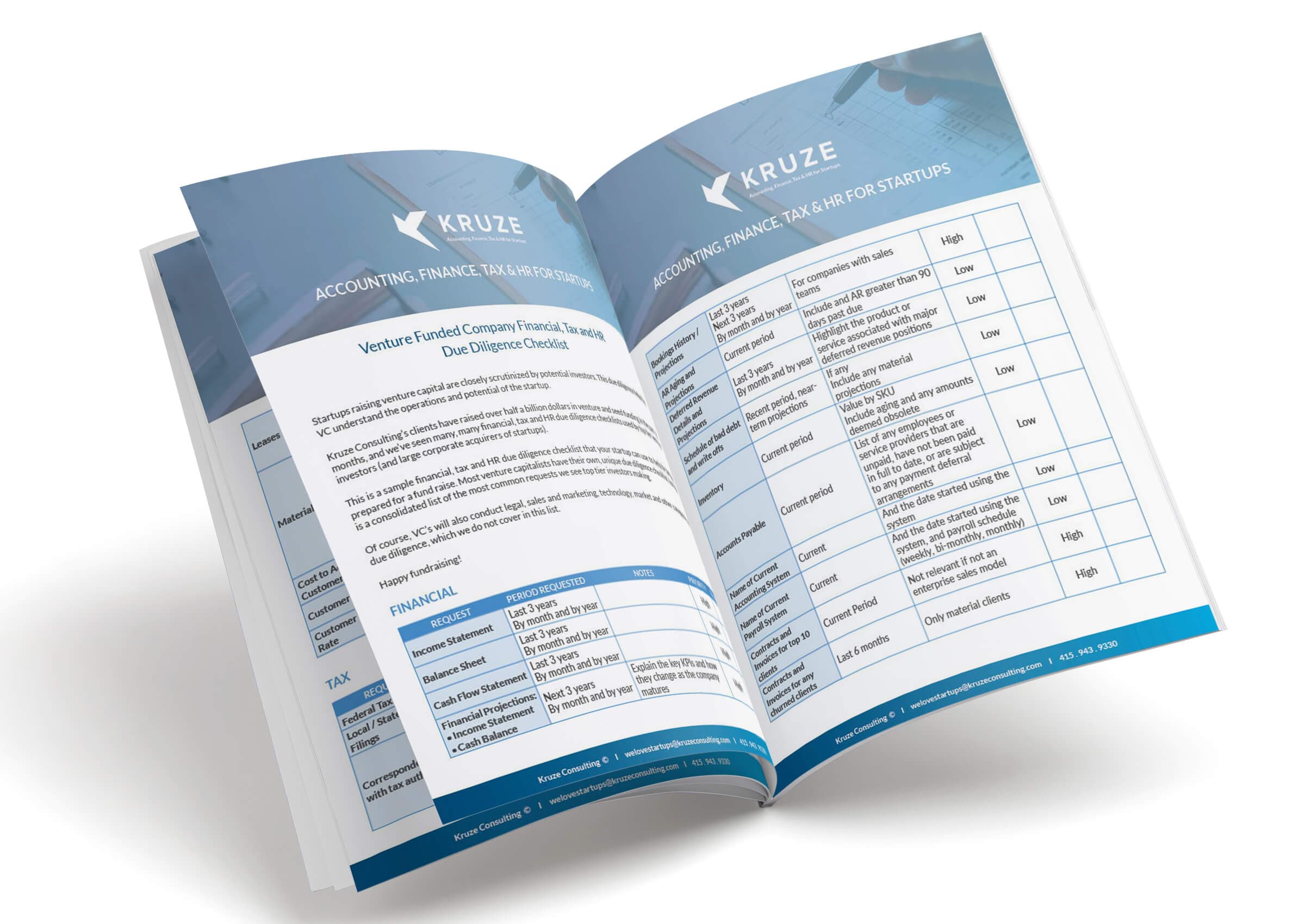
Kruze’s finance due diligence list
We’ve compiled a standard list of questions that our team regularly assists in pulling together for VC investments. This list includes financial questions as well as standard tax diligence items - visit our VC due diligence checklist to see detailed lists for other categories of diligence and to access our downloadable pdfs.
Information Requested | Period Requested | Description | Pre-Seed | Seed | Series A | Series B | Series C |
|---|---|---|---|---|---|---|---|
Income statement | Last 3 years by month and by year | One of three key financial statements that shows the company's financial performance over a specific accounting period. | Yes | Yes | Yes | Yes | Yes |
Balance sheet | Last 3 years by month and by year | One of three key financial statements showing assets, liabilities, and capital of the startup at a specific date. | Yes | Yes | Yes | Yes | Yes |
Cash flow statement | Last 3 years by month and by year | One of three key financial statements that summarizes the amount of cash entering and exiting a startup. | Yes | Yes | Yes | Yes | Yes |
Bank statements | Previous 6 months | Bank statements should reconcile with financial statements. | Maybe | Maybe | Yes | Yes | Yes |
Financial projections | Next 3 years by month and by year | Explain the key KPIs and how they change as the company matures. | Yes | Yes | Yes | Yes | Yes |
Detailed capitalization table, including shares, options, SAFEs, and convertible notes | Current | The cap table helps investors model different investment scenarios. | Yes | Yes | Yes | Yes | Yes |
Option pool details | Current | Summary of vesting schedule, ungranted option details, projections on options to be granted in next 12 to 24 months | Yes | Yes | Yes | Yes | Yes |
History of funding rounds, including valuation and terms | Since founding | Shows how the startup's financial performance has grown by achieving targets. | Yes | Yes | Yes | Yes | Yes |
List of current investors and their ownership stakes | Current | Disclose current investors, their stakes and what type of security they hold. | Yes | Yes | Yes | Yes | Yes |
Bookings history and projections | Last 3 years history and next 3 years of projections, by month and by year | For companies with sales teams. | Yes | Yes | Yes | Yes | Yes |
Accounts receivable (AR) aging and projections | Current period | Include any AR greater than 90 days past due. | No | No | Maybe | Yes | Yes |
Revenue recognition policies | Current period | Policy should match up costs and revenue associated with long-term projects or contracts. | No | No | Maybe | Yes | Yes |
Deferred revenue details and projections | Recent period, near-term projections | Highlight the product or service associated with major deferred revenue positions; investors may ask for this by major customer as well. | No | No | Yes | Yes | Yes |
Schedule of bad debt and write offs | Recent period, near-term projections | Include any material projections. | No | No | No | Maybe | Yes |
Inventory | Current period | Value by raw materials and SKU. Include aging and any amounts deemed obsolete. | No | No | Yes | Yes | Yes |
Accounts payable (AP) | Current period | List of any employees or service providers that are unpaid, have not been paid in full to date, or are subject to any payment deferral arrangements. | No | No | Maybe | Yes | Yes |
Name of current accounting system | Current | Include the date the company started using the system. | No | Maybe | Yes | Yes | Yes |
Name of current payroll system | Current | Include the date the company started using the system, and payroll schedule (weekly, bi-monthly, monthly). | No | Maybe | Maybe | Yes | Yes |
Contracts and Invoices for top 10 clients | Current period | Only relevent an enterprise sales model. | No | Maybe | Yes | Yes | Yes |
Derail for any major churned clients | Last 6 months | Mainly for enterprise sales models, but some VCs may want to diligence churned customers. | No | Maybe | Yes | Yes | Yes |
Leases | Current period | Any agreements concerning the purchase, lease, or sublease of real property, and any personal property leases. | No | No | Maybe | Yes | Yes |
Material contracts | Current | Any agreements, understandings, instruments, contracts, or proposed transactions to which the company is a party or by which it is bound which involve obligations of, or payments to, the company in excess of $20,000. | No | Maybe | Maybe | Yes | Yes |
Gross margin analysis | Current | Measured by subtracting all costs associated with producing a product from the selling price; VCs will want to investigate any trends. | No | No | Maybe | Maybe | Yes |
Cash burn rate | Current period, near-term projections | The amount of cash a startup is spending each month. | Yes | Yes | Yes | Yes | Yes |
Customer acquisition cost (CAC) | Current and previous year | How much a startup spends to get new customers. Highlight expenses included and excluded. Consider monthly of quarterly cohorts to show trends. | Maybe | Maybe | Yes | Yes | Yes |
Customer lifetime value (LTV) | Current and previous year | The average customer's revenue generated over their entire relationship with the company. Explain the assumptions behind the calculation. | No | Maybe | Yes | Yes | Yes |
Customer churn rate | Current and previous year | The number of customers lost during a given time period. Explain any changes in churn rate. VCs wil likely ask for cohorts of data by date of customer acquisition. | No | Maybe | Yes | Yes | Yes |
Venture debt/lines of credit detail | Current | Explain any venture debt or lines of credit/loans currently in place; share contracts and payment schedules; disclose any covenant violations or negative correspondence from the lender | No | No | Maybe | Maybe | Yes |
Information Requested | Period Requested | Description | Pre-Seed | Seed | Series A | Series B | Series C |
|---|---|---|---|---|---|---|---|
Federal tax returns | Last 3 years | Shows the startup's tax exposure and any compliance issues. | Maybe | Maybe | Yes | Yes | Yes |
Local/state tax filings | Last 3 years | Ensures the startup is filing in every appropriate jurisdiction and any compliance issues. | Maybe | Maybe | Yes | Yes | Yes |
Correspondence with tax authorities | Since inception | Federal, state and local – any correspondence between the company and the IRS or any state or local tax bureau or any federal, state or local governmental authority. | Maybe | Maybe | Yes | Yes | Yes |
409A valuations | Last 2 valuations | Copies of Internal Revenue Code Section 409A valuation reports. | No | Maybe | Yes | Yes | Yes |
Research and development (R&D) tax credit reports | Current period | Shows the startup is optimizing R&D credits. | No | Maybe | Maybe | Yes | Yes |
How financial diligence varies by stage
In Silicon Valley, the amount of effort put into diligence dramatically increases depending on the stage of the investment. Here’s a breakdown of how VC financial diligence varies by the company’s stage:
Pre-Seed/Seed Stage
- Key Focus: Founding team, market opportunity, core idea. Note that it’s not finance!
- Finances: Basic financial model, use of funds, and burn rate.
- Accounting and Tax Compliance: Verification that the company has separate bank accounts for business purposes and that there is no commingling of personal and business expenses. Initial assessment of the company’s commitment to maintaining proper financial records.
- Checklist Complexity: Simple, often delivered via email text.
Series A
- Focus: Product-market fit, initial traction, scalability; do the finances and projections match the pitch.
- Finances: Detailed GAAP financial statements, cash flow projections, unit economics. Projections are examined in detail.
- Accounting and Tax Compliance: More formalized accounting processes are expected, adherence to tax obligations and proper tax filings.
- Checklist Complexity: More complex for product, sales & marketing diligence, modest accounting checklist complexity, typically delivered as a PDF attachment in an email.
Series B
- Focus: Scaling, operational efficiency, profitability path.
- Finances: Historical performance, revenue diversification, sensitivity analysis on projections.
- Accounting and Tax Compliance: Mature accounting practices, prepared to be audited (may not be required, but should be able to do an audit if needed), looking to ensure that there hasn’t been financial statement fraud.
- Checklist Complexity: Highly complex diligence around customer metrics, sales and marketing, expect detailed questions on margins and strategic accounting items, and a long list of accounting and tax files; typically delivered as a PDF attachment in an email.
Series C and Beyond
- Focus: Market leadership, product expansion, corporate governance and financial maturity.
- Finances: Comprehensive financial models, margin analysis, public market readiness (if relevant).
- Accounting and Tax Compliance: Complete audits, preparation for public scrutiny, international tax compliance, and planning, mature finance systems.
- Checklist Complexity: Highly complex diligence around customer metrics, sales and marketing; likely outsourced accounting and tax diligence to sophisticated accounting firm who will produce a minutely detailed report; checklist will be delivered by a variety of spreadsheets and PDFs.
The diligence process intensifies at each stage to match the increasing complexity and stakes of the investment. Early stages focus on potential and basic compliance, while later stages scrutinize performance, scalability, and adherence to more complex legal and regulatory standards. Financial diligence becomes more important as the company matures.
Fraud detection in later-stage due diligence
As startups progress to later funding rounds, the best VCs become increasingly vigilant about detecting potential financial fraud or misrepresentation.
They often bring in outside accounting firms who will analyze the quality of the company’s financial statements and internal controls and systems.
- Financial statement fraud: VCs may engage specialized accounting firms to conduct thorough audits, looking for any signs of manipulated financial statements. They pay close attention to revenue recognition practices, expense categorization, and any exceptional items that could distort the company’s financial picture.
- Hidden costs and liabilities: Investors scrutinize business arrangements and contracts for any undisclosed obligations or potential future costs that could impact the company’s valuation or performance.
- Corruption and unethical practices: Due diligence at later stages often includes background checks on key executives and an examination of the company’s business practices to uncover any signs of corruption or unethical behavior.
- Volatility of earnings: VCs analyze the consistency and sources of the company’s earnings. Unexplained volatility or an overreliance on non-recurring income can be red flags.
- Sensitivity analysis: Investors may perform detailed sensitivity analyses on financial projections to test the robustness of the company’s financial model and uncover any unrealistic assumptions.
- Third-party verification: VCs often engage law firms and specialized due diligence providers to conduct independent verifications of key claims and metrics.

By implementing these rigorous checks, VCs aim to minimize the risk of fraud and ensure that their investments are based on accurate and transparent financial information. Startups should be prepared for this level of scrutiny, and by working with great accounting partners - like Kruze - they can be set up to fly through later-stage diligence.
Preparing for financial due diligence: Best practices for startups
1. Maintain accurate and up-to-date financial records
Keeping your financial records organized and current is clearly important for finance due diligence - but it’s also best practice to keep your books and financial statements up-to-date and accurate. This includes:
- Income statements
- Balance sheets
- Cash flow statements
- Tax returns
- Financial projections
- Capitalization table
2. Implement robust financial controls
Establish strong internal controls to ensure the accuracy and reliability of your financial data - this includes keeping careful track of your expenses prior to fundraising. And after fundraising, it’s a very, very good idea to have a standard accounting software, bank accounts and corporate cards set up and dedicated to the business. This may include:
- Accounting software connected to bank and credit card feeds via APIs
- Expense management tools (the best cards have these built in)
- Regular reconciliations
- Segregation of duties and controls on who can approve expenses
- Documented financial policies and procedures - this is usually pretty light for early-stage companies but an outsourced accountant can help set this up
3. Engage professional advisors
Working with experienced professionals can significantly enhance your preparedness for financial due diligence. Consider engaging:
- A startup-focused accounting firm; most startups don’t have an audit, but an accounting firm that has executed many diligence requests will make the process smoother
- Legal counsel with expertise in startup law; startups with experienced law firms tend have better diligence
- Other finance advisors are optional at the earliest stages, sometimes a part-time CFO is helpful
4. Prepare a comprehensive data room
Organize all relevant financial documents in a digital data room. Most of our clients use a simple tool for their deal room like Google Drive or Box, but there are more expensive solutions on the market as well. As far as what to put into the data room, our checklist has a more through list of items to include, but at a high level, this should include:
- Financial statements (if you can go back 3 years do so)
- Tax returns
- Contracts and agreements
- Capitalization table
- Intellectual property documentation
5. Be transparent about challenges and opportunities
Transparency is key during financial due diligence. As one of our VC friends once said, don’t bet on stupid - you don’t want to hope that a VC misses or forgets to ask a question during diligence. Instead, be up front so that you can proactively address any challenging finance items. Be prepared to discuss:
- Any financial challenges or setbacks
- Growth opportunities and plans
- Market conditions and competitive landscape
The finance due diligence process: What to expect
1. Initial information request
The process typically begins with an information request from the venture investor or acquiring company. Again, check out our more detailed list, but at a high level expect them to ask for the following during finance diligence:
- Detailed financial statements
- Customer and revenue data
- Operational metrics
- Legal and regulatory compliance documentation
Note that some investors start out with a short request list and then ask for more as they go, whereas others start with a huge list. If you don’t have certain information - like financial statements - it is a red flag for the investors. However, other data requests may not make sense based on the stage of your startup; for example, if you only have a few paying customers and haven’t had any churn, then a churn report is going to be pretty meaningless. In that case, it makes sense to approach the investor and explain to them why you don’t have a particular piece of data or information, or why it doesn’t make sense.
2. In-depth analysis
Once the information is provided, the investor’s team will conduct a thorough analysis, which may involve:
- Trend analysis of financial performance
- Margin analysis (e.g., operating margin, gross margin, unit economics or how margins will change over time)
- Cash burn analysis
- Projections and runway analysis
- Customer acquisition cost (CAC) and lifetime value (LTV) metrics - sometimes they will even get into the channel level
3. Management discussions
Investors will likely want to have in-depth discussions with the management team to:
- Clarify any questions arising from the financial analysis
- Get a walk through of the projections
- Understand the company’s strategy and growth plans
- Assess the team’s capabilities and expertise
5. Third-party verifications
Especially at the later stages, investors may seek verifications from third parties, such as:
- Customer references
- Vendor confirmations
- Regulatory compliance checks
- Third-party diligence by accounting firms and other outside experts
Common challenges in finance due diligence for startups
1. Incomplete or inaccurate financial records
Many startups struggle with maintaining comprehensive financial records, especially in the early stages. This can lead to delays and complications during due diligence. Items like cap tables, payroll data should be kept cleanly, and, once again, in a solid accounting system.
2. Cash based books
Some founders, mainly less experienced ones, don’t keep their financial records in the accounting method that VCs expect - accrual based accounting. Instead, they record transactions as they hit the bank account, which is cash accounting. Most VC metrics are based on accrual financials, so this can cause delays in diligence. And, many very early-stage startups often operate with informal financial processes, which can raise concerns during due diligence. Implementing formal procedures early on can help address this issue.
3. Complex revenue recognition
For startups with innovative business models or subscription-based services, revenue recognition can be complex. Since so many VCs use metrics that are based off of ARR and revenue, ensure you have a clear and defensible revenue recognition policy and are correctly recording revenue.
4. Unrealistic projections
VCs expect high growth when they examine startups’ projections. However, overly optimistic financial projections - especially low expenses - can damage credibility. Be prepared to support your forecasts with solid assumptions and market data. Growing fast is good, but projecting that your startup will grow fast without increasing any expenses is usually the sign of an inexperienced founder.
5. Poor tax compliance
Neglecting to file tax returns and other compliance issues can be expensive to fix. VCs don’t want their capital going to pay for fines and late fees, especially for problems that occurred prior to their investment. Engage with tax professionals to ensure compliance and optimize your tax position.
Conclusion: Embracing financial due diligence for long-term success
Financial due diligence is a critical process for startups seeking to secure funding, explore M&A opportunities, or simply strengthen their financial position. By understanding the process, preparing thoroughly, and approaching it with transparency and professionalism, startups can not only successfully navigate due diligence but also use it as a catalyst for growth and improvement.
Remember, the goal of financial due diligence is not just to satisfy potential investors or acquirers, but to build a stronger, more resilient company. Embrace the process, learn from it, and use the insights gained to drive your startup towards long-term success.
For more guidance on preparing for venture capital funding, including financial due diligence, check out our comprehensive guide on how to raise a Series A round.
Important Dates for Financial Due Diligence
Custom embed needs manual implementation — see migration.md’s schema-discipline rule.
