
STARTUP PITCH DECK COURSE
The ultimate startup pitch deck course, led by two former VCs!
Watch the video lessons, follow along as the instructors explain what goes into the best startup pitch decks, and copy the free templates to use as you’d like. This free course contains Google Slide templates, over 8 hours of video lessons, examples of top mistakes, and more.
Features
- Free course
- No email or registration
- Learn at your own pace
- Understand what investors look
- Addressing common issues, avoiding pitfalls
Includes
- 2 Free to use Google Presentation templates
- Downloadable financial model template
- Over 8 hours of descriptive videos
Category: Startup
Pitch Deck Course Trailer
Course Plan
- 1Introduction / Order of SlidesWelcome to our Startup Pitch Deck course. In this intro episode, we are taking a look at the slides you need, and how to think about the order the slides should go in
- 2First SlideYou only get one chance to make a first impression, so let's make it count. In this episode, we discuss what information you will need on the opening slide in your startup's pitch deck.
- 3Top 10 pitch deck failsIt's always cheaper to learn from someone else's mistakes, and in this episode, we have collected some of the most common things founders get wrong when creating a startup pitch.
- 4The ProblemAll companies need to solve a problem. Ideally, the problem is worth solving, and it's worth money to your target customers to address these problems. This is the slide where that gets explored.
- 5The SolutionYou've talked about the problem. Your company's product is the solution to that problem, and in this part of the narrative we talk about how you are doing that.
- 6TeamThe founding team and its ability to attract the right talent is one of the most important pieces of the puzzle. Why are you the best people in the world to address this problem?
- 7TractionA business exists to make money, and to hit key milestones on its path to profitability. The traction slide shows how the history of how your company got to where it is today
- 8Sales / Go To MarketYou've got to find your customers, or they have to find you. Either way, the strategy and tactics of how to do that will be of interest to your investors.
- 9Market SizeFor a VC to invest, they have to believe that your company can potentially grow big enough to make it worth their while. This slide is your chance to make them see dollar signs.
- 10CompetitionNo company exists in a vacuum, and the competitive landscape will affect your chances of success. We discuss a few ways to present a map of what's happening in the market.
- 11Operating PlanA lot is going to happen between when you raise this round and the next. The operations plan is a detailed road map of how you're going to get from here to there.
- 12Financial ProjectionsIn business, it all boils down to cold, hard cash. Your financial projections are going to be an important decision-making tool for your potential investors to decide to invest or not.
- 13Financial Model 101Often overlooked, your final slide is more important than you might think. We explain why and what you need to pay attention to, to ensure that the Q&A at the end goes well.
- 14Final SlideOften overlooked, your final slide is more important than you might think. We explain why and what you need to pay attention to, to ensure that the Q&A at the end goes well.
About
About This Free Startup Pitch Deck Course
The startup pitch deck course is designed to be taken at your own pace. Both instructors bring their experience as investors to the course, helping founders understand the why and what investors are looking for at each slide in your startup’s pitch deck.
The lessons on specific pitch deck slides dive into “why” on each slide. Why is this slide important to your startup’s pitch? Why do VCs care? What is the purpose of each slide, and how does it advance the importance of your startup’s mission and opportunity? Next, the course will explain what the VC is looking for on the slide, and how to modify your startup’s pitch based on your specific strengths and weaknesses. They also over some design ideas that may help your startup pitch deck clearly communicate with investors. Finally, the instructors will go over the most common issues on each slide are addressed so that you can avoid pitfalls.
Startup Pitch Deck Templates
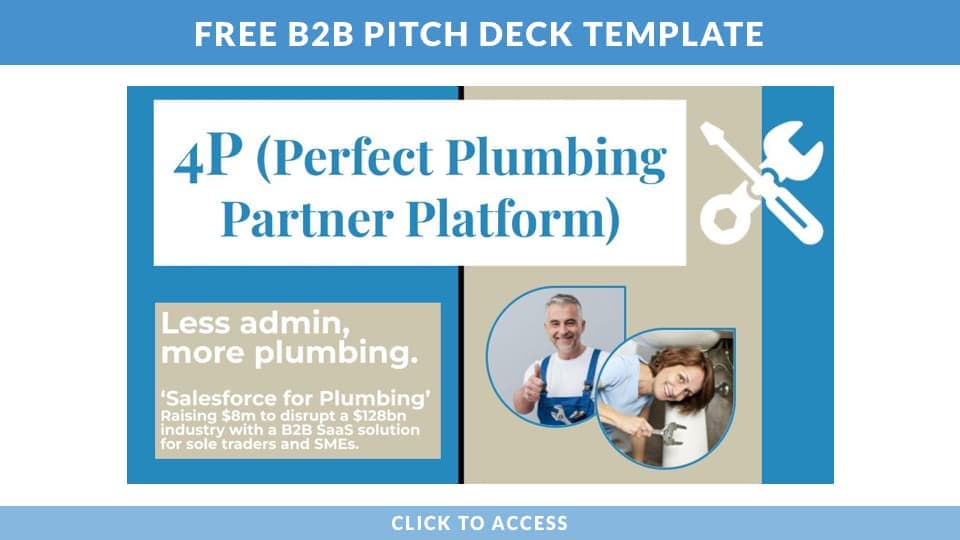
Grab our free startup pitch deck temples below. One pitch deck template is for a B2B company, the other is for a B2C company. These are Google Slides - simply click on the template, then choose “file -> make a copy” and duplicate the template. You are free to use these templates however you wish.
The actual companies in these templates are dummy companies that we created to illustrate slides and content on each slide that we recommend for B2B and B2C companies raising venture funding - they are NOT intended to be real companies. In fact, we made them a bit silly so that you don’t actually focus on the business models but instead focus on the actual slide templates. Use them to get a feel for the design, flow and content on each slide of your startup pitch deck, and review the video lessons alongside of these templates to get a feel on how to present them to investors.
We also link to specific other startup pitch decks throughout the course. You can also see examples of other successful decks on our Top 10 VC Pitch Decks article. Companies like Uber and others have great pitch decks that you can use as examples as you think about your startup’s pitch. If a slide template has worked in the past, don’t reinvent the wheel! It’s all about selling your business and communicating what makes your startup and vision special to the investors, and the pitch deck is the visual part of your story telling.
The Course Summary
The startup pitch deck course has templates and deep dives into following pitch deck slides:
- The First Slide - make it count; you only get to kick off your pitch once!
- The Problem - why is the problem worth solving?
- The Solution - how is your solution going to change the market?
- Your Team - why are you the best team to tackle this problem?
- Traction - metrics on the business.
- Sales / GTM - how are you going to get customers?
- Market Size - is the market big enough to justify a VC investment?
- Competition - who is your startup’s competition, and how does that impact the market?
- Operating Plan - where does the money go and what’s the plan?
- Financial Projections - use your numbers to sell the business.
- The Final Slide - set Q&A up for success.
The startup pitch deck course also contains:
- Two Free Google Slide templates
- One Downloadable startup financial model (Excel)
- One Introductory session and lesson on the top mistakes (“fails”) that founders make when crafting their startup pitch deck
Free to Use
This free startup pitch deck course is free to use. While we intended this to primarily benefit startup founders, we welcome academic use of these materials as well. Nonprofit educational institutions may reproduce and communicate, in paper or electronic form, this information for purposes of research, private study, or education.
We only ask that educators using these materials link back to https://kruzeconsulting.com/ as the source.
All Lessons
Click on any of the pitch deck lessons now to jump to the slide you most want to learn about. Each lesson can be used individually, or watch the entire course to learn how to craft your startup pitch deck from beginning to end. Clicking on any lesson will jump you down to the video and images of the template slides used in the video lesson.
We recommend you also watch the Top Ten Pitch Deck Fails course, as it outlines the most common mistakes we’ve seen founder make in their pitch decks, and it explains what you can do to avoid these mistakes in your deck.
1. Introduction / Order of Slides
What slides do you need, and what order do they go in?
Watch the Introduction / Order of Slides lesson2. First Slide
Cover Slide: Let's kick it all off with a strong start.
Watch the First Slide lesson3. Top 10 pitch deck fails
Top 10 pitch deck fails: Learn what not to do when telling your story!
Watch the Top 10 pitch deck fails lesson4. The Problem
The Problem slide: What are you solving and why?
Watch the The Problem lesson5. The Solution
The Solution slide: How are you serving your customers?
Watch the The Solution lesson6. Team
Team slide: Why are you a winning team - and able to build an even better one?
Watch the Team lesson7. Traction
Traction slide: What have you accomplished so far?
Watch the Traction lesson8. Sales / Go To Market
Go to market slide: How will you find your customers?
Watch the Sales / Go To Market lesson9. Market Size
Market slide: How big can your company possibly get?
Watch the Market Size lesson10. Competition
Competition: Who else is doing what you do, and how are you different?
Watch the Competition lesson11. Operating Plan
Operating Plan slide: What happens between now and your next fundraise?
Watch the Operating Plan lesson12. Financial Projections
Financial Projections slide: Are you venture-scale? How fast will you grow?
Watch the Financial Projections lesson13. Financial Model 101
Any questions: How to kick off the Q&A session at the end of your pitch
Watch the Financial Model 101 lesson14. Final Slide
Any questions: How to kick off the Q&A session at the end of your pitch
Watch the Final Slide lesson
Pitch Deck Course
- Below are the startup pitch deck course lessons - one per slide. You can also expand the instructors’ transcripts by clicking the “transcript” button.
- Remember, the startup pitch deck template images shown below the video are available in Google Slide format above, on this page, and are free for you to copy and use.
1. Introduction / Order of Slides
Welcome to our Startup Pitch Deck course. In this intro episode, we are taking a look at the slides you need, and how to think about the order the slides should go in
Healy Jones:
Hello, and welcome to the Kruze Consulting free venture capital and startup pitch deck creation course. This course or guide is designed to help founders put together the perfect pitch deck to raise venture capital funding. I'm Healy Jones and I'm joined by Haje Kamps. I am the leader of FP&A here at Kruze Consulting. Kruze is one of the leading CPAs focused on venture capital-backed startups. Our clients have raised over $6 billion in venture capital funding, and it's my job to help them get ready to raise funding, with a particular focus around making sure their numbers are telling the story.
To get the other way to tell the story, which is through the presentation, I've brought on one of the leading pitch deck consultants in Silicon Valley, Haje Kamps. Haje, do you want to quickly tell us about yourself?
Haje Jan Kamps:
Yes, hello. My name is Haje, and I have had all sorts of weird career moves over the years. I'm a multiple startup founder. I've raised a bunch of capital. I was in venture capital for a bit, and I am now a reporter at TechCrunch. So I've kind of seen the venture capital world from lots of different angles. After I left venture capital, I discovered that the most fun things I know how to do is to help founders tell their stories.
So I started blogging about that, started consulting, and actually ended up writing a book about that called Pitch Perfect. It came out last year. It looks an awful lot like this, and basically it's a guide for how to think about building a perfect pitch and how to get a really good story behind the mechanics and the storytelling of getting across what your startup does to a venture capitalist.
Healy Jones:
Excellent, Haje. Well, you are the best person in Silicon Valley to help us with this. Your clients have raised hundreds of millions of dollars. I've been fortunate enough to work with founders who have raised probably over a billion dollars at this point. And additionally, I was a venture capitalist in the past with Summit and Atlas and have been at startups that have raised quite a bit of money, including one that went public. So I definitely have the battle scars to have proven that I've done this before, and I really enjoy working individually with founders and startups as they're getting ready to raise capital, but I think this is a great way for us to help many founders all at once.
This is designed to be an entire course which we're going to offer for free on kruzeconsulting.com/pitch-deck. That's kruzeconsulting.com/pitch-deck. And we also will have two free templates, which are a B2C company and a B2B company that you're free to grab their Google Slides, and we'll also link out to some other pitch decks that we really love, Airbnb, Uber, Mattermark. We have quite a few that we've seen that have been great, and they're wonderful resources for you to take a look at as you think through.
During this course, we're going to go through each slide and talk to you about what the strategy is behind the slide, how it tells the story, how you weave the story together between the slides. I'll talk about some of the common mistakes we've seen when we were investors and things that trip you up in the process or could make the VC pause. And so, you'll be able to access all of these as videos on YouTube, and we tend to do it as podcasts. And again, it will also all be available in written content on the Kruze Consulting website.
Before we actually walk through the order of the slides and talk a little bit about what should go in each slide, I want to kick it over to Haje to talk about the story that you're trying to tell and how you weave that into the narrative.
Haje Jan Kamps:
Yeah, absolutely. So I think there's a really fun thing that happens when you sit across from somebody and you have to paint a picture of the world you want to live in. You are sitting across from somebody who might potentially give you millions of dollars to help that reality become real, and it means that you have to have a little bit of pizazz behind the story you're telling.
Now, when I say storytelling, it doesn't mean make stuff up. It means having a structured narrative that can help pull all the different parts of your presentation together. What that typically means is having examples that can be used as you work your way through to various slides. It's like a red thread that runs through everything. It also means that you can use storytelling techniques to set something up and then pick it up later or, later on, refer back to something in your story, and thinking about your story like a multidimensional being like that is really helpful.
So that's all fun and fancy and all, but really what all of this is in aid of is to make sure that the venture capitalist remembers you and that they walk away with the salient points about why your company might be worth investing in. And the things you are really telling the story about is, why is this venture scale? Why is this investable? Why is this a good idea? Why now? What is the macroeconomic system around all of this? Why are you the perfect founder to actually go and do this? And why this? Why is it important to do exactly what you're doing right now and why is this such a good opportunity?
And all of these pieces will come up again and again as we go through this course and talk about the various slides and how to tie them all together. And it's one of my favorite things, so I can't wait to share all of this with you.
Healy Jones:
Yeah. It's definitely one of the things that I've appreciated as we're preparing this course, is the importance of story and how you could be strategic as a founder. To double-click on that, one of the things that I remember as a VC being really impactful are when a founder can mention particular clients and their pain points and how their solutions solve them, how they've retained the client for a long time, how the client has started to spend more money with them as they're growing, how the client chose them over the competition. These are very specific examples of a client's success that can be mentioned on multiple pages in the pitch deck and can really help the VC be able to repeat that story, and that leads into what's the purpose of the pitch deck.
So the first purpose of the pitch deck is to get a meeting. It's often that the VC is going to ask for the deck via email generally before even wanting to take a meeting. So it's got to be able to stand on its own when it's just an attachment in an email coming in kind of cold. Okay? So that's the first thing it needs to do. The second thing that it needs to do is, it's got to get them focused and get their attention and keep their attention during the meeting. Right? So you want them to be engaged. You got to get them to put down their phone and focus on you, ask you important questions. You guide them and keep them focused with the pitch deck.
And then the third thing is, I think, where that story really comes in. You have to remember, most venture capital firms are partnerships. And so, you have different investment partners or maybe even junior associates and investors who interact with each other. Now, pre-COVID, it used to be in the hallway. I can specifically remember in the hallway by the coffee pot. There was a particular investor I used to spend a lot of time with because we both loved espresso, so we'd be talking there together.
And so, if the deck has helped tell a story and helped drive a story into that investor's mind, when they are talking with one of their partners or investing partners or one of their investors called limited partners, they can repeat that story back and it can really drive the message home and help them remember you and remember why your company is exciting and why they want to invest. Right?
Haje Jan Kamps:
Yeah. There's a really good parallel here too. It's like the difference between brand and branding. Branding is the information you put out there and the brand is what others say about you. So in effect, the deck is your branding. This is your chance to tell your part of the story. But the thing that sinks in and the phrases people use and the way they describe you, that becomes your brand within this fundraising cycle. And so, at the coffee pot, they go, "Oh yeah, that company that does the thing." What they say there, this is your chance to plant that seed and make your story part of the way they talk about your company.
Healy Jones:
Exactly. And I've definitely seen moments where, particularly if you have a client that the investor knows of or is a brand name, if Uber is using your technology or if a major hospital is using your technology, those are little mentions that if you drive it through your narrative really well, it could definitely stick in the investor's mind and they can be very impressed and they can say, "Oh my gosh, we just talked to this company that's selling to Coca-Cola and Uber and they're doing this and I'm very excited about them." You have to try to, Inception-style, plant the awesomeness of your company inside their mind, and the deck is a vehicle that helps you do that. It helps you tell the story and get those things across.
Haje Jan Kamps:
Yeah, absolutely.
Healy Jones:
Great.
Haje Jan Kamps:
I love that.
Healy Jones:
Wonderful. So we just talked about, you've got to get their attention with the deck and you've got to use it in the meeting and you've got to tell the story. Now, the venture capital industry is interesting. There's particular dances that happen in the VC industry, and it's probably partially the reason why it's such a sort of exclusive industry in a bad way where certain groups have more challenges getting into it just because there's a particular way that VCs are used to interacting. And your slide deck, your pitch deck, and the order of the slides and the topics that you present are... That's part of the dance. Right? And so, we're here trying to help you understand the dance.
And so, what we're going to do is we're going to show you a standard list of the slides that go into your pitch deck and a standard order. Now, there's going to be caveats where you change the order up and we're going to talk about how and why you do that. Okay? But first, let's show the order here. Now, as we've mentioned, we have created sample pitch decks that you can get on our website. And again, these are four companies that we made up. We're actually not trying to raise money for these companies. They're intended to be slightly funny. So don't judge us on what the companies are. We want you to look at the content and the order and how the story is presented.
Okay. So I'm going to share with you the very standard order or list of slides now, because we are... You can certainly read this if you're looking on YouTube, because we're also going to release this in a podcast format. I'm going to do the thing we don't recommend during a presentation. I'm going to read the slide, because visuals are not great for podcasts. So the order of slides that we recommend are a cover slide, the problem slide, the solution and/or product slide, a market or market size slide, a team slide, a traction slide, a go-to-market slide, which can be potentially summarized, be merged with the traction, but not always, competition slide, and operating plan, financial projections, and a closing slide. Okay?
So those are the typical slides that we recommend. What we'd love to do is dive into a specific example that we put together. It's called a company called 4Ps. Again, you can get this free pitch deck template off of our website. And what this company is doing... Haje, do you want to quickly talk about what this company is just to set the table there for that?
Haje Jan Kamps:
Yeah. So we made up a company that is essentially a plumbing SaaS platform to help plumbers get more business and to run their businesses. The slogan for it is, "Less admin, more plumbing." And the idea is to essentially show what a story could be for a company like this.
Healy Jones:
Exactly. So I'm going to jump back and forth between a visual of the slides and their order and then the actual slides. And in this part of the course, we're going to briefly touch on each slide. Again, we have entire 20-minute to hour-long discussions that we've recorded and we're releasing on each individual slide. So if you really want to dive in on an individual slide or you have the time and interest, you can watch all of them in order. We'd love it if you did that. We'd love to get your feedback on it as well. But again, here is the order for the 4Ps and the intro slide. So, Haje, let's talk about the intro slide. It is a missed opportunity, I would say, for many founders.
Haje Jan Kamps:
Yeah. A lot of the time, remember the context. Right? So people show up to a meeting. They're waiting for things to start. This is your chance to set the theme. Explain what kind of industry you're in, summarize what you're doing, or pull people in somehow. If it just says a logo of your company, you're missing an opportunity there.
So it's a really good idea to set the scenes, set up the narrative and stuff like that, and it's a good idea to explain what you're doing. Are you B2B? Are you B2C? Are you a SaaS company? What stage are you? How much revenue do you have? Anything that can help position this in time and space is really valuable on this slide.
Healy Jones:
So I love the one-liner that we have on here, which is Salesforce for plumbing, Uber for X. These types of taglines that are pretty easy for the investor to understand your business model and who you're trying to service are really powerful. So I strongly, strongly recommend them. And just the biggest problem, I would say, I see early in the presentations is that you reach the third slide and nobody knows what you do yet.
Haje Jan Kamps:
Yup.
Healy Jones:
Right? So this is your opportunity to hopefully make it pretty clear, at least at a high level, what your business model is and who you're targeting.
Haje Jan Kamps:
Yup. And I think that's what that slide is really helpful for.
Healy Jones:
Exactly. So the next slide is the problem slide. Okay? And on the 4Ps here, the problem that is trying to be addressed is the admin overhead that plumbers have. Again, it's less important what this company is actually doing and more important to talk about the strategy behind the slide. Haje, you want a different-
Haje Jan Kamps:
Yeah. I mean, here's your chance to really explain why this is a problem worth solving, and hopefully this is a problem that people are willing to pay money to solve. Right? It has to be compelling and interesting enough so the VCs understand, "Hey, there's a real market here. This is a problem that is worth solving and I should take a closer look." A lot of the time, especially if you're deep in an industry, it might be tempting here to get a little bit too inside baseball, and I think it's a little challenging if you make it non-obvious what the problem is. So spell it out, don't make any assumptions, and make it as easy as possible to understand, A, that this is a problem worth solving and, B, that this is a problem that a lot of people experience.
Healy Jones:
Right. So think about the purpose of your deck. Again, it's been emailed to a venture capitalist. If they're going to open it, hopefully, and they're going to look at the first slide and then this is the second slide, now this is the moment where you've got to make sure they're still going to pay attention here. Okay? So this slide needs to be compelling enough for them to want to take a meeting. They've got to get it. It can't be too confusing, too jargony, as you said, too inside baseball.
Haje Jan Kamps:
Yeah.
Healy Jones:
And then when you think about when you're actually in the meeting with the venture capitalist, what does your startup need to get across here? You've got to get the excitement going about why this is a legit problem and that there's real customers out there who have this and it's a big enough market. Okay?
Haje Jan Kamps:
Yup.
Healy Jones:
So again, the biggest issue, too inside baseball or not making it obvious or crystal clear. So next, we recommend a solution slide which, if you think about it through your narrative, you're just talking about a problem and then a solution.
Haje Jan Kamps:
Yup.
Healy Jones:
So we'll take a quick look at the solution slide.
Haje Jan Kamps:
Yeah. The solution slide really is pretty straightforward, right? So I wouldn't spend too much time here. It's very tempting to dive into this. As a founder, you spend a lot of time on your solution. It's your product. It's whatever you're doing. But really, you just need to show that you have a solution to the problem you have outlined. Remember that really high-quality founders are also able to pivot. So I wouldn't get too married to your specific solution, but what you're really saying is like, "Hey, this is the problem space and here's what we're doing so far to give a solution to our customers."
Now, there's a few different ways of solving this. Some people use a solution slide. Some people use a product slide. You can use either. You can use both. It's just kind of, whatever flows best for your narrative.
Healy Jones:
Right. And so, in this particular example, we actually have dedicated a few slides to this. We dive into a specific thing that this app is doing that is unique to this industry.
Haje Jan Kamps:
Yup.
Healy Jones:
It definitely has a buzzword in here, which is AI. People still like investing in AI companies. And then we actually have a demo as well. I would say that the biggest issue I see on this slide is it becomes a list of features.
Haje Jan Kamps:
Yeah.
Healy Jones:
And then the second biggest issue I see is that this demo can become way too in-depth. "Hey, then you click here, then you click here." Just remember the purpose. This is not a sales call where you're trying to sell your product. Okay? This is, you are trying to excite an investor to purchase a piece of your business and to come along with you for an eight- to ten-year journey. So don't sell. Don't list features. List the benefits. And that additionally, the other thing that's really important here is that this slide will vary by the stage of your company. So you could be pre-developing your product. So this will talk about how you anticipate fixing the client's needs.
However, if you're a Series B, Series C, it's going to get a little more tactical around what you've actually done and where you're going and product roadmap, but again, focusing on why it matters and how it's helping solve customer pain points, unlocking revenue potential, and things like that.
Haje Jan Kamps:
Yup. Absolutely.
Healy Jones:
Perfect. So after the demo... And again, your demo better be super tight if you're doing a demo. And if you're spending more than five minutes in a demo, you're doing something very wrong.
Haje Jan Kamps:
Yeah. I mean, in general, I would recommend not doing demos during the first pitch.
Healy Jones:
I agree with that.
Haje Jan Kamps:
If the product is very unique, especially if you do something with hardware, it's really nice. You'll just be able to hold it up so people can see it's a real thing. That's often enough, like, "Hey, here's the thing. I can show more to you later, but it exists." Right? If you're doing a SaaS solution, just having a screenshot is often enough so people get a little bit of a vibe for what it looks like, what kind of features you can deliver, and the kind of things you do. That's often enough in the first pitch. And then later on, they'll probably double-click deep on both the financials and the product itself in subsequent meetings, but you don't have to spend time with it on the first one too much.
Healy Jones:
If your startup pitch is compelling enough, there'll be plenty of time to go into demos.
Haje Jan Kamps:
Yup.
Healy Jones:
So don't over-rotate on that.
Haje Jan Kamps:
Yeah.
Healy Jones:
So in this slide, the next thing we have is the market size slide.
Haje Jan Kamps:
Yup.
Healy Jones:
And I actually like the way we've done this slide. There are many different ways to do it. The design on this one though actually is something that I like quite a bit. Haje, let's talk about what the purpose of this slide is.
Haje Jan Kamps:
Yeah. The market size and the market trajectory are like... In this particular example, I've lumped those two together. But basically, I think the importance of this is showing that there is a big enough market to sustain a business that's big enough to be worth investing in. It's really that simple.
Healy Jones:
Yeah.
Haje Jan Kamps:
Often, it's done as a TAM, SAM, SOM. We talk about this in great detail in the market portion of this course. But it's a really powerful way to show that, "Hey, you might not have thought about this market so much, but it's huge and it's worth addressing." If you manage to ram that home and just basically say, "Hey, there is space for a multi-billion dollar company in this space and we think it's going to be us," that's really the only point you have to get across here, I think.
Healy Jones:
Yeah. Is this a venture scale business?
Haje Jan Kamps:
Yeah.
Healy Jones:
The other point that I think you should constantly be making incredibly clear to the investor is that you understand the market dynamics and you understand the customer pain points, and this is another opportunity to make it super obvious how you understand this market, perhaps help the VC shift their thinking a little bit to realize like, "Hey, I thought this was already being solved," or "I had never thought about this, but while there's definitely a lot of individuals, companies, corporations, whatever, out there who are having this problem, this is a legit market. This is pretty interesting to me." Right? So again, capturing their attention, telling the story about how you really understand the market and the clients. That's what this slide is trying to do.
Haje Jan Kamps:
Yup.
Healy Jones:
So next, in this deck, we have a business model slide. Now, this is not the order that we just recommended to you and, in fact, when we are done walking through these slides, we're going to compare the order of the different slides so you can understand some of the strategy behind how they're different. But in this 4Ps, we're going to the business model slide next. Haje, what is this slide?
Haje Jan Kamps:
So I think there's an interesting... It's actually a-
Healy Jones:
Oops.
Haje Jan Kamps:
... narrative device in this particular case, because if you look at the next slide, if we go slightly forward, yeah, the next one is the sales and go-to-market slide. But in the narrative for this particular startup, I was like, "Wait a minute. We can start talking about how we do sales and how we'd go to market, but unless the investor understands what the business model is that underpins all of this, this doesn't make as much sense."
And I think this is a really good way of illustrating that sometimes there is this standard 10- or 11-slide deck that everybody knows about and that we recommend. But in addition, you are kind of in service to your story. And if your story doesn't make sense with the standard order of slides, you can change it. And in this particular case, what we did was that before we'd go and talk about sales and go-to-market, we had to talk about the business model, because there are some complexities here about the different tiers in the SaaS model, about the additional revenue streams, and that kind of thing.
And in order to really explain what the go-to-market is and how we do market expansions and that kind of thing, it is helpful to explain this part of it. Now, in some businesses, you don't have to do that. In other businesses, you can just roll it into either your market or your product where you say, on the product slide, "Oh yeah, we do this and that, and it costs $20 per month." Super straightforward. If it gets a little bit more complex, spend a little bit more time on it. That's perfectly fine.
Healy Jones:
Exactly. Perfect. So here, we've got the business model and then the sales and go-to-market. The go-to-market slide is, I would say, pretty important for companies that are in the SaaS space, crypto space, hardware space. Much less important for biotech companies, because the go-to-market is just not how you think about it. But for a company that you're going to be generating sales soon or you're already generating sales, this is an incredibly important slide.
Haje Jan Kamps:
Yup.
Healy Jones:
And the whole thing you're trying to talk about here is, where are your customers going to come from? Right? And the corollary with the previous slide is how you're going to make money. So again, on some presentations, you can kind of... Where your customers come from and how you make money are tied together. And in this particular instance, we decided to break it apart just to provide a little bit more detail.
Haje Jan Kamps:
The thing people often get wrong here is not having a clear enough vision of how they're actually going to reach their customers. Right? And that makes a lot of sense, because in the early days of a company, you're probably really focused on building the product, and you haven't necessarily thought that much about the specific mechanics for how to go to market and how to get sales. That's going to be a problem by the time you talk to a venture capitalist, because they want to know that not only can you build the product, you can also market it and get people to pay for it.
And so, that's really the part of the story that this tells. If you have a reasonably believable story here where you say, "Hey, we know what it costs us to acquire a customer, we know the channels we're going to use, and we know how we're going to balance all of that," and it works from a financial point of view, that makes the whole problem go away, then you just go, "Okay. Tick the box, we know how to do this, move on."
Healy Jones:
So this slide becomes a lot more numbers-oriented and perhaps even tactical as your company advances in stages, becomes more mature.
Haje Jan Kamps:
Yeah.
Healy Jones:
So when you are a more mature company and you have sales and marketing channels that are working and you have customer acquisition costs that you can calculate, you'll put those things on here, and what you're basically doing is, you're telling the VC, "I know what I'm doing. Here's what we're doing. Here's how we're going to grow it." So at the later-stage companies, more detail. Earlier-stage companies, particularly ones that haven't launched yet, what the venture capitalists are trying to do is they're trying to evaluate the credibility or how realistic you are in how you're going to acquire customers.
A great way to talk about that prior to actually having launched or started your traction is to understand what other companies have done that are either competitors or who have similar business models that target similar clients and talk about how you're going to discover it. Right? So this page becomes less of, "Here's what we've done and what's working," and more of, "This is our process or our strategy for figuring this out."
Haje Jan Kamps:
Yeah. So again, this becomes a place where you say either, "This is how we've done it and we're just going to do more of it," or "This is our playbook and we know how to do it." The one thing you don't get away with is like, "We have a great product. If you build it, people will come," because you'll be laughed out of the room, and that's the end of the conversation.
Healy Jones:
Right. Exactly. So if you don't know, then talk about how you're going to have a process to get there.
Haje Jan Kamps:
Yeah.
Healy Jones:
So that's probably the biggest issue that I have seen. The second biggest issue is where you have something that's just not realistic or doesn't mesh or isn't a coherent strategy. Right? So if everything you've sold has had to be, you have to get on the phone or go in-person meeting and close the deal yourself, that probably means you need to have a sales team as you grow. Right? So you shouldn't anticipate what's called product-led marketing where people just click and sell if everything to date has had to actually have a salesperson involved or yourself as a salesperson. Right?
So just make sure you're being consistent with what you think is going to happen, with what has happened, or if there's going to be a big difference. There needs to be a strategy. You need to be able to articulate why that's going to change.
Haje Jan Kamps:
Yup.
Healy Jones:
Great. All right. Now, let's go to the competition slide, one of my ultimate favorite slides. I love competition slides. I love it when companies have competition. Haje, what is the deal with the competition slide?
Haje Jan Kamps:
Ah, this is one of my favorite slides, relatively recently. It actually happened during the course of making this course for people. Competition slide is your chance to say how you fit in the market. It gives you a chance to show both that you understand the playing field. That is crucial. If there's a major obvious competitor here that isn't on this list, it shows that you're not a believable founder. The other piece is that you can really explain. This is your chance to set yourself into a market against your competitors. And if you have a good, compelling narrative here, that really helps set the tone for the rest of the conversation.
If you have a very strong competitor, for example, in this particular case, Salesforce, right? We're saying, "We're Salesforce for plumbing." Well, Salesforce is kind of a competitor. You can build a plumber tool around Salesforce. Perfectly doable. But the value-add, the thing that 4P adds is so specific and so helpful to this business that that alone is a competitive advantage. And using your competitive landscape slide to talk about that and to explain what the strengths and weaknesses are of your competitors and how you are different is just such a beautiful way to tell part of your story. It also invites, really, a lively conversation a lot of the time.
Healy Jones:
So the biggest mistake I see is where a company doesn't think they have competitors.
Haje Jan Kamps:
Right. Right. Yeah. I mean, we talk about this at great length in the actual competition slide.
Healy Jones:
Yeah. Yeah. Again, this is one of our best discussions. I would highly recommend you check out the competition slide recording that we have put together for this course.
Haje Jan Kamps:
Yeah. That one was really fun.
Healy Jones:
This is a great slide. You need to have this slide. It's an important slide. You show the VC, "There's a real market. There's real competitors out here." And hey, Salesforce, SAP, those companies are acquisitive. Who doesn't want to have someone as a possible acquirer that could spend billions of dollars on your startup? Holy cow. That's amazing. Right? So this is a strong, strong slide to do really, really well.
Haje Jan Kamps:
Yup.
Healy Jones:
Okay. Again, the order in this deck is, particularly we've got the team slide almost buried a little bit, and when we talk about how to adjust the order, we'll talk about why that's the case. But here's the team slide. What is the purpose of the team slide?
Haje Jan Kamps:
The team slide basically shows that... It depends a little bit on the size of the company. Right? But if you are an early-stage company, the question becomes, are the founders believable? Do I believe that the people who are about to go and build this company can pull it off and make something magic happen? And so, really, it's just, do you have a competitive advantage in some way? If you have a PhD in this field and you're cutting edge there, great. If you own patents, fantastic. If there's something about you and your network, for example, you've been in this industry for 25 years, you know every mover and shaker here and they love you, that all becomes super important advantages to you as a business.
And this is your chance to tell that story. Why is your team the right people to do this particular company? And in my mind, the other side of that is, if you were to give this slide deck to founders who are not you and they can go build the company, then that's a little worrying. Right? There has to be something special about you and how you think and how you work and who you are to make you a really good founding team. In later-stage companies, it becomes more about, are you good at hiring? Can you surround yourself with the right people to build this company in a way that nobody else could do? And can you attract the right talent?
Healy Jones:
And this slide is definitely one of the slides that you move around in the slide deck based on how powerful your slide is, or your team is.
Haje Jan Kamps:
Yup.
Healy Jones:
So again, we'll talk a little bit more about when to move these around. But this is definitely the slide that I think gets moved around the most in the deck depending on who the people are.
Haje Jan Kamps:
Yup.
Healy Jones:
Perfect. Okay. And then here we have an operating plan slide, which is a fun slide, particularly for Kruze Consulting because we help our clients put together these projections quite a bit, another one I like. One of the big things that this slide is doing is, you can see that it's... Basically, that's 18 to 24 months of what you expect the company to do in terms of performance, both financially and from other key performance indicators, other KPIs. Right? This slide helps you justify how much you're raising, because you say where you're spending it and you say what you're going to look like when you're done.
Haje Jan Kamps:
Yeah.
Healy Jones:
So every VC is going to look at your deck or look at your company, and we've talked about this a lot, and we're going to talk about the financial model. They want to know, if they give you $5 million, $20 million, what does the company look like when you're next raising money? Have you created something that's dramatically more valuable? Are you going to be able to attract capital? So for this slide, you're trying to make sure that you understand what metrics you need to look like in order to be successful in unlocking that next fundraise. You need to understand what your valuation or value creation milestones are that you're going to basically unlock as you spend this money and grow, and you're justifying the round size. You're explaining why you need $8 million or $20 million. That's what this slide is doing here. Right?
I think the biggest issue that Haje and I have seen here is where there's just not enough progress or traction as the company runs out of money. So sometimes, that's because founders don't feel like they can raise a lot, so they say they only want to raise two million when they really need eight, or sometimes it's just because the clients are being... The startups are being too conservative.
Haje Jan Kamps:
Yeah. I think the thing this really needs to answer is, when you get to the end of this particular slide or the end of this particular timeline, if you do everything that you promise on this thing, can you raise your next round? And there's two sides to that, right? Is it realistic that you can do all those things? And two, if you do all those things, can you raise money? If either of those aren't clearly answered on this slide, you're probably going to struggle to raise money, because it shows that you haven't thought ahead far enough to know what happens when you raise your next round of funding.
And so, really, what you're putting in front of somebody is like, "Okay. We're going to raise so-and-so many millions of dollars. At the end of this, we will have $3.6 million of annual recurring revenue. Our team size will be 45, and we have two and a half thousand customers. Does that sound like a place where we can raise 15 million?" Those numbers sound pretty good to me, so you'll probably get two thumbs up, and that is the end of this conversation essentially. So it's a really good place to tell that part of the story through numbers.
Healy Jones:
Exactly. Got to remember again, venture capitalist is constantly thinking, "What does this company look like when it runs out of money? Will it be able to raise the next round?" You're proving to them here that you've got a plan and you're going to be very attractive to the next round of investments. Haje?
Haje Jan Kamps:
And not to state the super obvious here, the only thing that will kill your company is running out of money. Everything else, you can work with. If the market shifts, fine. If a massive competitor comes in, great. If your product is wobbly and doesn't launch properly, that's okay too. You can fix that. If you run out of money, it's game over. And so, really, you're showing here that as the CEO of this company and as the founder and as somebody who's financially savvy, you're not going to let that happen.
Healy Jones:
Excellent. And so, the next slide that I love is the financial projection slide. Now, sometimes a company doesn't need this if they've got the operating plan. But the big reason I love this financial projection slide is because it goes out three to five years, and you're proving to the VC that you're playing the game. You're trying to go big. And so, you can see this company has quite a bit of revenue in the out-years. VCs need to invest in companies that can return their portfolio. Any individual investment needs to be potentially successful enough that it is worth all of the money their investors have given them for all of the companies that they've invested in. Okay?
Haje Jan Kamps:
Yup.
Healy Jones:
That is the game here. So they're not trying to have you just grow slowly and be small and be successful but not huge. They would actually prefer that you'd be risky and try to be huge. And so, this is part of the dance that I talked about earlier. And so, you are helping the VC understand that you know what the game is. You're trying to go big. You have the chance to be that really big company for them.
Haje Jan Kamps:
Yeah. And if this is your first time raising money, it's worth double-clicking on that too. VCs are not a bank. If you are a sure bet and you can definitely give a return, you can go to a bank, get a bank loan, and you can go build your businesses. That's not the industry VCs are in. They're doing super high-risk, super interesting investments, and with those interesting investments, they want huge returns. And that's why this slide is super, super important to show that you're in the right lane. You're at least understanding that this is the game you are in. Yeah.
Healy Jones:
So I think the biggest issue that I've seen here is, first of all, companies are not projecting to be very large. So you're a software-as-a-service business and you think you'll have five million in revenue after five years, but you need to raise $20 million to get there. Nobody wants to invest in that business. It's not going to return their fund. It's not going to be worth enough at the end. That's a common mistake that I see, and that's why I really love this slide because it's forcing you to think big and forcing you to help articulate to the venture capitalist that you're playing the game and you're going to try to be big.
Now, in this course, we have an operating... We talk about the operating slide in one presentation, we talk about the financial projections in another, and then we actually have a third one where we talk about the financial model and what goes into it, and then we have a template model that we're providing as well that you can download. So if you're interested in this, please check out those three recordings and that part of the course, and hopefully it can help your startup.
Haje Jan Kamps:
Yup.
Healy Jones:
Great. And then now, in the 4Ps here, we have the traction. We're ending on the traction slide for 4Ps pretty much because it is a relatively strong slide.
Haje Jan Kamps:
Because... Yeah. Yeah.
Healy Jones:
And what is this one, Haje? What is the traction slide?
Haje Jan Kamps:
So the traction slide really is just what you have done so far. Right? I often like to combine it with milestones. It's like, "Hey, we launched..." So this is kind of looking back, like what have we done to date? So revenue, number of customers, product launches. And so, it's like, it's a timeline, essentially, that gives you the chance to talk about what you've done so far and it pairs with the rest of the deck because the rest of the deck is about the future, like what are you planning to do going forward?
And the cool thing is, by doing it this way, you're able to set yourself up for a really interesting conversation. Now, typically, I would say, if you have really strong traction, I would put it at the top of the deck. Now, because of the narrative idea I had here, it was like, "Hey, let's end with really strong traction so we can go straight into Q&A next." And then you've basically woken people up, shaken them away. It's like, "Hey, look at this amazing amount of user growth we've had, look at this fantastic amount of ARR growth, and look at how we are improving at customer acquisition. Now let's talk."
And the way you would do the transition there is like, "Okay. If we had $15 million, we could grow this thing at this clip for the foreseeable future." So you really... It's a storytelling device to help people think about what is about to happen next, which is the Q&A slide.
Healy Jones:
So a pretty typical joke in the venture capital community is the up-and-to-the-right slide, the hockey stick chart. That's what this is here.
Haje Jan Kamps:
Yup.
Healy Jones:
But what you're doing is you're visually helping the venture capitalist imagine how fast you've grown, and they like to connect the dots. They want to think big. And so, they want to see this up and to the right continuing, so to the extent that you have valid metrics around traction of your business. So here, we've got revenue and customers, which are pretty much as valid as you get going up and to the right. Have the up-and-to-the-right chart. It's really very powerful.
Haje Jan Kamps:
Yup.
Healy Jones:
I think the issue that some startups have is that they're at too early a stage. They don't have traction yet. In which case, you probably wouldn't really have this slide. You wouldn't need it.
Haje Jan Kamps:
Yeah.
Healy Jones:
Okay?
Haje Jan Kamps:
Totally.
Healy Jones:
And then just going to jump to the final slide that we have, which this the... This is the slide that... is the one that kind of pops up after you finish your presentation and the VCs start to ask questions. Now, in a good pitch, the VCs will have asked a lot of questions along the way. Okay?
Haje Jan Kamps:
Yeah.
Healy Jones:
But putting that aside, this is the slide that you're going to have up when you start to kick off the Q&A. And, Haje, this is one of the things that I think I've taken away from working with you on this, is the importance of this slide. You want to talk a little bit about this?
Haje Jan Kamps:
Yeah. I love having something up that helps guide the conversation. Right? And a lot of the time, what ends up happening is that you kind of try and bury the bad news. So the slide before this may be your weakest slide. If you have a weak team and you're just like, "Oh yeah, and we have a team," you're not really talking about that.
The last thing you want is for your weakest slide to stay up while you start Q&A, because guess what you're going to get grilled on, right? So it's a good idea to throw something else up and have a pretty picture to look at or recap like, "Hey, we're Salesforce for plumbers," or something like that just to kind of... It's the narrative piece. It's the one thing people take away with them when they walk away. Remind them. Remind them why they're there. Remind them what you're doing.
Healy Jones:
Set the tone for the Q&A with this slide.
Haje Jan Kamps:
Absolutely. Yup.
Healy Jones:
Awesome. So that is the order of slides and list of slides. We're going to talk a little bit about comparison of the order of slides. I think we should do a quick detour through into an appendix.
Haje Jan Kamps:
Yeah.
Healy Jones:
An appendix is a useful tool that I like to have because if a venture capitalist has, to a startup founder, detailed questions that would be a little distracting to have in the main part of the pitch, you could put that information in the appendix so that you could just jump to that slide and use it to both visually and sort of... Basically, it's to guide you on answering that hard question. Right? So stuff that I think really goes well in the appendix are detailed financials, detailed marketing, or go-to-market plans, staffing growth.
Haje Jan Kamps:
Yeah.
Healy Jones:
Some other things that are helpful is if there are source materials you have around the market sizing. If you think you might get some feedback around people who don't believe the market size, they don't quite understand how you're calculating it, great place to put that.
Haje Jan Kamps:
Or additional product screenshots, additional photographs, additional graphs, data. If you have a complex business model, make maybe a breakdown of the different parts of it. If you have a complex sales funnel, a breakdown of the different sales funnels. If you have a very complex blended customer acquisition cost formula, you can break that too. It's like, "Hey, some of our channels are expensive. Some of them are cheap. Some scale better. Some scale worse."
You don't really want to get into that in the middle of a normal pitch, and there's a very good chance that you'll get a question about it. And if you do, it's very helpful to be able to throw the numbers up because, two things, one, you probably can't remember the numbers off the top of your head. I certainly can't. And I don't want to misinform someone, but I also want to be able to give a good answer.
So what I typically have when I pitch for companies and when I work with clients, we typically end up with a slide deck that is around 15 slides long and probably another 15 slides or so in the appendix. Now, if you send ahead the slide deck, you wouldn't include the appendix, but it's just there. So you don't have to switch to another deck. You don't have to switch to another piece of software. You just go, "Boop, boop, boop, boop, boop," and you're right there to show off the bit you need to show off.
Healy Jones:
It's very powerful for when the VC asks the drill-down question or the double-click question on one of the topics that you're presenting to be able to say, "Wow, that's a really good question. I've thought a lot about that." And then to be able to jump to an appendix slide where we can show them more detail. It's really powerful. It shows that you're very thoughtful.
Haje Jan Kamps:
Yeah.
Healy Jones:
Couple other-
Haje Jan Kamps:
And you don't have to beat yourself up. If you get a question that you don't have an appendix slide for, at the end of that pitch, go home and make one. Right? The next time it comes up, you're ready for it. And that's often how these things evolve. Right? You get a couple of questions that a lot of people ask? Great. Make a better answer for it. Make a slide if you have to.
Healy Jones:
Certainly.
Haje Jan Kamps:
But it's an iterative process. You don't make the slide deck once and then never touch it again.
Healy Jones:
Okay. Great. Now that we've talked about the appendix, let's go back to talking about the order of slides. Again, it's a really important topic. I'm going to share the order of slides for the presentation that we looked through, the 4Ps, BeerSub, which is the other example, a startup pitch deck template that we've created, and then the suggested startup pitch deck template, table of contents or order of slides as well. So you can take a quick look and compare them.
Haje, they definitely deviated with the 4Ps a little bit from the suggested order, and I think, in particular, we put the team slide back quite a bit and the traction slide back. I want to talk a little bit about the thought process on how the story and why you move those slides around a little bit.
Haje Jan Kamps:
Yeah. I think, a lot of the time, when I work with founders the first time, they've downloaded the template somewhere and they've just crammed all of their information into the template. That is great if your story lends itself to that particular order of slides. But what I also learned is that a lot of the time, if you have a particular strength or a particular weakness, no two businesses are the same, and you do need all of this information in a slide. Right? If you're trying to do a pitch and you don't say anything about your team or your competition, it's not a good pitch deck, but you don't have to say it in that particular order.
And so, sometimes, there's two slides in particular that get moved around a lot. It's team and traction. So with the team slide, if you have the most incredible team in the world, if you have three PhDs and a bunch of people who have deep industry knowledge, lift it up. That becomes a really good part of your story. You can say, "Hey, we are the only team who could possibly deliver this." If that is true for you, then tell that part of the story.
Same thing with traction. If you have incredible traction, honestly, nothing else matters. That's your second slide right there, just like, "Hey, we're growing rapidly. We are delivering. We are growing. The only reason we need to raise money is that we can go faster." At that point, it doesn't matter how good or bad your team is or what your competition is doing, because you are executing the ever-living crap out of it. And I think that's the way to think about it. What are the specific strengths and weaknesses for your team, for your company, for your product, for your market, for everything that's happening here? And that's how you tell your story, and that's why the order of these various slide decks are slightly different.
Healy Jones:
So again, you should feel free to move these around based on how it works for your narrative and your story. It doesn't hurt as you're putting together your presentation to just take one of the templates we have here and just follow that order, and then to think about it. Talk through it in your mind. Talk through it with your co-founders. Talk through it with your existing investors. Take the top things and pull them up. But again, remember, team and traction, in particular, move around quite a bit.
Haje Jan Kamps:
Yeah.
Healy Jones:
And then also be thoughtful around the product and demo slides, how much time you need to allocate to those. You can often go through those relatively quickly depending on the stage.
Haje Jan Kamps:
Yeah.
Healy Jones:
And then the other big piece of advice that I want to make sure you take away from this is that make sure you've got an operating plan that's showing what you're producing with the money that you're getting, that you're going to be more valuable, that you're credible. I just definitely think that's incredibly important, and I highly recommend that.
Haje Jan Kamps:
Yup. So the cool thing about these different slide decks is that you realize that there's a different number of slides for one thing, and they have a few little differences. Right? The BeerSub slide deck actually has two slides-
Healy Jones:
Yeah. I'll show that.
Haje Jan Kamps:
... that don't exist in either of the other two. So in this case, the "why us", slide six, and "why now", slide 11, are different. You also note that in the suggested, you have financial projections in both the suggested and 4P, but BeerSub doesn't have any financial projections. So there's slight differences there. In the BeerSub story, the ops plan actually takes the place of financial projections, and in others, you might need both. So it varies a little bit.
Healy Jones:
Right.
Haje Jan Kamps:
The "why now" slide is particularly interesting to me because it's really trying to place it in time. So what we're doing here is we're saying, "Hey, there's been a macroeconomic shift that is happening, and within this macroeconomic shift, it's really important to keep in mind that this company could not have existed 20 years ago, and it shouldn't exist five years from now. Now is the time." And for some companies, that is super obvious and not important. And for other companies, you have to help set the stage for that.
The other one is the "why us". So in this case, it's about the moat. It's like, what are we doing here that makes us special? So in this particular story, what I've done is, I'm telling a story narrative around why this team is unique and really well-positioned to run this company, and then later, I'm talking about the specific people in the company and why that is true.
Again, they're just little storytelling techniques, but you get to have a little bit of fun with this. You get to have a little bit of wiggle room for how you tell each part of the story. So I guess the overarching point I'm trying to make here is, don't get too hung up on the templates or the order. Think about what the story is. Think about it, do you need to spend more or less time on something? And if you start getting a lot of pushback for a particular part of your pitch, think about, would an additional slide help or would moving it around help?
A while back, I worked on a company that was all about virtual events. And this was right at the beginning of the pandemic, and so there was a god awful amount of competitors. We had so much pushback on competitors by every investor we talked to, but we were still like, "No, we have a really solid reason why it still makes sense for us to start this company. We're not being outcompeted from every angle. This deserves to exist." And as a result, I ended up with two different slides about the competition. One was just this big slide taking the entire market of 45 competitors and saying, "Hey, the vast majority of these you can ignore because they sound like competitors, but they are not. Zoom, yes, you have pictures of humans on the screen and they're talking to each other, but it's not a virtual events platform. It's different, and here's why."
So basically, we did this scorched-earth thing where we took, out of the 45 competitors... where we reduced the actual competitive field down to about five and then had a second slide that talked about those five specific competitors and how we were different. It was really clunky and, in the end, it was the only way I was able to tell that part of the story because it was such a frothy, competitive landscape. And so, again, you have to somehow get a little bit creative about how to tell the parts of the stories, especially when you get a lot of pushback.
Healy Jones:
Yup. So I think the key takeaway there is, listen and take that feedback and use it to craft how you're telling your story.
Haje Jan Kamps:
Absolutely.
Healy Jones:
We highly recommend starting with the template. And again, we've got a couple that you can grab, just to get the ball rolling, but then go ahead and make changes after you've done that.
Haje Jan Kamps:
Absolutely.
Healy Jones:
Another important topic to think through as you're crafting your deck is that there are a couple different axes in how your deck might be different, and one of those is based around your stage. So later-stage companies will have slightly different order and emphasis on the slides, and particularly leaning more into numbers, whereas the earlier-stage companies will likely talk more about the story and the plan about how you're trying to figure things out and where you're trying to get to and to prove you've reached the various proof points around product-market fits and understanding your sales and marketing channels.
So that's one thing to think through. Now, we talk about how to think differently about your slides based on stage in the individual conversations. So please check out the individual videos or recordings to go more in-depth on each slide to see how they differ.
Haje Jan Kamps:
Yup.
Healy Jones:
There's another way or another matrix to think differently about how your deck comes together. Haje, do you want to talk about that?
Haje Jan Kamps:
Yeah. I often recommend that people actually create two different versions of their slide deck. So you have to... I mean, that takes more time to keep in sync and to keep everything up to date. So I would build one first. Build your pitch deck, like the actual one you're going to be used for pitching. But then remember, a lot of the time, when you build a really good Keynote or PowerPoint, it's about... The slides back up what you're saying. Right? But if you're not doing a voice-over, if you're not talking, it might actually not land as well.
So build that deck first, but then think about if you were to do a send-home deck, whether before or after the meeting, is there additional context or information or links or all that kind of stuff you would add to really help the story stand on its own? And I like to... What I typically recommend to my customers or to my clients is to have two different decks. One is the presentation deck that you use when you tell your story, and one is the send-home deck. Now, the send-home deck can have a little bit more words because people are not going to be distracted by the words while you are talking, and you can add links, you can add a little bit of extra context, and it's really helpful to be able to send one and then present from one that looks really similar but is better for showmanship.
And so, think about the medium and the recipient, right? The send-home deck, people will have a quick skim through and look at the things they're interested in. For the presentation deck, it really is just there to support you in telling your story. So they're subtly different. You don't always need two different ones, but I typically recommend having two slightly different versions of it just so you don't lose something in translation when you're sending it to someone.
Healy Jones:
Yeah. I think that particularly makes sense if you're going to be doing a lot of prospecting, which is the initial reach-outs. You want to make sure that the deck... That someone opens up and their email attachment can stand alone and that there's no important context that's lost. When you're presenting, of course, less text on the screen can really be helpful. So just think through what your presentation style is. And remember that if you're putting something on the board that could be read, a lot of the time, people are going to stop and read it, and they may not be listening. So just think through the ratio of how much you want to be delivering verbally versus via text.
Haje Jan Kamps:
Yeah. And the most value you get out of your slides is if you do stuff that you can't do with words. Graphs, pictures, illustrations, charts, any sort of thing that you can't really do as easily in words really makes sure that the slide deck does the heavy lifting there, because it means that when somebody is looking at it, you can do the voice-over, you can explain why this is important, why this is relevant, and it's just good multimedia storytelling.
Healy Jones:
Thank you for listening to the first episode of the Kruze Consulting startup Pitch Deck Course. Again, we have gone through every single slide with its own unique episode and recording. We have free templates available, and we also have a free financial model that you can download. All of this is on kruzeconsulting.com/pitch-deck. We hope you found this enjoyable. We'd love to hear your feedback. After you've raised your money, of course, please come to Kruze Consulting if you want to get the best accounting, bookkeeping, tax, and financial advice available to you venture-backed companies. And Haje, folks would like some help putting together their presentations. How can they reach you?
Haje Jan Kamps:
I would be absolutely delighted to help. I'm super easy to find. You'd find me on Haje.me, so my name dot M-E. It has some information about what I do. And there's also a book, so it's available in all good and some terrible bookstores. Go to haje.me/book for that. It's a pretty quick read. It covers a lot of the stuff that you need to know in order to really pull together a good pitch deck.
Healy Jones:
Thank you everyone for joining us for this episode, and please check out all the other episodes that we've recorded on every single startup pitch deck slide. Thank you so much.
What slides do you need, and what order do they go in?
Hello, and welcome to the Kruze Consulting startup pitch deck course. In this course, we're distilling decades of experience in startups, finance, fundraising, and storytelling into a dozen or so bite-sized chunks.
For our first episode, we're taking a look at the slides you will need to fully tell the story, and we are talking about why the order of your pitch slides matters. The exact order depends on the strengths and weaknesses of your company, and how you're planning to weave your narrative for the investors.
In general, we recommend starting strong - if you have great traction, lead with that!
2. First Slide
You only get one chance to make a first impression, so let's make it count. In this episode, we discuss what information you will need on the opening slide in your startup's pitch deck.
Healy Jones:
Hey, hello everybody. This is Healy Jones from Kruze Consulting. I'm joined by Haje Kamps, and this is the beginning of the meat of our venture capital pitch deck course. This is a free course that we are offering to help you get up to speed on how to build a pitch deck for your startup. We are starting at the beginning here with the very first slide. Before we dive in too much, just a reminder, this will be available at kruzeconsulting.com/pitch-deck.
Kruze Consulting is one of the leading providers of finance and accounting consulting services to venture capital backed startups. Our clients raise over a billion dollars a year. I run the FP&A team. I help our clients prepare for their fund raises in particular, making sure their numbers tell the story well. Part of telling the story however, is a pitch deck and as a former venture capitalist, and then operating executive who helped raise quite a bit of venture capital funding, I've got some strong opinions on what works in a deck and what can be successful. And I advise a lot of clients around that. My clients have raised hundreds of billions of dollars recently, obviously not completely based on my advice, but I do like to think that I've been helpful.
Haje is joining me because he is one of the leading pitch-deck consultants in the United States. He's here in Silicon Valley. He's written the book Pitch Perfect, which if it will focus on it, which it probably won't, is the book. You can go get it on Amazon on how to build your pitch deck. He's also a reporter with TechCrunch. Has been an executive at startups and successfully raised quite a bit of money. And also has been a venture capitalist at a pretty well known accelerator. So Haje, thanks for joining me. And thanks for joining with us.
Haje Jan Kamps:
Yeah. Thanks for having us.
Healy Jones:
So let's level-set here. We're about to talk about the first slide of the pitch deck. Sometimes people incorrectly think this is a throw-away slide, but it actually can help quite a bit. What is the slide for, the very first slide? Like the cover slide of your deck?
Haje Jan Kamps:
Yeah. Well, in the olden days, when you still did meetings in person and hopefully that'll start happening again, this is the slide that you typically throw up on the projector or on the screen, just to make sure that everything is set up correctly. So it's actually up for quite a while. While the associates and partners find their way into the room, everybody gets their cups of tea or whatever happens. Typically, a couple of minutes worth of downtown and smalltalk. You will bet that people are going to be looking at this slide for quite a long time. Same as the last slide actually. So not using it for what it's worth is a pretty silly idea. This is your chance to really set the theme for, "Hey, this is what we're about to talk about."
Healy Jones:
I totally agree with you. Other than putting your name and perhaps your logo up there, I think if you were doing something that is understandable, this slide should help the venture capitalist immediately understand what you're doing, or at least get some context around the industry. I think the thing that is cliche these days, but "I am Uber for X, or Airbnb for Y, or I'm Salesforce for this." Those types of analogies actually do really help ground everyone to understand a little bit more about what you're doing.
Haje Jan Kamps:
Yeah. In an ideal world, this slide should actually be enough for some VCs to not take the meeting in the first place. They pull up your slide deck, they pull up slide one and they say, "Oh, they're a B2B company. We don't invest in those." Don't waste anybody's time. A fast no is the second best answer you'll possibly get from the VC.
Healy Jones:
True. That's right.
Haje Jan Kamps:
So let's get there as fast as we possibly can. Let's not waste anybody's time.
Healy Jones:
Exactly. Totally. Just to demonstrate, we have some example pitch decks. I just want to quickly pull up Uber, because again, everyone says, "Oh, my startup is Uber for this Uber for that." Here's what Uber did for their C [crosstalk 00:03:45].
Haje Jan Kamps:
Did they just say we're Uber for Uber? Because that would be hilarious.
Healy Jones:
Yeah, no. That would be great. They're like, "We're Uber for wait, you don't even know what that is." It's Next-Generation Car Service. So they did start off more as a car service and then maybe it worked in the East Coast, particularly in Northeast, like New York or Boston.
Haje Jan Kamps:
Can we just celebrate those retro phones? I love it.
Healy Jones:
I know that was pretty sweet, actually. I like the Blackberry, which again, ties to the fact that this is a black car, which is a pretty common thing back in the day for finance. So, even when you're doing something that's kind of newish like Uber was doing when they were raising funding, you can hopefully explain pretty quickly what you do.
Now, there is another thing that I like to do on this, which is highlight how much money you're raising. So I love it if it's, "I'm Uber for X and I'm raising a $10 million Series A."
Haje Jan Kamps:
I'm sitting here grinning now because you haven't actually seen the redesigned slide one for 4P yet. I think you should pull that up.
Healy Jones:
All right, great. So we have an example…
Haje Jan Kamps:
This morning… Yeah, go on.
Healy Jones:
We have example slide decks available again, kruzeconsulting.com/pitch-deck. They're Google slides. You are free to copy them, download them, use them, they're templates. We're trying to help you get to the starting line a little faster with your pitch deck. And so I'm going to share the one that Haje is excited to talk about. All right, so 4P. Let's take a quick look at this slide and figure out if we can understand what this company does.
Haje Jan Kamps:
So the idea here is basically this lives up on the screen while you are getting settled in. Now, there's a little bit too much text here. I don't like the design of it, but then, I'm not a designer. But what you get here is the name of the company, Perfect Plumbing Partner Platform, 4P. Hilarious plan because you're going to have to. But some of the things we talked about here, "Less admin, more plumbing," it's their strap line. It explains what the company does.
"Salesforce for Plumbing," right? We're going right to the heart of it. People know what Salesforce is. It's a customer relationship management tool. It's a sales tool. This thing is both, and this is specific for plumbing. And then immediately we go into, "We're raising $8 million to disrupt $128 billion industry with a B2B SaaS platform for sole traders and SMEs.” There's so much information on this slide that a VC can take and go, "Oh yeah, I know what this is," super helpful.
Healy Jones:
Yeah, the design is a little busy. I've definitely seen people pull this off a little more cleanly. It is possible that you could get by without the "Less admin more plumbing," and just go with "Salesforce for Plumbing." There's a few different ways you could play this. You might want to say that it's an eight million dollar Series A, but then we're putting more text on here. But the point is, on the very first slide, the very first moment that the VC opens up this deck or that when it's on the screen in the conference room to the extent that people ever meet again in person, when the investors walk in, they'll immediately know what you do, right?
Haje Jan Kamps:
I think including round size, as you were just saying Healy, including a round size is so helpful because it helps level-set. The VC will go, "Okay, if we're going to lead this round, we probably put up half. Do we want to put $4 million into this company?" And they immediately start thinking, who else can we rally to try and help fill out this round? They immediately jump to that. And it's what they do for a living.
Healy Jones:
So, that helps, just to take a tiny tangent into the way the venture capitalists think. When they invest in your business, they have a certain size fund and they have a certain portfolio construction strategy. They're trying to have a certain number of investments out of their portfolio.
Haje Jan Kamps:
Out of their fund.
Healy Jones:
Out of their fund. Out of their fund, right, exactly. So they're trying to construct this portfolio based on a certain allowance of ownership that they want to have in the investments. And they also have to remember that your company is likely to raise a lot of money over time. So they want to make sure they reserve enough capital to continue to support your business if you are successful, right? So they might support you in the A, the B, the C, all the way through. That is what they're doing.
So by telling them how much money you're raising, you can help them figure out, "Oh, this is the right size round for me." And if they couple that with the industry you're in, like let's say you're a biotech company and you're raising a $8 million Series A. Well, the biotech investor will know that you need a $100 million to get where you're going, and they have the right size fund to support you through all the rounds that you're going to need should you be successful. That's like a really important nuance there.
And the other thing is, again, the slide we just showed doesn't say it, but some investors are very particular about wanting to do seeds or A's or Bs. They have this swim lane that they've told their investors they'll play in. And so you just help make it super clear, hey, we're this type of company raising this much money. And it's a Series A, then it's like, they can check all those boxes and say, "This is a meeting I want to take. I kind of have a feeling for what you do. I'm excited to learn about the nuances, because it fits in my bucket. It's the right amount of money. It's the right stage. Let's go."
Haje Jan Kamps:
Yeah, totally. And just to kind of riff on that tiny little bit more the VCs investors, so the LPs or limited partners, they're typically sent a quick blurb on what this company is and why you invested. It's super helpful. If this first slide basically does most of the heavy lifting for you, and if this general partner at this firm goes, "Oh yeah, no, this will be super easy to explain to the LPs," you've done part of their work for them. Super helpful.
Healy Jones:
Yep, exactly. So again, what's the slide for? You're setting the table, making sure everybody knows they're in the right room, this is a conversation they want to have, that it's not a waste of anybody's time. It's exactly what it's for.
And so I think that the flip side of this is that it's not unusual for me to see a deck and to not know what the company does for several slides. In fact, I was joking with Scott [Orn 00:09:18] who used to be a venture investor who works with me at Kruze. He's gotten through entire presentations and not really known what the company does. And that's a problem. So don't be that.
Haje Jan Kamps:
Right.
Healy Jones:
Don't be that problem.
Haje Jan Kamps:
Well actually, I mean, if you make it to the end, then you still don't know, clearly somebody should have at some point told this founder that they're barking up the wrong tree. But even four or five slides. I mean people's attention spans are really, really short. A good professional VC will sit through the entire presentation. But remember they've already seen three pitches that day. They're thinking about the board meeting they have in the afternoon. Minds wander, it's what humans do.
So if you manage to get your claws into somebody early on and say, "Hey, you've got to lean in and pay attention. Put your phone away, put your computer away." You don't get to say that, but that's the vibe you're sending off is like, "Hey, you are about to miss out on a really good opportunity if you don't pay attention." I've [crosstalk 00:10:10]… Go on.
Healy Jones:
What that actually speaks to is that's a nice lead in for discussing a story arc or narrative arc. So that whole thing you're fighting if you're presenting remotely, is somebody going to check an email or Slack or whatever, while they're supposed to be paying attention to you. And the same thing in person, the phone with email, et cetera, that's very distracting. You're fighting that. And one of the best ways to fight that is by having a very interesting narrative arc. So you're actually telling a bit of a story. And Haje, you are a great journalist. You're well known. You probably live and breathe this stuff. You can explain it better than I. What is the narrative arc? What does that mean?
Haje Jan Kamps:
So I think the narrative arc really is the red thread that pulls it all together. If you've ever read a short story anthology, there might be different authors, different everything, but they have an arc, they're all covering the same subject or the same time span or whatever it is that pulls these stories together. And even quite different stories can be pulled together in that way. If you read the SF Chronicle, the thing that pulls them together is that they're all stories relevant to San Francisco.
The same thing is what you'll be doing for your startup. So you're figuring out, okay, in the story I'm telling here, what is the one thing that pulls all of this together? Does it make all of this relevant? Now, there's many different storytelling elements you can use here, but one is examples. So find an example that really makes this story come to life. And then throughout your story, you can fall back to that example and really kind of, "Hey, remember I was talking about them?" This is still relevant. "Hey, remember I did this?" It's still here.
Some of the most intriguing pitches I've sat through are the ones that actually set that up on slide one, where they talk about things like, "Hey, just to set the scene so we know what we're talking about here. Imagine you are someone," right? And now you're actually talking about a user persona. If you have a product-based background, you understand how to do this. But that works for finance, that works for all sorts of things. So for 4P, the slide we had up earlier, we could say something like, "Imagine that you are Nancy. You're an experienced plumber, but you've just moved from California to Florida," right? "You haven't established a brand yet, and you're looking for business, but you know, you know your business."
And so now you suddenly have a number of pieces to the puzzle here. You know that you're talking about experienced professionals. You know what the problem is here because everybody needs business. And without really saying much about your business, you've really set the stage for why your business needs to exist. You haven't really said anything about the business, but you've mentioned something about the product. And then if you have a second example that if you do a marketplace type play, that explains the other problem. So if you are Uber, you can say, "Hey, your car is in the driveway most of the time. And sometimes you need to go places." You've explained two pieces of the marketplace dynamic without really going into depth. But those two pieces, you can keep double-clicking down on to really get a much deeper understanding of the kind of dynamics that are at play for your particular business.
Healy Jones:
So, personas are pretty powerful. It doesn't mean you're explaining the personas, but you can use them like a common riff. A thing that I definitely have seen many great journalists do is they're maybe writing a story about something big or macro, like a societal issue. But they start by the first couple paragraphs, they're talking about an individual or a family that's experiencing that problem. And really personalizes what's going on. And then they zoom out to talk about the industry as a whole, or the problem as a whole en masse. And so doing something similar in your pitch, particularly if you have live customers that you can use as examples, you can tie everything together. That can be really, really powerful.
Haje Jan Kamps:
Yeah, absolutely. And I think a really good example of this is you might remember a few years ago, Flint was having a water crisis, right? 12,000 children were exposed to lead in drinking water, a huge public health crisis. But it is very hard for humans to imagine 12,000 of anything. But if you go and talk to one parent who has a sick child, you can bet that you get a very powerful story out of it because everybody can identify at least emotionally with what it would be like to have a sick child. And I think you can do that for your startup too. You don't have to invent sick children, but tell the story of one particular person. And then slightly later when you're talking about market size or you're talking about go-to-market, you can say, "Hey, do you remember I told you about Nancy?" There's actually three million Nancys in the U.S.
"You remember I told you about Bob? There's eight million Bobs in this country. We've identified them. We know how to reach them. And then you can actually play a little bit with that. And then further on, later on, if you have some testimonials or something like that, you can go even further. It's like, "Hey, I told you about Bob? Bob is actually real. Here's Thomas. Thomas is telling us exactly what's going on here. And there's five more of him." That kind of thing. And so you can play with that as a narrative device.
The other thing that's worth thinking about when it comes to red thread is how that ties all the different slides together. A lot of the time you see somebody run out of steam, they run out of things to say. And then they just click to the next slide. And then the next slide goes, "Oh yeah, I'm talking about…"
Healy Jones:
Traction [crosstalk 00:15:14].
Haje Jan Kamps:
Operating plans or traction, right? It doesn't feel professional. And that's how our brains work. But in a well-rehearsed pitch, you can actually set up your next slide before you hit go. So you could say, "Hey, I've talked about the operating plan. I've talked about all the things we need to do to build this company. Let me talk a little bit more about the team, because I think the team is extra important." Click. Now there's a team slide, right? It was one little sentence, but that one little sentence pulls it together so beautifully and it makes it look like you know what you're doing. And it doesn't take much rehearsing to get those little bridges to get those bridges from slide to slide together. That's the piece you rehearse because it makes it seem so good when it hits home so beautifully.
Healy Jones:
Exactly. Yeah. So I do like the idea of the narrative element and there are many places that I've seen founders very successfully tie in examples of customers. It works great on the enterprise. If you have big logos, investors love it when you have a big logo, like a Coca-Cola or Proctor & Gamble or Toyota. I don't know why I'm picking consumer brands, but you have one of those brands as a client and then you can talk about, "Well, I told you the average customer is paying us $50,000 a month. Well Coca-Cola is paying us $60,000 a month, but they're using these features, blah, blah, blah." And then when you come to like the traction side, you say, "Well, we have five companies including Coca-Cola, and then maybe some other ones you haven't heard." And then when you come to the sales and marketing side, you can say, "Well, as I mentioned, our sales and marketing is going to be focused around events. And we met Coca-Cola at XYZ event. We met 10 other companies there, two of which are still in the sales funnel."
That type of a thing can really make it clear that you know your business pretty well. And you might think that only works when you have a few clients, but actually when you get more clients, it works maybe even better because you're proving that you, as the founder, are focused on individual successes and making sure your organization is driving client success. But then you have the big numbers that sit beside it to show that it's not a fluke, it's not a random thing. And there's a lot of companies that are paying you to do that. A lot of consumers pay you to do that.
Haje Jan Kamps:
Yeah. And again, this is where it's all storytelling, right? Watch any documentary, people connect so strongly with the story. And VCs love to say that they invest just on the spreadsheets and just on the facts, but that is just not true. They have to believe in you. And as a founder, you are a storyteller. You tell stories all the time to your potential employees, to your potential customers. You are out there telling stories and driving that home and showing a VC that you're very good, like you can string a good narrative together and you can convince somebody of something. The very best founders are fantastic at this.
Healy Jones:
That's right. For sure. You've got to convince people to join your company so they may have a career, need to pay their rent, and might have a family to support. You're going to convince them to leave their cushy job and come work for you, maybe for less money. You got to be able to tell a story to get that to happen, right? You're going to be able to bring investors on. You have to be able to tell a story. You're going to be able to sell to whoever your end client is, it's telling a story. So believe it or not, storytelling is a pretty important skill.
Why don't we take a quick look at a couple of other examples that we like from around the internet. Now I'm not going to say any of these are perfect, but all these companies that we're going to show have successfully raised money. And so let's talk about them really quickly here.
So this one is from a company named Front. The CEO raised a Series A in 2016 and they were kind enough to put their slide deck online. I thought they did a nice job. So just to show you what they do, all your company's external communications in one collaborative inbox. So this helps set the stage for a somewhat complicated enterprise product. You could at least begin to grasp what it is and who it's for. And so this will help. Certain VCs will say, "No thank you. I invest in consumer companies. This isn't what I want." And others will say, "Oh my gosh, I've been thinking about the future of work and communication. I want to meet with you. This is really right up my alley."
And then another one would be Mattermark, which is a data company. And they say, "Organizing the world's business information." It's a little bit loose, I would say. It's maybe not super tight. However, that might be their slogan. I feel like they could probably have done a little bit better in terms of explaining what they were doing here. But this is probably, I would say the bare minimum of what you need to do on the intro slide. I think if you have less information than this, like the intro slide is not doing you any favors. And so why, if you're going to have a 10 or 12-deck slide, have a slide that doesn't do you anything. Right?
Haje Jan Kamps:
Yeah. And as you're saying, don't waste it. Just your logo with your name? This is the funny thing, you've been staring at this for so long, it's memorable to you. But it is not interesting to anybody else. And again, this one is actually a very similar part of the story, right? BeerSub.com, it's an awful company. But "Netflix for Beer. An AI-powered beer subscription that learns your taste." Everybody knows how much time and effort Netflix put into their recommendation engine, because it was such an important thing back when you were getting shipped DVDs.
And that actually got transferred really well to being able to browse streamable content. So it makes sense. I mean, you can argue with whether or not this makes sense as a business, but as a pitch, this makes sense. And it's saying launching 2.5 billion, it's a very small fundraise. So you're talking about essentially a proof of concept. Well, that makes sense. It launches in three strategic markets.
Healy Jones:
Right.
Haje Jan Kamps:
So it's very tight.
Healy Jones:
Right. And just to be clear, when Haje is making fun of this company, this company doesn't exist. This is an example company that he made to put into his book. So you can get this template, we'll share a link with it. Again, this is a consumer-focused business that you can get the template for. And so when we created these fake businesses for our pitch deck templates, we weren't trying to make them be real. We wanted them to be slightly silly. Because we didn't want you to focus on the business model. We want you to focus on the slides.
Perfect. All right. So we're probably about 20 minutes into talking about the first slide. And so let's talk about some of the common issues here. So the name of your company is Not Enough. "Don't miss an opportunity." Also I think the flip side is you don't want to spend 20 minutes just on the first slide. You're just going to just be rambling. There's no arc. So, the slide should set the stage and you should move on. And if you're going to do a story arc, this is a nice place to tee it up. It can't be a five-minute story arc. It's got to be 60 seconds. People don't get it, just get done with this slide, set the table, move on. Those are the most common issues I see with this slide.
Haje Jan Kamps:
100%. And on the narrative arc piece, like as a thought experiment, think about what it would be to tell part of the narrative on every slide. So you're talking about market size. You're talking about go to market. You're talking about team, you're talking about product solution, problem, all the different parts of your story.
Like what would it be like to tell a small part of this narrative arc everywhere? Now that's not how you would present it because that gets real boring and really tedious very fast. But if you have that in the back of your mind, like when the back and forth is happening and you realize you haven't tapped into your story arc for a while, you can mention it. It's like, yeah, this makes sense here. This makes sense there. And again, when you're rehearsing this, and I've done this with hundreds of founders now, it feels incredibly corny, but it makes a huge difference for how tight the pitch feels overall. It's like, you're just a friend who's telling a story and it makes a… It is incredible how much of a difference it makes.
Healy Jones:
Right?. And if you want to practice that, the way to do it is to on each slide, ask yourself if it's the sales and marketing slide, how did Nancy hear about us? If it's the industry slide, how does Nancy compare to the average plumber? So just ask yourself those questions. And then to the extent that the venture capitalist dives in and wants to go deep on something, a very awesome way to get a venture capitalist to think you know what you're doing is to have an example of someone who's paying you money, who has done it the way that you say things are happening.
Haje Jan Kamps:
Right. And then [crosstalk 00:23:22].
Healy Jones:
It's hard to refute that person has paid me $50 a month for the past four months. That happened.
Haje Jan Kamps:
Cash in the bank is definitely… And again, tapping into your narrative on the traction slide, super helpful because it's an obvious place to do it. But also on the very last slide, when you… We can talk about that in a different episode. But when you do your, "Any questions?" Or just a quick summary, you can actually wrap it up beautifully by saying, "Hey, let's help Bob and Nancy build a future of plumbing." Like, "Are you ready? Grab your checkbook? Let's do this together."
Healy Jones:
Exactly.
Haje Jan Kamps:
It is a really cool way to just wrap it all up in a bow and go, "Okay. Now the conversation really starts."
Healy Jones:
Perfect. All right. Well, let's summarize this here. So for the first slide, don't waste the opportunity. Set the table, make sure that it's at least plausible that someone who's just glancing at the slide can understand what you do.
Haje Jan Kamps:
Yep.
Healy Jones:
Ideally, if you can fit it on there, how much money you're raising, if it's a Series A, Series B, C, et cetera. And then just think about your story arc and get ready to give an example to support your story if it works for your pitch. So I think those are the key takeaways for this slide.
Haje Jan Kamps:
Yep. I love it. And I think the beautiful thing about the storytelling piece is that you can use it as a crutch if the conversation is a little bit crunchy, you don't really get through to people. And if there's a really good, free flowing back and forth, throw it away. You've accomplished what you need to do. You have a great back and forth. You have a great conversation going. Now, you're building rapport and the storytelling makes such a good crutch for that. If you have rapport, forget about it. Just focus on, how am I going to make you rich, because this is going to be amazing? It works really well for VCs.
Healy Jones:
Awesome. All right. Well, thank you everybody. And please follow along at kruzeconsulting.com/pitch-deck, to get the templates and to see us discuss what we think should go onto the rest of the slide deck. Thank you.
Cover Slide: Let's kick it all off with a strong start.
First impressions matter, and the very first slide of your pitch deck sets the tone for the meeting. A lot of founders just put their logo on the slide, which is a terrible shame, because this slide will probably be up on screen for a little while, as everybody says their introductions and settles in for the meeting. Never underestimate the potential for an investor to be late to a startup pitch deck meeting, so have something to chat about while you wait for the partner to wander in!
Give the slide a job, by adding some salient information about the round you are about to raise, or to start telling part of the story, for example regarding the type of company you are (a marketplace? SaaS? IoT Hardware? Biotech?), and to set an expectation regarding your progress.
Slides for the First Slide section
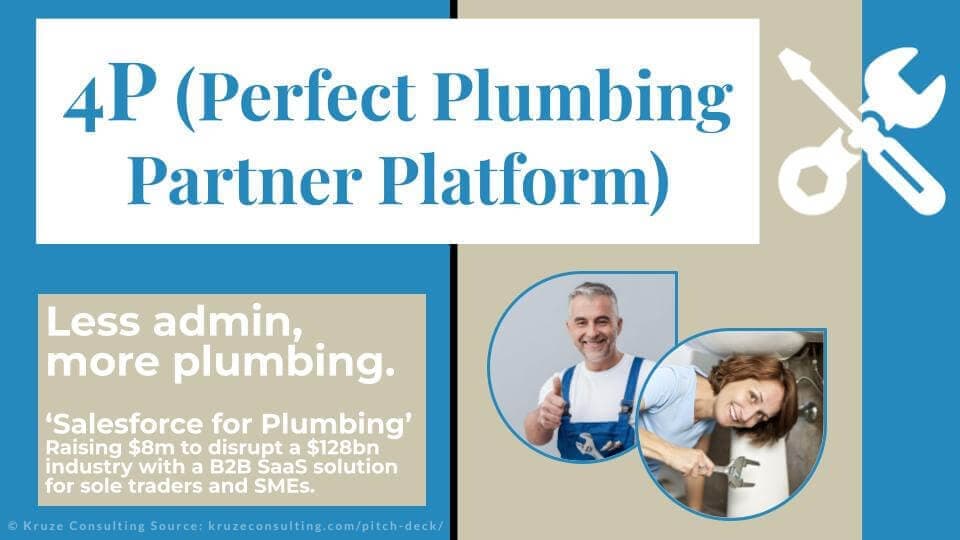
B2B Pitch Deck First Slide 
B2C Pitch Deck Intro Slide
3. Top 10 pitch deck fails
It's always cheaper to learn from someone else's mistakes, and in this episode, we have collected some of the most common things founders get wrong when creating a startup pitch.
Healy Jones:
Hello, and welcome to the Kruze Consulting Venture Capital Pitch Deck Course. We are going to present our top 10 venture capital pitch deck fails. These are the 10 most common mistakes founders make when pitching to VCs.
I am joined, as always, by Haje Kamps, who is the well-known venture capital pitch deck consultant based out of Silicon Valley. He's an author for TechCrunch, former venture capitalist, former founder of several startups. Haje, how are you doing today?
Haje Jan Kamps:
I'm doing great. I'm super looking forward to this one. I always end up talking about all the fun stuff that people get wrong, and it's one of my favorite topics. So let's get into this. This is going to be fun.
Healy Jones:
Yeah. It's fun, but I hope that we can help folks avoid mistakes that can legitimately torpedo your entire meeting. For all of the things that we're listing in here, I have seen fails that basically shut a meeting down. Or after the founder leaves, the partners all look at each other and say, no. End of story. Let's dive in on this. One of the things that I think we should actually mention before we dive in is that a lot of times VCs are not good at providing feedback about why they're passing on an investment.
Haje Jan Kamps:
Yes.
Healy Jones:
In fact, it never really helps a venture capitalist to be honest with you, which I found out when I was a VC. My partners always recommended a pretty calm-like thanks not right now. And then something pretty generic as a reason why, without trying to get into the specifics. I didn't feel that was right. I was like, I want to give some real pointers here. I'm going to collect the feedback from the partners and share it with the founders.
A few of the times it went really well, and I think the founders really internalized it. But a lot of the times it went very poorly. I think it's hard sometimes to take feedback, and the natural instinct is to want to rebut or argue. It's usually too late by the time you're getting the no. And so because of that, VCs are not very good at providing feedback.
You're unlikely to actually get the direct feedback from a venture capitalist about what you're doing wrong in your pitch. We're going to try to help you with these top 10 fails, understand where common mistakes are, so you can think about it objectively before you go in and present and avoid these mistakes. All right.
Haje Jan Kamps:
Yeah. Absolutely. I think it's a really funny point, because if you think about it, just to layer something into what you just said, there's no incentive for the VCs to make you a better pitcher. If they decided to pass, why would they care if somebody else invests? The VCs only care about the companies that are really in their portfolio, most of the time. And so you'll get a soft no a lot of the time, which is like, come back later, come back this.
Occasionally, I talk to founders that I work with who said, "Oh yeah, I talked to this venture firm that I really know really well, and they said this and this." I was like, okay. I guarantee that wasn't the reason they turned you down, because you are smack bang in the middle of their target zone. Let's talk about the pitch. Let's figure it out. And it turns out to usually be something related but different.
It goes to your point, and it's always something that is like, it is opaque to the founders because there's so deep in it and there's no incentive to actually give any real feedback.
Healy Jones:
Exactly. Hopefully you've been following along. We have a free venture capital pitch deck course available on kruzeconsulting.com/pitch-deck. That's K-R-U-Z-Econsulting.com/pitch-deck. We're releasing the whole series of informational courses and downloadable templates around helping you as a founder to prepare your pitch deck. But if you haven't found that, just go find it now and let's do it. Let's actually dive into this top 10 fails. Fail number one. Haje, what do you got?
Haje Jan Kamps:
Love it. Well, actually I wanted to make a quick general point, which is the one thing that actually isn't a pitch deck fail per se, but is the number one thing that people fall short on, which is being belligerent or arguing. I think if you think about it, what is the VC looking for? They're looking for a return on their investment, but they're also looking for whether you are nice to work with.
If they make an investment, they're probably going to be on your board for the foreseeable future. And if you are a horrible person or if you're really difficult, or if you don't listen, that is really, really hard. So they may say something that is wrong, but picking a fight at that point, especially in the early stages, is not the right way to go about it. I think being firm but humble is a good idea.
Healy Jones:
That's right. The venture capitalists want to be around someone that they like, and the problem is some of the VCs are difficult. Some can be know-it-alls, so you might want to argue with them. It then generally doesn't end well. It's tempting to have an open mind and say, "Well, I appreciate your point. My experience has been X, but I'm going to try to think carefully about what you said and I'm going to internalize that. Thank you." That type of thing.
It's sometimes hard to do that, particularly when you do have a difficult person you're talking with, who is maybe saying something that is possibly wrong. But that could also just be a sign that you're not dealing with the right person.
Haje Jan Kamps:
Well, this goes two ways. The venture capitalist wants to work with you on your board and knows that you're work withable, but that goes the other way, too. If you think about, hey, am I going to be okay talking to this person several times a month for the rest of the duration of this company? And have them on my board, and take their advice and potentially have them argue against me? If the answer is no, don't take their money.
Healy Jones:
Exactly. Exactly. Okay.
Haje Jan Kamps:
Anyway, should we talk pitch text?
Healy Jones:
Let's do this. The third time's the charm. We are legitimately diving in now. Major fails. I'm going to present because Haje has created some silly examples here of some mistakes, mistakes that we've seen. And this is definitely one of the number one mistakes, just completely biffing the team slide.
Haje Jan Kamps:
Yeah. There's two ways of doing that. For one thing, there's probably way too much information on this slide. You probably don't need a full org chart. Typically, only the founders and a little bit about the key members. You don't need your controllers and bookkeepers listed. But more importantly, and this is the really big fail here, which is, this is a veggie box delivery startup.
I see a CEO, I see a technical team, and I see a financial team. I don't see operations. I don't see the supply chain. I don't see all the things that you really expect from this startup. It looks like an org chart. If this is their full org chart, my immediate question would be, where the hell is your team? How are you going to deliver this product? So yeah, be very careful about what your team actually looks like and make sure you have the right team for the right startup.
Healy Jones:
For sure. Just in terms of the design of this, an org chart is never going to help you out, at least at the early stage. It just doesn't help you. In fact, what it probably does is it puts you in the, oh, this guy's probably an executive out of a big company, which is possibly a bad thing to flash when you're trying to go raise money. I would never present an org chart. It is a really bad idea for a venture capital pitch.
Haje Jan Kamps:
And none of … Go on.
Healy Jones:
Well, there's other times that it makes sense. If you're doing a partnership with a massive conglomerate, an org chart helps you understand who the key stakeholders are. So you know who you have to sell and get on board for a project. But that's not what you're doing here. Okay. You are a startup and you're trying to wow the founders with why you are the right team to attack this problem.
Haje Jan Kamps:
Yeah. And names don't do that. Woodrow Writer and Ronny Reader over here, I don't know why they're good. If you have a world-class CTO, I expect to see some logos here. I expect to see some accomplishments. Did they exit a company? Have they done a startup before? Why are they the perfect people to run a veggie box delivery startup? That is the info I want. Names? They're not helpful, unless you have, I don't know, Zuckerberg on there. But then in that case, you're probably not watching this video anyway.
Healy Jones:
Right. Right. Yeah. The purpose of this slide is so that when the VC has that question in their mind, like why can't somebody else walk in with this idea and do this, they want to think, oh wow, you are the team. This is the team that can do it. A team might be part of your moat as well. Oh, we have three of the leading artificial intelligence specialists in X, Y, Z, and there's only six of those people in the world. It's like, oh, well that's a mote. You want to dive like that.
Oh, I founded this because I was a product manager at a large Fortune 500 and I kept having the same problem. So gosh, darn it, I'm going to solve that problem here. That is like, boom, get that out there. Make this slide sell. Do not make this slide a list of names. In fact, even just a list of logos can't be bad unless they're perfectly on target or highly correlated with what you're trying to get done here.
Haje Jan Kamps:
Yeah. We covered this in great depth in the team slide, so go ahead and watch that one if you're worried about your team slide. But yeah, I've seen that a lot of people screw this up. Don't be one of them.
Healy Jones:
Yeah. It can be pretty bad. Oh my goodness. All right. Well, the next one is the market size.
Haje Jan Kamps:
Yes.
Healy Jones:
Let me advance to the market. Yeah. Go ahead. Let's talk about this one. Goodness.
Haje Jan Kamps:
We have a whole market size and market opportunity segments, so listen to that separately. But the thing people sometimes get wrong is that they try and pitch something in a market that is way too small. If the market is way too small, then the best case scenario for the VC doesn't show a return. At that point, there's nothing. Right?
Healy Jones:
Exactly.
Haje Jan Kamps:
So be very careful with making sure that your addressable market and your serviceable markets are big enough that this could potentially be a venture scale company.
Healy Jones:
Right. This slide is supposed to be silly. Everything about it is supposed to be silly. But basically what we're showing here is that this is a super tiny market of venture capitalists. There's no way they would ever put millions of dollars into a company if it captures 100% of the market, get half a million in revenue. That is a ridiculous trade. You would never ever make that. You don't want to show over a $10 billion market generally. Or sorry, over a billion-dollar market at a minimum, but 10 billion is actually pointed in the right direction.
The other thing that I think this slide is doing, which besides being silly, is that it's basically compounding the total addressable market and the actual service addressable market. Right?
Haje Jan Kamps:
Yeah.
Healy Jones:
Sure, there's a lot of pet owners in San Francisco. Maybe there's half a million pets, which I actually would believe. But if you're doing a thing for dogs, that's not the right number. You have to shrink it down to the dogs. In fact, what the VC's going to be doing in their mind is, well, how many people can afford this? Don't confuse the total addressable market and the serviceable market, unless you're doing it on purpose. Right?
Haje Jan Kamps:
Yeah.
Healy Jones:
I've seen beautiful examples of companies doing that on purpose, where they're starting with something small and niche so they can get the foothold, they can get the customer base. Work on the product, get their sales and marketing down. And then they have a plan to expand into the rest of the market. Or they have a plan to expand into adjacent markets. That's a slide that I think is incredibly powerful.
I think that it's very incredible. VCs love to start in one market and move into adjacent markets or expand through the market pitch. That is great. That is a great way to do it. This slide is a fail. The market's got to be huge, and it's got to be clear that what you're addressing, what your solution or proposed solutions as you iterate, is going to be able to address the number that you're showing up here.
Haje Jan Kamps:
Yeah. I want to make a quick mention here. If you are a sole trader in a half million-dollar market that you can actually sell to, you're doing something great if you're watching this and that is you. But you're not venture investible, and that's the important point here. There's a difference between something that is operating at venture scale and something that could be a good lifestyle business. I applaud lifestyle businesses, but that's not what we're here to talk about.
Healy Jones:
Exactly. Great.
Haje Jan Kamps:
Cool.
Healy Jones:
Okay. Next major fail is on the projection slide.
Haje Jan Kamps:
Yeah. We see a lot of this kind of thing. This is probably the worst slide I've ever designed, but I just wanted to have something here. But the point we're making here is that, look, if you are showing slow, steady growth that just keeps on going forever and goes nowhere, that is not helpful. Yes, you have growth, but this needs to be venture scaled. It's the flip side of the previous one. If your projection shows that you're unambitious and can't get there, that is awful.
The flip side is also true. If you have a curve that goes just almost straight up, businesses like that do exist, but almost always, there's something that happens before that massive upswing happens. We see this on slides all the time and it's just not believable. I don't believe you when you put this in front of me, unless you're halfway up that curve already and you have a way of growing that further.
Healy Jones:
My job at Kruze Consulting is to help clients put together their projections or their budgets, particularly as they approach a fundraise. And I see these problems all the time. I see founders who are, oh, I'm trying to be conservative. So they have very slow growth. Well, guess what? You've just modeled yourself out of a transaction. The growth is not exciting enough to be attractive to a venture capitalist.
In fact, if you do think you're going to have modest growth, you probably are not fishing in the right pond for your fundraise. You don't want to raise venture capital funding because you're not going to produce the tremendous growth that the VC is looking for. You should probably be considering another type of financing, like a debt loan or something like that. That's the way to go. Venture capital's not for you.
And then just like you said, here on the other side, so ridiculous growth. We have clients who achieve ridiculous growth, and some of them have had a curve like this. Okay. But if you're going to present a curve like this, you better be in it. Okay. From the left here the head should be historical. You should be somewhere around here so that the VC can actually extend the line up without having to do this curve. Okay.
If you're in it okay, present something crazy. All right. That's fine. However, eventually things do want to probably level off like that. That would be more realistic. The other correlated to this is a lot of times, founders show their revenue going up in some sort of way like this. Maybe not this steep, but pretty aggressively. And they don't increase their expenses at all.
It's going to be really hard to have a company that has, let's say a billion dollars in recurring revenue on the same expense base that it had when it was just starting out. You're going to have to have customer service. I'm sure there'll be all sorts of developers, QA, VP, sales and marketing, et cetera, et cetera. If your company is approaching some ridiculous profitability margin, and by ridiculous, I mean a 50% profitability margin is pretty insane.
I want you to take a hard look at it, because the VCs maybe won't laugh in your face, but in their mind, they could be saying, "Ah, this person is just-"
Haje Jan Kamps:
[inaudible 00:15:10].
Healy Jones:
"This person is not a good business person." That's what their thought process might be. All right.
Haje Jan Kamps:
Yep.
Healy Jones:
On this slide, you're trying to prove to the VC that you're thinking on a venture scale. So you want to show something big. But when you hit that crazy hockey stick curve, you probably ought to be in it to present it. Now, the one exception would be at the seed stage or pre-seed where you have no revenue. You want to show some sort of, hey, I think I can get to $100 million revenue in five years. But you may not necessarily need to present it something like this.
Just keep in mind your audience. Venture investors, theoretically, are numbers people. You want to make sure you're talking in their numbers. All right. Now, we are going to provide examples. We have examples of what we think looks good. You just get that from our pitch deck course. Just don't make this common mistake, because it is a really common mistake.
Haje Jan Kamps:
Yep.
Healy Jones:
All right. Number four, traction. The traction slide.
Haje Jan Kamps:
Right.
Healy Jones:
Oh, man. We could definitely tell some stories about this one. Haje, go ahead and talk about it a little bit of what you see that's bad here.
Haje Jan Kamps:
There's two things. Traction has to be real and it has to mean something. It should point to that you know what you're doing, and you're pointed in the right direction. Now, in very early-stage companies, you may not have traction. There may not be anything happening underneath at all. That is okay. But then don't have a traction slide. I see this thing kind of all the time.
Press coverage. Well, press coverage needs to translate into something. If it translates into sales, great. But then report to sales. Whenever I see press coverage, I'm like, okay, well, you didn't get the sales, so the press coverage was unsuccessful. Awareness isn't something that's easy to measure. Even companies like Coca-Cola who do care about awareness, spend so much money tracking it that as a startup, it's just futile.
Same thing with things like product testing. I see this all the time, where we have started making our product and we have lots of internal testing. We have 100% automated test coverage. Well, automated test coverage is something the VP of engineering cares about. Your startup investor wouldn't give two craps. It doesn't matter to them. I have seen this on slides. It's irrelevant. It's important to you as a company, but it doesn't show traction.
The final one is interest. It's like, oh, we are doing a brand new electric car and we have 100,000 people on our newsletter. Great. This is why, even people like Elon Musk for Tesla, they charge $100 for you to reserve your place in the queue. They know that some people will cancel, but at least you've put some real money down to prove that you're actually interested. Real interest is really hard to gauge.
Healy Jones:
That's right. Unless you're doing something like a content play or a social media type of a play, the best type of traction has got to be money coming to you somehow.
Haje Jan Kamps:
Yep.
Healy Jones:
Okay. But it is okay not to have a traction slide. If you don't have a traction slide, you're going to want to use your product slide. If you're not at the point where you've got traction, don't force it. You'll look like an idiot. I've seen really crazy stuff on here where someone's saying, oh, I'm picking a different celebrity, but it's like Kim Kardashian liked our company's tweet. It's like okay, that was not traction. That might be an interesting story that you somehow weave in here for some reason, but you don't put it on the traction slide. You cannot claim that as traction.
Traction should be in a … for the best companies, it is customers giving you some kind of money. Okay. Or customers actually in your funnel. Adjust this slide or pull it out depending on the stage of your business, and do not try to force fit a traction slide into a business that doesn't yet have traction. You're not helping yourself out.
Haje Jan Kamps:
Yep. Totally.
Healy Jones:
Okay. Perfect. All right. Now, the next big fail that we see pretty regularly is where companies don't have a coherent story. Haje, you're definitely an expert at helping founders craft their story and weave it through their deck. Explain a little bit more about the fail you've seen with this.
Haje Jan Kamps:
Yeah. I think a lot of the time, what happens is that people lose vision of why they're doing what they're doing, which is, forget the boogle. Because as a startup founder, you are so deep in your universe that you forget who you're talking to here. You're talking to a venture investor. The product you are selling them is shares in your company. If your pitch isn't that, if your pitch isn't about, "Hey, this is why this company is going to be valuable," you're telling the wrong story. It's so easy to do, because you spend all day in, day out talking to customers and making sales, and doing marketing and hiring, recruiting, all that kind of stuff. But what you're really selling is the vision of the future and the value of your company.
So not having a narrative around there, you're not selling your product to them. It's so often I sit through an entire pitch and I'm like, "I want to buy your product, but I really don't want to invest in your company," which might get you one customer, but that's not what you're doing here. Think very carefully about what your end goal is and make sure that the story actually supports that end goal.
Healy Jones:
An example that you put together here, and actually it ties into our pitch deck course. If you haven't seen the welcome slide part or piece of our course, now you want to check that out. But the welcome slide is a way for you to start to weave that story in here a little bit. You've created this silly example where MilliCorp is … We're going to blow your mind. It doesn't make any sense.
Haje Jan Kamps:
Right. Right.
Healy Jones:
It's nonsense.
Haje Jan Kamps:
Unless you have mind blowing as your specific industry, but even then, I don't know if they're B2B or B2C. I don't know if it's a multimillion-dollar company or an idea on the back of a napkin. I don't know how big the team is. I don't know what they're raising. This says nothing. This is worse than having no slide at all. Make sure you actually tell the story.
What are you setting up here? What are you trying to achieve? What are you trying to get across? Your first slide is, as we talk about on this part of the course, your first slide is probably going to sit up on the screen for a while, while everybody gets their coffees and thinks about their day and introduces themselves to you. Make it count. Make it part of the story.
Healy Jones:
Exactly. Yeah. That's another important thing to think about with the first slide, setting up the story. There's always this awkward, "Hello, my name is," and the VCs give their background for five minutes when you kick off your pitch. This is the slide that's going to be up there, so make sure this slide is starting to tease the story here. You're wanting the venture capitalist to put down their phones and start to focus.
Haje Jan Kamps:
Yeah. The other way I see an incoherent story is too many examples. If you are constantly bouncing back and forth between different examples for different customer segments, different this, this often comes up because I work with a lot of B2C customers. And they're like, "Oh yeah, we have a distribution strategy. We have a direct-to-consumer strategy. We have a B2B strategy. We have this strategy and that strategy." I'm just like, okay, where's your focus?
This is the thing to remember about a pitch. You don't have to explain the full depth of everything about your company. It is much better to actually take a red thread and pull that all the way through. And then at the end you can say, well, we're doing really well in our B2B, sorry, B2C subscription market. Actually, we thought about other market extensions too, and we've done some experiments, yada, yada, yada. That's where you talk about that.
Don't try and clump it all together, because this story gets so messy and so confusing. In the end they sit back and go, okay, what do you actually do? Are you a B2B? Are you a B2C? Are you a subscription company? Do you do distribution? I've sat in meetings where that happens and at the end they go, "Oh no, no, no. We're not doing any of that. We're just doing B2C." And the VC just sits there and goes, "Well, I was benchmarking you against all the SaaS companies I've invested in, and now the whole pitch doesn't make sense."
Be tight, be focused, and keep it together, because we get it. I'm excited for you. You are excited about your company, but you have to have a tight narrative to really explain what you're doing.
Healy Jones:
That's right. Exactly. All right. The next major fail, number six, which is all too common unfortunately, is missing important slides.
Haje Jan Kamps:
Right. I had some fun here making a slide about a slide that doesn't exist, but again, this is about the story and about how you do this. What are the slides that are often missing, Healy?
Healy Jones:
Competition slide, I find, is missing a lot, and that is a mistake. Competition is generally good, and you want to see competition. Ideally, you're seeing the old slow-moving incumbents as competition in a big market, proving people are willing to spend money, a lot of money for the thing you're trying to solve. Don't miss the competition slide, people. It's a natural question. All VCs are going to have that question, so you want to be able to guide them to who the right competition is.
Very bad things can happen when you don't have a competition slide. The investors can think there's not a market there, not a solution. The investors can think that you don't know the market, you're not smart enough to know who the competition is. The investors can imagine that you are the worst competitor in the market, and therefore are going to fail. So set the stage and tell the story about who the right competition is for the thing you're trying to get done. Do not forget your competition slide.
Haje Jan Kamps:
Well, and we covered this in our competition slide quite in depth, but it's worth repeating. When we said earlier, if you don't have traction, don't put a traction slide in, not having competition is not an option. That is almost impossible. It doesn't exist.
Because either, if nobody's willing to pay to have this problem solved, you don't have a business. It's really that simple. In some way, people are solving this problem currently, that is your competition slide. Whatever the solution is currently, put it on there and show it. And expect to see some pushback and some challenges there
Healy Jones:
That's right. We think back to historical examples, Henry Ford, his competition really wasn't other cars. It was horses. So you want to talk about the general horse transportation market if you were him. There are people, companies, whoever your target customer is, has to try to be scratching this itch somehow, and so you need to be able to talk about that.
Haje Jan Kamps:
Yeah. 100%.
Healy Jones:
Great. All right. Now, the next slide that I see missing a lot or needing a lot of help is, either the operational plan or the financial slide, the projection slide. Yeah. A lot of times, I don't see that. Even for a small-stage company, I strongly recommend some sort of a projection slide or operational projection slide, because the investor's going to want to know what they get with the money that they put in. Hey, you're raising a $2 million seed. What do you look like when you run out of the $2 million? How long does that last? These are very common, important questions.
Just make it pretty easy. Like, "Hey, listen, with the $3 million in 18 months, we're going to have these many customers, this much revenue. Or we will have developed the product in this way, or we will have reached the following features. Or we'll have built our sales team out as X, Y, Z." What the heck do you look like while this money gets used up? And are you building something, a company that is worth more money at the end that it can raise funding again?
Haje Jan Kamps:
Yeah. It's surprising. Well, maybe not. But a lot of the time, I talk to founders who are like yeah, I just want to extend my runway. They say, "We've been working. We've been doing really well. We just need to extend our runway." That is a terrible thing to say. Because really yeah, great, you can run for longer, but what are you actually going to accomplish? If I'm the investor and I say I'm going to give you $5 million, how is the company different at the end of those $5 million as it is now?
Tell that story. And one way of telling that story is through numbers and projections and your operations and that kind of stuff. Show how many people you're hiring. Show what the product milestones are. Show all those pieces. Because if you don't explain that, then VCs don't want to just pour money into a hole. That's really what you're saying if you forget this slide. So it's super, super important.
Healy Jones:
Perfect. Another slide that I think founders are sometimes afraid to put in here, if they're first-time founders or they're really young is the team slide. Where you position the team slide in the deck can help mitigate that a little bit. If you have a very strong team, you're going to want to put it right up at the front, or sometimes at the end, because you want to end on a high note or you want to start with a strong note.
But if you're really young or a first-time founder and you have imposter syndrome essentially like, oh my gosh, why do I deserve to run this company or whatever, that's baloney. You've got the passion. You must have some sort of market insight. You still need a team slide. Don't forget about the team slide.
Haje Jan Kamps:
Yeah. Yeah. I think by leaving it out, you're really saying we're not the right team. I don't have faith in my team. And if you don't have faith in your team, what are you doing starting this company? So yeah, be upfront about it. There's always transferable skills. If you are fresh out of university, explain, or fresh out of college, explain why you are still the right person to do this company. If you can't explain that and you have any doubts about you being the right person, don't start a company.
Go and do something else for a while, while you figure out where your expertise is, and then start a company. You see so many people come through who think it's going to be super fun to be the next Bezos or the next Zuckerberg. I agree, that does sound very fun. But the people who reach those echelons are so rare that explain what your path is going to be to where you're going, and that's what the team slide is for.
Healy Jones:
Definitely. All right. Any other slides that we missed? Those are the main ones that I can think of.
Haje Jan Kamps:
Yeah. No, I think those are the main ones. There's a couple of people who occasionally don't talk too much about the product or don't talk too much about the challenge. Sometimes you can get away with not talking too much about that if you are very early, but you should still have some sort of conversation about what you're trying to build and how you're solving a problem. But it's very unlikely that you'll forget to add that to your slide deck, because as a founder, you spend a lot of time in that space.
Healy Jones:
It is true, but you do want to make sure you pull your head up. And this goes back a few points to the setting the table and explaining your story, explaining what you do. I can't think of specific instances where a partner has turned on me after the founders left and says, "I actually don't understand what they do." That is a mistake. It's not that the product was too technical, it's that the founder really never explained what the heck they do very well. It's like, make sure what you're talking is somehow in here. Okay.
Haje Jan Kamps:
Remember the other piece. Having slide decks, it is natural to be nervous. You're sitting across from multi-billionaires who are so used to talking to founders, who do a lot of board work, who know their stuff. If you have a little bit of imposter syndrome, that's an extra good reason to put the slides in. They'll keep you on track. They'll make sure you don't forget anything. They help you remind you of the points you're trying to make, and they can be used as a crutch. Make a deck, rehearse with it, and it just makes it really easy to keep you on track.
Healy Jones:
Perfect. Awesome. All right. Next major fail we see is, I think, a critical one that even people with a beautiful deck can make, which is not being able to deliver the pitch in different amounts of time. Man, this is such a big … I've seen this problem. Oh my gosh. To the extent that there's a problem with the coffee pot at a VC firm, this could totally derail the amount of time you have to pitch. I'm talking from actual examples. I have been in situations where there's a problem with the coffee pot and the fricking meeting couldn't start. And so the founder only gets 20 minutes. It is crushing.
Haje Jan Kamps:
Yeah. Or a VC turns up late because people. You cannot understand how crazy the calendar of a blue chip VC is. If you are a partner at a blue chip VC firm, you are the busiest person in the universe. It means that your entire calendar is planned into five-minute blocks. It also means that things go horribly awry. You're on the board of a company, something explodes. They call you and you take the call, because this is a multimillion-dollar investment. You need to have that conversation.
Sometimes people turn up 20 minutes late to a 30-minute meeting. You can say, well, you were 20 minutes late and I’m not talking to you. Well, that says a lot about you as a founder. Or you can say, you know what? I've got 10 minutes. Let's do this. Let me talk to you for 10 minutes. Let me explain why what I'm doing is important. At that point, the only goal of the meeting is to get it rescheduled. If in 10 minutes you manage to screw the pooch and they all just go shrug, I don't want to talk to you, in effect, you've torpedoed your thing.
Think about it. How would you tell your story in five minutes? How would you tell your story in 10 minutes? What is your elevator pitch? If you stand next to Marc Andreessen in an elevator, literally, and he says, "What do you do," and you go, "Well, I'm a founder," you get 10 seconds to tell the story. In those 10 seconds, you either get a business card or you don't. Think about that. Well, how do you condense your entire story down to two sentences? Or in a meeting that goes really, really well, I've been in those meetings too, you sit with an associate and a partner and the partner gets so excited.
Somebody else walks by and goes, "Hey, James. Walk in here. You've got to see this." It's rare, but it does happen. You've got to be prepared, but people will cancel meetings to sit with you for longer. It happens sometimes. You don't really have control over how long you talk. That is up to the people around you. But what you do have control over is making sure that you nail the story, you tell the important bits first, on the assumption that you get cut off later. You don't bury the lead, as they say in journalism. It's just a really powerful way of making sure that you really get to make your points.
And then from there, you flex up and down. Your operations plan, if the meeting's running short, you say, "Look, I've got a really good ops plan, but let's talk about the other stuff first." If you have a lot of time, okay, let's go in deep. Let's dig in. Let's explain when you give me $5 million, how I'm going to spend the $5 million to get to where we need to go. It gets really interesting. If you are able to be flexible about that, your meetings will run much, much, much better.
Healy Jones:
I totally agree with you. It is so important to have the ability to hit the important points in your deck in a very short period of time. In fact, I recommend being able to do it in five minutes and in 10 minutes. I know you've got 15 minutes on here, but there may be a situation where you get a chance to talk to a venture capitalist and you only have five minutes. You can imagine, at the airport-
Haje Jan Kamps:
At a cocktail party.
Healy Jones:
… at a conference, at a cocktail party. Even then, have that tight five-minute pitch in your mind. If you're doing it in your mind, although I do recommend having a deck click, have the outline. Make sure you're not missing anything. There are key important points you want to get through. You don't want to miss it. Again, be ready to deliver this really quickly or over the course of the standard half hour, hour pitch meeting. In a partner meeting, it could be two hours. However, there's going to be a lot of questions, hopefully if you're doing a good job. Just be ready. Just be ready.
And then the other thing that you have on here that we've touched on a little bit is the appendix slide for deep questions. These are slides that you don't necessarily want to have in the core deck, because it could slow down the conversation or take you down a rabbit hole that you're not interested in going into. But if you do have a partner that is picking on a particular issue, having these in the appendix shows that you're prepared and then gives you the structure to be able to walk through it really cleanly. Great advice there.
Haje Jan Kamps:
Yep. Yep. I guess the final point that I'd like to make here is that I, for a while, ran a company called Triggertrap. What the company did was it created really interesting high-speed triggers for photography. I actually had MOO Cards. Moo.com, you can make business cards where every card is a different picture. Well, we got a bunch of our customer pictures and put them on the cards. When I was presenting the company, I would get a handful of those cards out and I would actually show the pictures that people had taken with the product.
Now, if that is an alien way relevant to what you're doing, if you have a visual storytelling part of the thing where the visuals really help, then you can use that as a trick. What I ended up doing is I'd show people the pictures and the one they reacted most to, they're like, "Oh, that's really cool," that's the business card you give them. They will never forget you. Do that. It's a gimmick, it's a trick, but it works. If that applies to you in any way, feel free to do that. It's all about the storytelling and making sure that you can condense the story into a small amount of time.
Healy Jones:
That's an awesome example. That's really cool. All right. Let us move on being able to make the story adaptable. We're moving quickly. Next biggest fail is definitely missing competitors. Haje, you've created a hilarious slide to do an example of this.
Haje Jan Kamps:
Yeah.
Healy Jones:
All right.
Haje Jan Kamps:
In this particular slide, the company is revolutionizing internet search and say, meet our competitors. Now, honestly, I don't see anything wrong with this slide, Healy. So we can just move on to the next one, actually. These are the only competitors I can think of in internet search.
Healy Jones:
Right. If you want to search for something, you would definitely Bing it. That's what it is.
Haje Jan Kamps:
Yeah. Totally. Famously, that's what people say now.
Healy Jones:
Exactly. It's so … Yeah. I can't tell you how many times I've seen this. It's horrible to miss major competitors. You never want to be in a meeting where the VC is suddenly questioning how well you know the market. I can think of an example. It was a very long time ago. A founder was presenting, this was some sort of pitch competition thing, was presenting an idea where there would be a website that you would go to, where you could see the times of TV programming.
Haje Jan Kamps:
That sounds like a really good idea. Let's launch that.
Healy Jones:
I thought it was a great idea, but he'd never heard of TV guides. He didn't realize that when you have your cable provider, you push the little guide button and it shows the times of the program. Basically, it seemed like he never actually used a television before. Don't leave out important competitors. Just don't.
Haje Jan Kamps:
Yeah. We talked about this in some detail on the competitor slide detail as well, where I was talking to somebody who was launching an exercise bike with a screen on it. I was like, "Oh, I like Peloton?" And bless his soul, he'd never heard of the company Peloton. I was like, "Okay. Well, that's really bad news." Those are extreme examples, and that relatively rarely happens, to be fair. But know your market. It is so important. Spend an afternoon Googling. It'll get you all the information you need.
Make a spreadsheet. Make a presentation. Do whatever you need to do for yourself and talk to your customers. Your customers, one of the good questions you can ask them is, how do you currently solve this problem? Or who do you think my competitors will be? They will tell you, and at that point, you can analyze whether that's correct. And then in that case, what are you going to do to mitigate that as a risk? Or if they're wrong, great. Don't worry about it.
Healy Jones:
By the time you're pitching to a venture capitalist, you should have talked to potential customers.
Haje Jan Kamps:
Yeah.
Healy Jones:
Okay.
Haje Jan Kamps:
Yeah.
Healy Jones:
One of the questions should be, how are you solving this problem? They should be giving you names of companies or solutions that they're using. You want to make sure you know who those companies are. Just don't leave them out. If your particular product competes in a small segment of the market, or at least initially, and you only want to show those really Uber Direct competitors, it's okay to have a slide with that. But then you better have an appendix where you go deeper if someone questions your knowledge.
You want to jump to something where you do have a more robust list, so it doesn't look like you missed everything. It's okay to say for sure, I know about that. Here's how I've mapped the market. Show a quick slide and say these people are not what I would consider a direct competitor because of X. However, I'm aware that they're in the market. That's an okay way to try to get around it. But if you're doing an internet search, you have to have the Google logo on the slide. That one is so important.
Haje Jan Kamps:
Oh, yeah. That's the one I left off. Yeah.
Healy Jones:
There you go. There you go. All right. All right. Now, the next major pitch deck fail is just the amount of, well, text on a slide.
Haje Jan Kamps:
Yeah. Yeah. Yeah. This is an extreme example, but there's a temptation to put too much text on your slides. My rule of thumb is, if you are tempted to make the text smaller than I think 20 points, maybe think about why. Why is there so much text on this slide? Now, there's a difference here, which we'll talk about in a different episode, which is about the send-home deck versus a presentation deck. The send-home deck, maybe there's space for a little bit more text, because you want to add context that otherwise, you would've given through a voiceover.
But what you don't want is for this slide to show up in a pitch presentation. Because what will happen, they completely stop listening to you and they diligently start reading, because that's what people do. Or they tune you out, whatever. For the next few minutes, you may as well sit there singing songs. Nobody's listening to you. They're just analyzing the slide and trying to poke holes in it, or think of questions, or see how this fits into their mental map. Just don't fall for that temptation. It's a waste of everybody's time.
Healy Jones:
Yeah. On a slide, any slide, you have to assume simultaneously that the viewer is only going to read the title, or that the viewer is going to read every single darn piece of text on there. In the same slide, you could have two partners in a meeting with you, one doing that, and then one doing the other thing. Just make sure the slide is going to work in both scenarios.
Haje Jan Kamps:
Yeah. It's a storytelling thing. Think about the user experience. That's what you do as a founder. You think about user experience. What is the user experience of somebody looking at this slide? If it's awful, don't do it that way.
Healy Jones:
I haven't seen this in a long time, but I have occasionally seen folks present where they're literally reading the slide.
Haje Jan Kamps:
Reading from the slide. Yeah.
Healy Jones:
Too much text is almost a temptation to do that. I know it's a very boring meeting. You're going to lose your audience. I don't think that merits to the level of a fail. I haven't seen a founder do that in a long time, but that is a thing that folks do sometimes when they're presenting.
Haje Jan Kamps:
I see that occasionally. The way I work with my pitch coach clients is that they often, the first session is pitch whatever you have. I want to see where they're at, how good they're pitching and all that kind of stuff. Granted, it's pretty under-rehearsed at that point, but they also spend a lot of time going over stuff that they are just reading off the slide. The reason you are there as a founder is to add context and color, and magic and passion, and all that kind of stuff. Reading off a slide never ends that way. Again, it's a user experience thing. Nobody wants to watch that.
Healy Jones:
Exactly. Exactly. Okay. Perfect. Now, to our pen … This is ultimate? Ultimate. Ultimate pitch deck fail. Definitely see this a lot in a hot market. You would be tempted to do this if you're raising your series A or series B. Do not do it. Do not merely reuse the previous deck with minimal text changes. Hopefully, your company has advanced in any amount of time between your last fundraiser. Now, you want to tell the story. What the heck happened? Where are you? Why are you bigger and better than you were before? You can't just change the amount of money you're raising and make it go from pre-seed to seed, or seed to series A. That is a fail.
Haje Jan Kamps:
Well, and I think the reason, there's two fails there. One is laziness and storytelling, but the most important thing is you have, as a founder, learned a tremendous amount about your market in the last 18 months. That better be true. Because if it isn't, what have you been doing for the last 18 months? If you're just heads down building a product and you haven't learned anything, you're doing it wrong. It's not a good idea.
Really, it's about getting to a place where the story starts to make more sense. Your understanding of the market and your customers makes more sense. Your product sense is more strong. Realistically, that means you start from scratch. There's nothing left on the deck that is the same. Maybe your vision, but even that probably has been refined. I would say, don't edit. Start over. Start from scratch.
Healy Jones:
Yeah. It's a great idea. A lot of times, you're going to pitch a venture capitalist for a seed, and they're going to say, "It's super interesting. I'm more of a series A investor. Why don't we connect in 12 months?" In 12 or 18 months when you're actually raising that series A, you don't want to present the exact same deck. Now, it's good to have something in there so they can jog their memory and help them tie. But the real thing you're trying to show them is, "Hey, I told you I was going to get 100 customers," or, "I told you I had a successful product that was in the insurance market. I was moving into the banking market, and I did that. And look what happened." Prove to them you did what you said you were going to do, so that they believe that you're a solid operator who can get stuff done.
Haje Jan Kamps:
Well. Even if you didn't, that is fine, too. He's like, I said I was going to get 30 insurance customers, but it turns out that wasn't really the market that this product was great for. Instead, we got 50, I don't know, banking customers. Actually, the revenue was higher and this is all the stuff we learned. This is the process.
Being able to roll with the punches, you don't have to keep your promises. But you do have to perform well and be able to back up with what you're doing. I think it's an opportunity to really have those conversations with your investors as your understanding of the market evolves and develops.
Healy Jones:
Yeah. Think about what the investors want to say. The venture capitalist wants to be able to tell their limited partners, their investors, "Hey, I made this investment in a very cool series A company. I have known that company for 24 months or 18 months. Over that time, I've seen the founder execute and do X or Y or Z." They want to have that long term relationship with you.
Because one, it helps them get more comfortable, and two, it helps them sell how awesome they are to their investors. Make this change. Help deepen the relationship. Prove that you're doing this stuff you said you were going to do, or that you're learning, that you can execute. Don't just reuse the previous pitch. That doesn't get you there.
Haje Jan Kamps:
Yep. Totally. I like this. I think we made some really good progress on all these slides. I think the thing I would like to highlight is that it's so much cheaper to learn from somebody else's mistake than to make your own. So use this. Really think about it, am I making these mistakes? Hopefully some of this was funny and hopefully some of this was helpful, but take it to heart because you wouldn't believe how many of these I see weak in, week out. It's just sad.
Healy Jones:
Yeah. Well, now that we've walked through the top 10 pitch deck fails, why don't we leave with a few, just tips, a few helpful things that-
Haje Jan Kamps:
Yeah. I like that.
Healy Jones:
… should be useful to pretty much anybody putting together a venture capital pitch deck. The very first tip that I have is you got to practice.
Haje Jan Kamps:
100%.
Healy Jones:
You have to practice. Treat this how you treated the presentations you did in high school or college or sales pitches. Just practice this. Really practice it. Practice being able to deliver it in a short five, 10 minutes or 40 minutes or an hour. Practice the different lengths. Make sure that you can actually walk through it. You've got smooth transitions, the story's tight.
Also, that you're essentially unflappable. There's going to be questions coming at you. If you're doing a good job, you're going to get questions. You're going to go off track. The practice will help you have that outline in your mind, so that you can bring the story back and make sure you hit all your important points.
Haje Jan Kamps:
Yeah. Absolutely. There's going to be people around you. If you're an entrepreneur, ask other entrepreneurs. People have done this before. Pitch to your friends. Not any friend, pitch to friends who understand how this works. If you have any friends who are VCs or angel investors or fellow entrepreneurs, ask for advice. Get them to help you, or at least give some feedback on this.
What I often do is my whole coaching program is five weeks long. This is pretty intense. But sometimes, I actually say, look, just pitch at me, I'll record it, and I will do a voiceover afterwards for the stuff that worked and didn't work. It takes an hour, but you get so much really good feedback. Find some people you trust and ask them to do that for you. It is really valuable.
Healy Jones:
Yeah. Asking for advice, asking for help, is really important. Again, an advantage of being in Silicon Valley is that there are a lot of people around here who have raised, to the extent that you have friends or connections who have just raised a similar round or a little bit ahead of you in the fundraising game. Ask if you could buy them a coffee and then go through your deck and get some candid feedback on it. It's always going to be friendlier and nicer to get it from someone who's not actually trying to give you money, right?
Haje Jan Kamps:
Yeah.
Healy Jones:
They can give you more candid feedback. They don't have any ulterior motives of trying to angle to get in there. Get help. Ask for advice. Again, that is a major thing that I do here at Kruze as well. I listen to a lot of pitches, because we want our clients to be successful. We want them to raise money, so they keep being clients and grow their business and take care of the problem that they're trying to solve. Having the right advisors can help you out there.
The other folks that are great for asking for advice are your existing investors. Now, you know your existing investors, hopefully pretty well, but particularly the ones who are very experienced should be extremely helpful as you get ready for whatever your next round is.
Haje Jan Kamps:
Yeah. Love it.
Healy Jones:
Great. All right. Now, this problem I know is a little bit specific to me, but a tip is not to talk fast when you don't have a lot of time. That is definitely something I do, particularly when I'm caffeinated and I feel time crunched. I talk very quickly. I have seen other founders do this. It actually makes it a lot harder for the investor to understand what the heck you're trying to get to say. It just doesn't come across as credible or professional. Talking fast is not the answer in a time crunch. If you've got a time crunch, you want to hit the important points without going into as much detail, unless you really need to. That's how you get stuff done in a short timeframe.
Haje Jan Kamps:
Yeah. Totally. In a dark past, I dabbled in standup company for a bit.
Healy Jones:
Possibly.
Haje Jan Kamps:
It is a very specific piece there where you talk about story gates. In a story, it's like you have to give them a piece of information that you then do a call back to later. From a storytelling point of view, you say something early on and you work your way through the story. And then you refer back to it. That is really what this pitching is about, too. You need to be able to make some points along the way, and then you pull it together in a neat bow at the end. Or throughout, you'd be able to pick up those things, whether that is through examples, whether that is through context and all that kind of stuff. But you have to make sure that those points land.
Because if you set up a joke early on, or you set up a point early on and you try and tell the punchline later, but you are speaking so fast or somebody coughed or somebody was briefly inattentive, you lose people. Same as with the slide deck. Make sure you make the points. And after you make a really important point, pause for a bit. See if it sinks in. See if they get it. Now, okay. Cool. Move on, because you know you're going to refer back to it later. This is where the practice and the rehearsal comes in.
In a long pitch, in the hour version of this, you have a little bit more space to play with it. But in the short versions, you still need to hit those points because otherwise, your story doesn't make sense.
Healy Jones:
That's right. Yeah. Wonderful. Other tips?
Haje Jan Kamps:
Well, what you said about earlier is like having an ongoing conversation. If you're raising money right now, that can be a little bit tricky. But remember that investors typically don't invest in the snapshot. They're not just going to look at your deck once and then give you a check. Does happen, but what happens much more often is that they say, "Hey, this is interesting. We're interested in this space. You're pretty cool, but maybe a little bit later." Keep them in the loop. Now, instead of having a single snapshot, they can see you trending. They can see you operating. They know what you're like as a person and as a founder and how you treat people. All of those data points become really important to invest in later.
In the pitches I've seen and when I was in venture capital, you often see somebody get a soft no, or a check back later, and they will come back later. Sometimes third, fourth, fifth time around, that's when the investment happens, because the investor wants to see tenacity. They want to see that you're never going to give up no matter what. As long as you don't get a hard no, keep coming back, because if they want to have nothing to do with you, they don't want to waste their time. They will tell you no. So keep going at that.
Healy Jones:
That's right. Yep. Exactly. Investors really do want to have that relationship. They want to see the trend, and that is an awesome way to tell the story. Say, "Hey, six months ago, I told you I was going to do this, and here's what I learned." It gets back a little bit to that story gate thing you just mentioned there. Bring them along, make them feel like they're a part of the journey there. That can actually really help you get them more excited to invest.
Haje Jan Kamps:
100%.
Healy Jones:
All right. The final tip I want to bring up, and probably two examples I want to talk about with this one is that you want to use your deck as an outline or reminder, or even a crutch, so that you don't forget really important points. Specifically, I can remember when I was a VC, I met with a founder several times and brought them in for the final partner meeting. For whatever reason, the partners were asking a lot of questions, and we just didn't do the competition slide. We just double clicked over it. Didn't do the competition slide.
In the partners meeting, one of the partners said, "You know what? He didn't talk about the competition. I don't think he knows the market." I was like, "Wait. No, he totally knows the market. I've talked with him many times about it." He said, "He didn't talk about it. I just don't think he gets it." We were checked at the investment because we didn't talk about the competition side. That is because the founder got distracted by all the questions coming in and just blew through it.
It was probably just a double click type error, but you want to make sure you're hitting all the important points. Because the pitch deck outline that we're recommending and that you see pretty much everyone's recommending online, it's the stuff the VCs want to see.
Haje Jan Kamps:
Yeah. Remember, and I think there's something interesting there too, even if you have told the same story to an associate, then associate and a partner, and then associates and a bigger partner meeting, you don't get to skip stuff. You have to bring people along. You can't just trust that the associate and the original partner you spoke with are going to … As you just said, Healy, you stood up for this company and still, they got passed by. It's not that they don't trust your judgment, but it's like no, this is part of what it takes to be a founder. You have to be able to tell the whole story every time in order to really land.
Healy Jones:
Yep. Exactly.
Haje Jan Kamps:
Yeah.
Healy Jones:
The other part of this that I have seen, one of the best investors that I worked directly with, who will remain anonymous, but he had many superpowers. But one of the superpowers was, he's very friendly and really engaging. He's actually some of the best reporters that have interviewed me. Just gets the founder talking. Just gets them talking, gets them going all over the place, answering questions in a dialogue.
At the end of the pitch, I didn't really go through the slides. It was just a conversation. What the partner was really doing was trying to see, how organized is this person? How do they deal with things coming at them from different angles? Can they still be coherent, organized, thoughtful, tell a story, get their message across, even when I'm maybe distracting them a little bit?
If you couldn't get through your important points when he was having this conversation with you gen, they were hour-long conversations, but again, if you missed important points, that was a negative. Now, he didn't necessarily not invest based on that. But his very standard strategy was to just get the person at ease, start throwing a bunch of questions at them, and there is where he thought he would actually see the true mettle of that investor.
Again, the deck is a crutch. It helps you not forget important points, because your deck is organized to tell the story and to sell the business to that VC. So you don't want to miss those important points. Just refer back to the deck or the outline. Even if you're having that conversation, hopefully you've practiced enough so that you can check off in your mind. Wait, did we talk about competition? Oh yeah, we did.
Oh, did we talk about the operational plan? Like, what are we doing with this money? How much are you raising? Oh yeah, we did. Just make sure that you're getting through all the important points. And again, the deck is a beautiful outline crutch agenda item for you to do that.
Haje Jan Kamps:
Yeah. Love it.
Healy Jones:
All right. Well, that is our top 10 venture capital pitch deck fails. Again, we have-
Haje Jan Kamps:
Are we having no bonus tips?
Healy Jones:
Free bonus tips at the end. We have a whole free course, if you like this. We're going through every single slide that you need. Kruzeconsulting.com/pitch-deck, we have two free downloadable templates and more. Please, go there, find it, follow along. If you need help on this particular slide, find that particular slide and enjoy the content. We hope it's helpful.
Haje Jan Kamps:
Thank you so much for listening.
Healy Jones:
Take care.
Top 10 pitch deck fails: Learn what not to do when telling your story!
We've seen a lot of great startup pitch decks over the years, but – let's face it – we've seen some howlers, too. It's easy to get lost in the jungle of storytelling, so we decided to collect our top ten pieces of advice.
These are mistakes we've seen, issues we've come across, and funding rounds that fell apart over completely avoidable silliness. If you only watch one lesson in our startup pitch deck course, make it this one; at least you can make sure that you make new and interesting mistakes, rather than failing in ways that others have failed before you.
Slides for the Top 10 pitch deck fails section
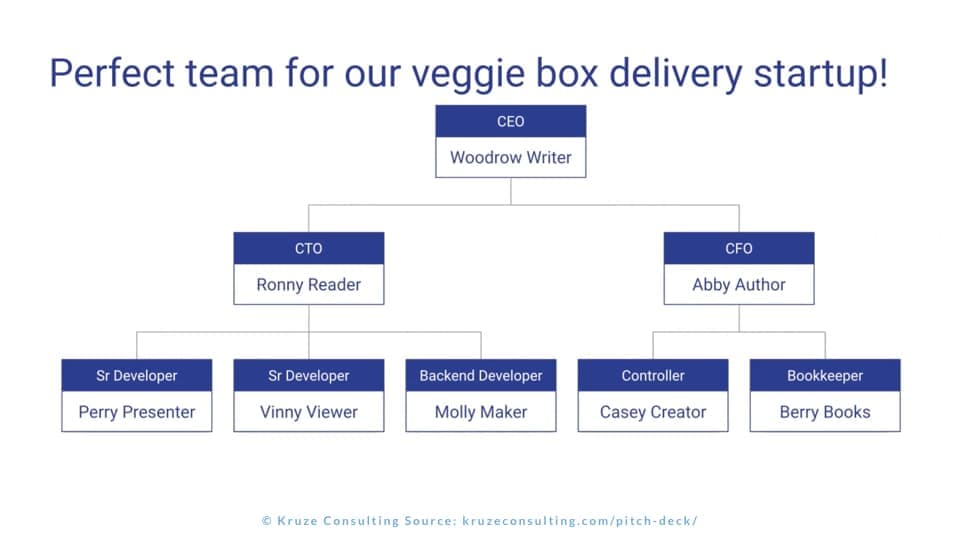
Pitch Deck Top 10 Fails Slide
4. The Problem
All companies need to solve a problem. Ideally, the problem is worth solving, and it's worth money to your target customers to address these problems. This is the slide where that gets explored.
Healy Jones:
Hello, everyone. Welcome to the Problem Slide of our free pitch deck course. For those of you who have already been following our Pitch Deck course, you should probably skip ahead about a minute or 30 seconds or so as we go through the introductions. To those of us who are new to this free online course on how to create a pitch deck, welcome. This course is available on kruzeconsulting.com/pitch-deck, K-R-U-Z-E, consulting.com/pitch-deck. My name is Healy Jones. I am the vice president of FP and A at Kruze Consulting. I'm a former venture capitalist who has made over 40 plus investments in startups, including three unicorns and quite a few that have been acquired for hundreds of millions of dollars.
Healy Jones:
Kruze Consulting is one of the leading finance and accounting consulting firms, serving venture capital back startups. Our clients raise over a billion dollars a year. We are not in the business of helping make pitch decks. However, we do look at a lot of them and do consult around the finance portion of these pitch decks. So we've brought in one of the leading experts on pitch decks, the creation of a pitch deck consultant by the name of Haje Kamps. He actually is not only a leading consultant, he has written the book called Pitch Perfect, which you can get on Amazon. Haje, you want to give your quick background?
Haje Jan Kamps:
Yeah, sure. Good to be here, Healy I'm Haje. I have the world's weirdest background. I have a journalism degree. I spent a bunch of time in hard journalism, was a tech wrench for a while and then ended up doing all sorts of things. I founded six or seven startups. I was in venture capital for a while, helping a portfolio of about a hundred startups in all sorts of things really. And then when I left all of that, I went into working as a pitch coach. And in that capacity I'm helping companies that generally have the company side of what they're doing together, finding the story and telling that story in a way that works for venture capitalists. It turns out is a pretty different thing to pitch your company for sales than to pitching it to VC's. And so I'm helping bridge that gap basically.
Healy Jones:
Awesome. And where can people find you online?
Haje Jan Kamps:
Haje.me. H-A-J-E.M-E.
Healy Jones:
Perfect. All right. And as we go through this, we are going to show an example, actually, several examples of pitch decks that we like. And we have created two free downloadable templates, which again are available at the URL I mentioned earlier. One is intended to be an enterprise focused SAS example, and the other is more of a B2C focused SAS example. So we're going to go through that. So first of all, the problem slide-
Haje Jan Kamps:
Yeah, I just want to highlight as well that the B2B example we've created, especially for this course, and the B2C example is the one that I'm using in my book. So we've both spent a bunch of time on making these templates pretty amazing. And it's a good idea to look at both of them to get a couple of different ways of telling the story and to figure out what works the best for your company.
Healy Jones:
Excellent. And so this slide we recommend as basically after your cover slide, the next slide. So either the second or first slide, depending on how you want to count it. Why is this slide so important in the pitch deck?
Haje Jan Kamps:
Oh goodness. So to really understand why the problem slide is so important, you have to think about who your audience is. And VCs come in all sorts of flavors and sizes and colors. And the point that really happens with this is you can't really assume anything about the person you're sitting across the table from. And if somebody doesn't understand why this problem is worth solving, you have a problem there.
Healy Jones:
Right. So you are sitting with a venture capitalist who sees, if they're good, 10 plus pitches a day. And in fact, they might even have just received this pitch deck over email and not even had the opportunity to talk to you yet. They're trying to see if they want to talk to you or not. This is the slide that they first see. That's how important it is. The slide needs to be compelling enough to get them to want to take that meeting. The problem has to be crystal clear enough, it's got to be worth solving. There's got to be a real market. And you've been in these meetings yourself as a VC. This is the moment where you get the venture capitalist to put their phone down and actually start to look at you and pay attention.
Haje Jan Kamps:
Yeah, totally. I mean, if it's just an email screen, if they don't understand that it's a problem worth solving and that people are willing to pay for that problem, there's no investment. There's so many little things, so many… I keep saying this, whenever you're in a room full of entrepreneurs, there's 200 ideas. Ideas are dirt cheap because there's so many annoyances and problems in our everyday lives, that there's always worth solving some sort of problem. The problem is a lot of these problems, people are not willing to pay for. Or they're like, well, it's annoying, but whatever. I do this once a year and it's not really worth me paying for somebody else to solve this. And so for a company to… You have to think about how a VC thinks about this.
Haje Jan Kamps:
Is this a space where it's worth spending a bunch of time and money to solve this problem? If that's not the case, then there's nothing basically. And I see a lot of founders that fall into that trap of thinking, oh, well, you get this [inaudible 00:05:36]thing, where you're like, hey, how about turnstiles at the Bard station? It's like, yeah, that's a problem, but nobody's willing to pay money to solve that. So it's an interesting challenge to ask yourself. And it's particularly challenging for startup founders because you've spent so much time and energy trying to solve this problem, that it becomes completely invisible to you whether or not this is actually worth solving. So just to set the scene and to have it as a starting point of your story is like, hey, this is something that's really worth solving. It's a really powerful way to open the conversation.
Healy Jones:
Right. And another thing that you highlighted here is thinking about the audience. The audience for this slide is going to change as you move through a venture capital fundraise process.
Haje Jan Kamps:
Absolutely.
Healy Jones:
So initially it's probably shared over email. So it's got to stand on its own. You may have a meeting with a VC. It might be a junior VC who knows nothing, and it's just a gatekeeper. It might be a partner who's worked in this industry for 40 years. It's got to support both of those. And then as you move through the process, hopefully you eventually get to do for most firms, a full pitch to a group of partners or all of the partners or the investment committee. And you can expect that those partners all have different areas of expertise. Some may be great investors, and they may know nothing at all about this problem, about the customer, et cetera, et cetera. So you've got to not only hook those people, you've got to hook the person who might have been a founder in this space and been really successful and knows everything about it. So this is a really challenging slide, a really challenging slide.
Haje Jan Kamps:
Yeah. And just to say a little bit more about that, there will be moments where you are pitching, especially… So for example, you might send this deck to a partner who is really deep into this, but partners are extremely busy and they might pass it to an associate and they might just say, hey, this is an interesting startup, take a look. But unless they have some context about why this is an interesting startup… So remember that the audience is going to shift. And as you just mentioned in the final stages of an investment, you might be in front of the entire investment committee and you might be pitching your agricultural robotics technology company to somebody who only does crypto. And there's no reason why they would have a deep understanding of the challenges of AgTech, but it's your job as the founder to explain why this is worth solving, even to people who have no idea about this market at all.
Healy Jones:
Exactly. So let's dive in the meat of the slide here. What is the problem that you are solving?
Haje Jan Kamps:
Yep.
Healy Jones:
What does the venture capitalist need to know about this problem, so that they're psyched enough to want to keep the meeting going. So this is actually a pretty easy slide if there's a super obvious market, you don't have to talk too much about it. You can focus a little bit more on what your solution is. However, it doesn't matter if it's obvious to you. It matters that it's obvious to the audience. So you've probably been thinking about this space a ton as the founder, but the VC maybe hasn't. And one of the things, Haje, that you mentioned before is inviting the audience in, in case they don't know about it. Do you want to talk a little bit about what that means?
Haje Jan Kamps:
Yeah. I think there is this moment where… Like, imagine you're Facebook. And you're building the future. You're Zuckerberg, you have this very clear vision of what the future of the internet is going to be. And this startup makes no sense. MySpace is popular and like, well, how is anybody ever going to take on MySpace? And I imagine you get very similar challenges now. If you are trying to start an internet search engine, the investor will have a concept of Google and maybe a few other search engines, but they'd be like, okay, who are you to take on Google? So you have to tell a really good story around both what the overall market is and where the market is going. And we'll talk about that more in the market slide. But for the actual problem piece, it's like, if you're a challenger brand, why are the incumbents struggling with solving this problem?
Haje Jan Kamps:
Or if you are creating a brand new market, why is now the right time to solve that market? And there's a few different ways of looking at that. I know in the preparation for this, we were talking about Uber. Before Uber came along, there weren't really any good solutions for just pressing a button on your phone to get a cab to turn up at your door. And as an investor, the pushback would be, well, why would anybody want that? I can just call a taxi company now and it'll be fine. Or, if you rewind even just a few years before that, nobody had smartphones. And so the market wasn't ready. And so there's a whole bunch of pieces of the puzzle that have to fall into place for your company to make sense. And in the problem slide, you have an opportunity to outline what are the bits and pieces of the puzzle that are now possible. That means that this has gone from something that people don't really care about to a real pain point, that people are willing to pay real money to solve.
Healy Jones:
Exactly. So in a new market, that is the strategy, you have to help invite the venture capitalist or the audience in explaining why now is the moment, why it matters to the customers, and it's a real pain point. It's something they're willing to pay money for. In the existing market, you should focus more on the nuance of how you are fitting in with the customer's needs. And more, you're taking advantage of an existing market, but you have a better mousetrap. So I do love the Uber example and I've got it here. So I'm going to share the screen for a second and we can talk about the Uber example.
Haje Jan Kamps:
So yeah, I'd love that.
Healy Jones:
Great. So I am sharing a screen over here. Now, this is not ours. We found this on slideshare.net. I'll make it a full screen thing so you can see everything. So theoretically, this is one of Uber's first pitch decks back when it was called Uber Cab. And then they hit exactly into the problem statement. So they have two slides of the problem. All right. And the problem they're laying out, first of all, is that the current technology sucks. That's what this is right here. Current technology in this market is crap. Then they talk about how it's a bad customer experience. So hailing is done by phone or hand. And I actually can remember this because I'm old enough to have to call to get a cab. And you never knew when they were going to show up, you didn't know where the driver was. It was a pretty bad experience. And they're also showing that it's a bad experience on the cab driver's side as well.
Haje Jan Kamps:
Yeah.
Healy Jones:
And then-
Haje Jan Kamps:
And I actually really like this slide, if you can pop back to it for a sec. I really like this slide because what is happening here is that they're really… If you're calling a cab to your house, at least you have a firm address. That is relatively easy. If you're at a bar, sure, maybe the bar has an address. And the cab drivers know where the bars are. If you are at a particular corner of a park, there is no way that a taxi is going to show up and you don't know how long it's going to be. You don't know if it's been canceled. If you walk to a payphone and call from there, it's a nightmare. And so this part of the pitch is really, really solid. They're really explaining why this particular product makes sense. And they're able to weave a story around the use cases and the examples for why this company needs to exist.
Healy Jones:
Exactly. And if I could tell a funny story, it was just completely not going to be helpful, so people should skip at 30 seconds if they don't want to hear my funny story. But I can remember back in 2000 New Year's Eve, I was out and may have had a few cocktails and then called the phone number to get a cab on my cell phone. It was too loud for me to hear. So I gave the address. I called them again a few minutes later. I called them again when I was outside. And the lady on the other end of the line said, "This is not a cab company. This is my house. Stop calling me." That's how bad the experience was back then. And I take no [inaudible 00:13:25]-
Haje Jan Kamps:
Did she come and pick you up?
Healy Jones:
No, she didn't pick me up. It sucks.
Haje Jan Kamps:
That's terrible customer service.
Healy Jones:
Exactly. And then Uber has broken this up into another slide for their problem, which is the price, it's too expensive. So they have laid out basically three things: The current technology sucks. It's a bad customer experience. And the solution is too expensive. That's actually a pretty killer problem deck right there.
Haje Jan Kamps:
Yeah. I mean, if you're able to address those three things in your problem slide, you are… And I think this is important to highlight, the purpose of the problem slide is for the VC to put their phone away, as you said, and lean forward. Like, okay, I've got to pay attention to this. And what the problem that some founders have is that when they start telling their story, they're getting to a place where some interesting stuff is happening, but the painful thing is if the VC only leans forward about halfway through your pitch, they've missed the first half.
Haje Jan Kamps:
And it becomes one of those, oh yeah, did I have to pay attention? And I mean this with all the love in my heart, but if you work in venture capital, you are crazy, crazy busy, and you are going to… If it doesn't immediately strike your interest, you have 16 other meetings that week. And there's 10 board meetings you have that week. And it is a crazy, crazy job. And so on the one hand, should they be more professional? Absolutely. On the other hand, for you as a founder, it is your job to hook them in and drag them along. Because other founders will be doing that and they'll be doing it really, really well. So it's just the professionalism and the art of pitching has shifted a lot over the years and you have to keep up. It's really important.
Healy Jones:
Very important. And so let's show the other slide decks that we've created as demo examples. Again, you can get these for free on the website that we mentioned earlier. We have two. I'll share my screen again here. So we have two, again, one is focused for an enterprise business, and one is an example for more of a consumer focused business. So this first one is for a made up startup that we're calling Four P's. It's just Perfect Plumbing Partner Platform. We're trying to be a little silly with these ideas. We don't want you to fixate really on the idea, we're trying to give you a template. And then the other one is for a beer delivery startup. What did we call this one again? What do you call this one? Oops, you're on mute there.
Haje Jan Kamps:
Oh, really good question. I can't remember.
Healy Jones:
Okay, well, I'll just scoot to the beginning then. What do we call this? Beer Sub. There we go.
Haje Jan Kamps:
BeerSub.com. Yeah.
Healy Jones:
Okay, great. Perfect. Okay, so let's-
Haje Jan Kamps:
Do you want to do that one more time so we can actually splice that in?
Healy Jones:
Yeah. Sure. All right. Great. Well, I'll start again. So we have… Okay, so I just started sharing my screen. And we have two again, demo pitch decks that you can get for free on the website. One is for a consumer focused startup called Beer Sub. And the other is for a more enterprise focused one called Four P, which is Perfect Plumbing Partner Platform. We're not trying to have you focus on the concept behind these, they're intended to be a little bit silly of companies. It's more, we're trying to show you the template. And the flow and how to weave a thread or a story throughout your deck. So please don't tear us apart for what these companies are about. We just made them up to try to be helpful here. So let's start with BeerSub. Haje, do you want to talk about what is on this slide? And I will make it big enough so that the audience can easily see it.
Haje Jan Kamps:
As Healy was saying, BeerSub is kind of a joke. You're not going to actually subscribe to a beer solution. Well, maybe you are. But what I wanted to talk about here with the problem slide here is to really tease out some of the reasons why somebody might be interested in this. And so if I were presenting this slide, I would weave a story around why these things are important. People are eager to explore new beers, but there's too many choices. And I think that's something that everybody can kind of relate to. If you walk through a big, like a BevMo or something here in California, or a big beer store, you have hundreds and hundreds of choices. And the labels are super pretty, but you have no idea what's good. And unless you have a staff member there that can help you out, you're kind of struggling.
Haje Jan Kamps:
You might do a beer tasting or something, but it's actually legitimately hard to find something that fits your taste profile and all that kind of stuff. The other thing is if you go to a liquor store or a supermarket, it's the same thing, but there, you don't have any advice. And that gets really complicated. And so really what this pitch is for is, really, if you are interested in beer, but you're not willing to sign up to become a full on beer judge and do lots of training, there needs to be an in between thing. And so the idea here is just to create enough tension in the story that people are interested enough to think, hey, this might be something that is worth looking into. And yeah, that's what the problem slide is here.
Healy Jones:
Again. And so the format that you can see on this is basically a hard hitting headline. And then here we have three bullets, and this actually is somewhat similar to what you saw with the Uber example, where they had three main issues that, or problems, that they thought needed to be addressed. If we jump over to the Four P's example. Okay, you can see here again, we're following the three bullets. But here we're saying that the admin that a plumber or a handyman has to spend billing and scheduling meetings is actually disruptive of their ability to earn a living, which is when they're billing by the hour and actually doing work. And this manual billing problem and customer relationship management can actually result in an underwhelming customer experience. You may be undercharging customers, because you're leaving money on the table.
Healy Jones:
You might overcharge some, you might not be very quick at getting in touch with them. And then finally plumbers are often really busy or they need more work. And so the solution can actually help plumbers load balance and find more opportunities. Now again, the pitch that I just went through would not be one that would be good enough to raise venture capital funding. You need to do a much better job than this. But what we're trying to critically focus on here is that the current market has an issue. And then for this plumbing example, the way that a plumber would solve this is hiring an administrative assistant or secretary, which would be depending on where they are, 20 to maybe $50,000 a year of an expense. So you're throwing out there that, hey, people actually are solving this now, but it's really expensive in terms of what they're currently doing.
Haje Jan Kamps:
Yeah, totally. And I think for people who've ever been in a consulting or freelance business, you realize that these things are actually really universal. The admin, the time you're not spent doing the actual work, is just cost to you. And a lot of people who are very vocationally oriented are really bad at admin. It's just a universal truth there. And so all the time you're spending doing plumbing, that's where you make the money, but then you end up wasting all your time doing the other stuff. And the other odd truth is, when you're out doing jobs, the horrible thing that happens is that you're super busy. So you're not out there doing marketing and you don't get as much inbound. And so you finish all your jobs and you look at your calendar and suddenly it's empty and it's like, ah, I don't have anything to do.
Haje Jan Kamps:
And then you do all your marketing and suddenly you're super busy again. And so really what the pitch would be here, the way you would tell this story as a pitch is you're evening out that curve. Saying when you're doing work, there's still a way of getting more work. And when you're doing the actual work out in the customer land, you are making the experience better so you get more word of mouth. And so it becomes a marketing/admin story that you can start weaving throughout this pitch.
Healy Jones:
All right. So one thing that can be tempting when you're presenting the problem is actually, instead of telling the problem, just giving your solution slide, which is a different slide or giving the market slide, which we, again, we think should be a different slide. And even a competition slide, which could be a different slide, which should be a different slide. So this slide can really bleed into those other things. Now you have to adjust this slide based on how much the audience is going to know about your market. So if they know nothing about the market and they think it's maybe a $20 million a year market, you probably want to tease that you're innovating in a $50 billion market category. Or currently the customers are spending on average $40,000 a year to fix this problem.
Healy Jones:
Proving that there's something out there. That doesn't have to be a bullet, that could be in the headline. Or it's something maybe you can say orally if you're in a meeting. But again, think about, okay, the venture capitalist is coming in. Do they know that this is a big market? Do they know that there's a willingness to pay? Think about those things and be very careful about bleeding too much into your feature or demo slide, because without actually setting the table about how there's a problem here, your pitch can lose a lot of its awesomeness.
Haje Jan Kamps:
Yeah, absolutely. And I think that the thing to really keep in mind, that this is your teaser. This is your appetizer that really makes people go, oh, wait, I haven't thought about this. There's two outcomes here. One is, oh, I've never heard about this. This is interesting. I'm going to pay attention. Or the other one is, oh, I know something about this space. And I think just from a psychology point of view, if you don't know anything about it, but you're a curious person, you're going to be like, okay, tell me more. This is interesting. If you do know something about it, a lot of people fall into this mode of like, okay, I'm going to catch them out. I'm going to see if I can catch them in saying something that wasn't right. And so this is, in both cases, great, because people are engaged, they are listening, they're paying attention.
Haje Jan Kamps:
Maybe they're taking notes. That is the thing you really want for this slide. And either way, you set yourself up for a win here.
Healy Jones:
Exactly.
Haje Jan Kamps:
And as you were just saying, it's really about what can you tease? What can you line up? And for me as a pitch coach, I really believe in telling story arcs. And what that means is that you have an example or a piece of the story that comes back several times throughout the story. And this is where you get a chance to set that up. So if you're talking about the plumber example, give the plumber a name. Bob is out there doing this and Bob is really struggling, blah, blah, blah. And later in the story, you can talk about Bob again. And I think it's such a good way from a storytelling point of view to really tie it all together. So this is your chance to really set the pieces for what's about to happen in the rest of your story.
Healy Jones:
Great. And you know what? You just teased something that is really important that we should double click into, which is you should have talked to a bunch of customers by this point. Or potential customers or people in the market. So to the extent you're going to go pitch a venture capitalist on an idea, and it's not something that you've been doing yourself at a big enterprise, you need to go and have talked to so many customers that you've done the market development, that you can prove that, hey, I've talked to 50 plumbers and they have all shared the same experience around X or Y. Those that have solved it, have an intern who they love, or maybe it's their wife, or their husband or someone is actually solving this for them. And when they think about the opportunity cost of that person, that they could be earning a salary somewhere else, that they actually understand that it's really expensive to solve.
Healy Jones:
So you need to have talked to customers and you can bring those anecdotes into this part of the pitch really, and make it very profound or personal. And in fact, if you're selling to enterprise, this is even better because you can say that you talked to, or you used to run the X, Y, Z thing at big company X. And this was a problem there, which is why you started this company. Or a bunch of your friends are running security at fortune 500 companies. And they've been complaining about this. You can weave that in here, but heaven forbid you should actually go to try to talk to the VC before having talked to potential customers, because they are going to call you out on it and you're going to look really stupid. So one, talk to customers, two, weave the anecdotes throughout the presentation. And this is a nice place to tease that.
Haje Jan Kamps:
Yeah, totally. And I think I want to double down on that as well. So the beautiful thing about having really deep understanding, either through traction in your companies, you can talk about real customers, or even just having done a large number of customer interviews, is that you can talk with great… So the VC is going to want to invest in big numbers. So individual stories almost don't matter. But VC's are humans, and there's a reason why… Look, if you read the press and there's been some sort of a big disaster, they interview one person about something bad that happened to them, that family, or that person, because that's how you really connect. That's how you build a psychological connection with the person.
Haje Jan Kamps:
So even if you've done 50 interviews, don't try and tell the story of 50 people, tell the story of a small handful. And you can talk really compassionately and passionately about that. And that works fantastically well when it comes from a psychological break through those walls, like, hey, I'm talking about real people here. Yes, there's 50,000 of this person, so this is how we're going to make money. But let me tell you the story of Nina, who is a plumber in Oakland, California, and has this problem. You wouldn't believe how effective that is. That's really one of the things to focus on when it comes to your storytelling.
Healy Jones:
Great. That's a wonderful example. I've seen that as a VC be very compelling. And in fact, it gets even more compelling when that person is a user or a customer. And they'll be a reference call later, weaving that in is a really, really powerful idea. I love that. Yes.
Haje Jan Kamps:
Yeah.
Healy Jones:
And so this slide can be easy or this slide can be hard. This slide is easiest if you're doing something universal. And it's a problem that everybody would know about. It's also very easy if this is a massive market. So again, looking at the Four P example, this is a billing/CRM solution for plumbers. So salesforce.com is a massive public CRM. They have big competitors like HubSpot, and there are many others, so there's a big market here. And so you can tease into that being a big market.
Healy Jones:
And even actually, if you think back in time, when Salesforce came about, when Salesforce pitched, there was a desktop/main… I don't know if mainframes are the right word, but behind the firewall solution, Siebel Systems was their big competitor, it was a huge business. So Salesforce's pitch was probably actually easier because they could point to a big market and then they could list all the problems. Just how Uber did.that was probably a really great pitch for them. So this slide is way easier if there's a big market or if it's a universal thing.
Haje Jan Kamps:
Yeah. And if it isn't yet, you also have opportunities there. So the idea of predicates in markets is really helpful. So for example, when you first started pitching, or when Peloton first started pitching, it's a really good company. Right now, it becomes obvious. They're on TV all the time with their adverts. It's really obvious that this is a big company that's doing well. But when they first launched, they were like, how the hell do we tell this story of a $2,5000 bike with a $60 a month subscription? How does that make any sense? Well, they had some really good predicates. One of them was, exercise bikes in the home that already existed, they've been existing for a long time. And the other one was spin classes, stuff like Soul Cycle and such. So they're able to say, hey, it's Soul Cycle with real teachers, but at home with a screen and with the gamification of being able to race against 10,000 other people. Suddenly that story comes together really well because you've taken something that is a little bit abstract.
Haje Jan Kamps:
It's like nobody's going to buy a $2,500 bike with a screen on it, do something that makes a lot of sense. They're like, well, people do go to Soul Cycle, but the people who really want to do this kind of thing, but don't have time like moms with young babies. Can you get a 20 minute exercise when the baby is sleeping? Or really busy professionals. And there's all these subsets of users that you can very easily point to that really want this product, but that didn't exist. And suddenly you come up with a really compelling narrative by just leaning on the predicates that exist in the market. Same thing for Salesforce. The predicate was the company that, to install it, you get shipped a DVD and you have to install it on your computer.
Haje Jan Kamps:
And when there's an update, they have to ship a million DVDs around. Suddenly they say, well, what if it's all on the internet? What if it's all just completely available that way? And when the Salesforce is out and about, they can use their phones to quickly check the info about the person they're pitching and all that sort of thing. So think about how to use the predicates in the market and think about using adjacent products and that kind of stuff. Even if you're doing something completely new. Even if you're Uber, there are other predicates you can use to help tell that story. The thing that people don't really realize is that Lyft was actually out there before Uber with the whole people's own cars thing. Uber completely stole that idea and then out executed Lyft. But the cool thing is Lyft was doing something really innovative.
Haje Jan Kamps:
Lyft wouldn't have been able to do it, if Uber hadn't been there to do it with their own fleet of cars. But then Uber took it and ran better. So you get this really cool back and forth within the macroeconomic market of the different types of products that are out there. And you can really lean on that in your story, because that is what brings it to life. That is what makes this seem real. And as a startup founder, you have to be a storyteller, you have to be a salesperson, and here's your opportunity basically. And this slide is really where it starts. This is where the narrative begins.
Healy Jones:
So I do love the way you took the Salesforce pitch that I gave and made it better there. So I'm going to go do the Peloton one, because I think that's brilliant as well. So for Peloton, first of all, there's the at home part. You're a busy professional or a busy mom or something, you can't get to the Soul Cycle, but now you can do it at your house. Secondly, maybe the Soul Cycle coaches in your area are good, but they're not best in class. Peloton actually does probably have the best Peloton coaches on the planet and you can get them on demand or on a schedule in your home. Pretty amazing. And then the third thing that they have is the gamification of the data and tracking your progress. I'm sure they pitch that as well in their deck as a way to keep people coming back, keep them excited, badges, rewards, all that stuff.
Healy Jones:
So, again, that was a new market, but they just, bam, blew it out of the water I bet with their pitch, particularly if you look and see how much money they've raised before they went public, really successful. Now where this becomes a much harder slide is when it's a totally new concept. That can be really hard. And it also is hard if you're not able to articulate who the buyer is or who the person is, who has the problem with the issue, or if that person is going to put money down. And it's also hard if there's a cheap solution out there that is doing an okay job. That's another place where this slide gets really, really hard.
Haje Jan Kamps:
Yeah. Yeah, totally. And I think a good example of that is at=home vacuuming robots. The iRobots type things. Before they started becoming available, it was like, guys, do we really need a little robot that goes around and hoovers when it isn't that big of a job to just vacuum your own floor? It's not that hard. I was actually a little bit surprised that so many people ended up buying them, but it turns out I had missed something about that market. It is the convenience of being able to vacuum three times a week, rather than just once a week. And I feel like sometimes even people who are really in these markets, looking at stuff, miss these big pieces of information. And I think as a founder, you get to inform your VC about stuff they don't know. And about trends you've seen and about things you know about the market. So think about that too. Sometimes saying really obvious stuff makes everybody feel really good because everybody agrees. And sometimes being a massive contrarian is a way that you're able to raise an enormous amount of money.
Healy Jones:
Right. And in the massive contrarian landscape, it's even better if you've talked to a bunch of customers and you have some who are already paying you, or are willing to pay you. Obviously depends on the stage of your startup. But if you've talked to people who have the money and the pocketbooks to pay for the solution and you've already got them excited about it, even before you've launched this, this slide gets a lot easier.
Haje Jan Kamps:
Yeah, absolutely.
Healy Jones:
Perfect. Well, I think we've done a pretty good job explaining what we'd like to put on the slide and where we've seen best in class. Again, you can get our free examples. Do you think we've missed anything or should we just summarize this up for everybody?
Healy Jones:
Well, I think we've outlined what we'd like to see on this slide, where we've seen companies have a lot of success. So to summarize here, this is the most important slide in your deck. It's the first slide. If it's not compelling, you're probably not even getting a meeting. So this is your excuse to get the venture capitalist to stop texting with their friends or CEOs about whatever's going on and actually put the phone down and focus on you. So you're selling. You are selling, the slide is selling. It's incredibly important. Next, remember-
Haje Jan Kamps:
Yeah, super important.
Healy Jones:
Remember your audience. Remember that some of them may really know a lot about this. Other people may not. You've got to get them all in on this and all excited about the problem. And again, invite them to be the insider with you. Invite them to have this unique insight or angle that they hadn't had before. All right. You are explaining why this is a problem worth solving and why people are willing to pay for it. That's what you're doing here. Again, that's the thing that you're going to pull all the way through this? This is the hook slide. Keep it great. Keep it pretty tight because you don't want to spend forever on this. You want to keep the slide moving forward. All right. And again, you can't spend 30 minutes on the slide in a meeting. That's probably not a good thing. You have a whole pitch deck to get through here. So it's got to be, bam. It's got to lay it out there. It's got to get everybody excited. It's got to keep people moving.
Haje Jan Kamps:
This was the problem slide. And this is where you set up all the pieces. The obvious next step to go is the solution slide. How are you going to solve this problem in a way that makes the customers lean in and go, oh yeah, this makes sense. So we'll talk about that next. Thank you for joining us. And I look forward to seeing you in the next episode.
The Problem slide: What are you solving and why?
People and companies spend money because they are experiencing an issue or a problem. Spending the money is cheaper, easier or more convenient than making the product or fulfilling the service themselves.
Having a very clear understanding of the problem you are solving and how it is affecting your customers is a crucial step towards convincing a venture firm to give you money. In many cases this isn't the most important slide in a startup pitch deck - but, if you can't articulate the problem, then you are going to have a really difficult time raising capital.
The problem should be something that's experienced by a lot of people – or something more niche, that a few people are willing to pay a lot of money for. This slide is your chance to shine a light on the problem space.
Slides for the The Problem section
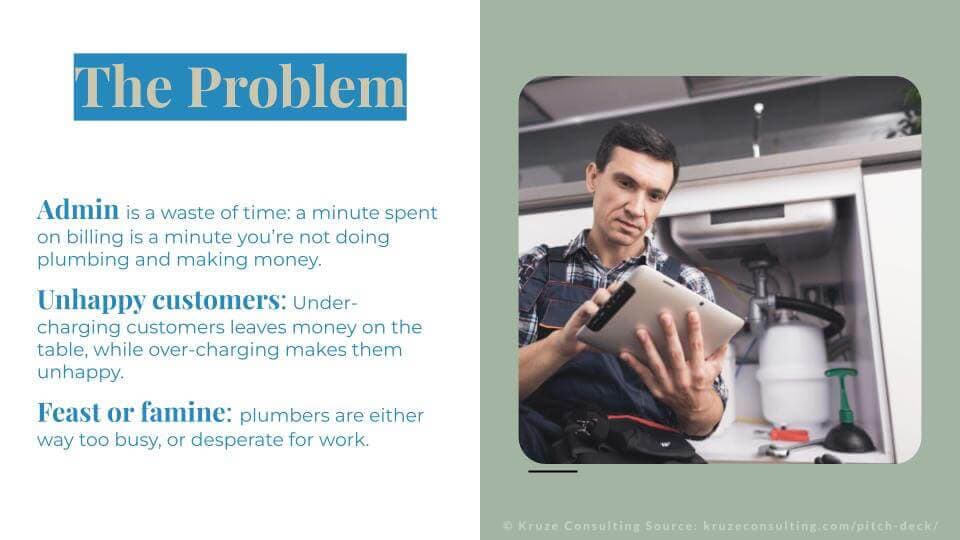
B2B Pitch Deck Problem Slide 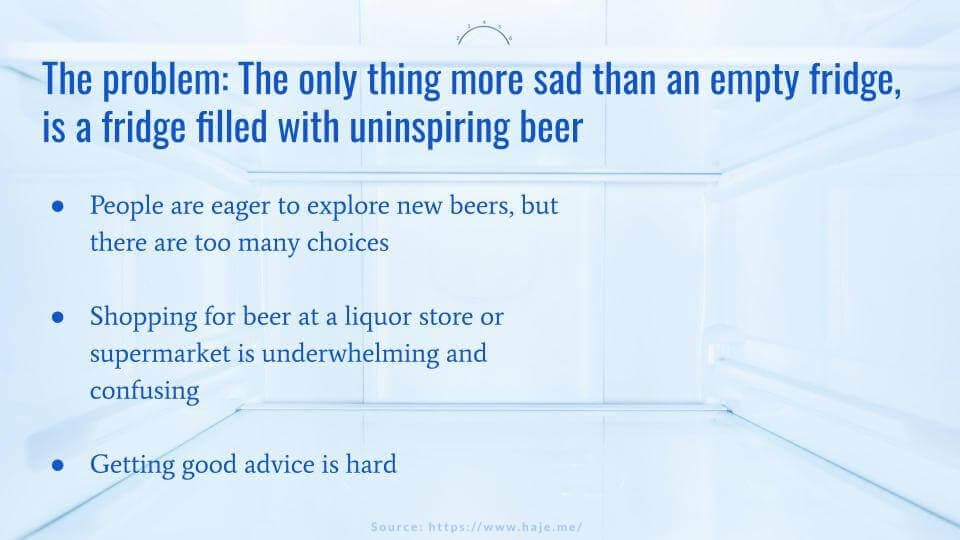
B2C Pitch Deck Problem Slide
5. The Solution
You've talked about the problem. Your company's product is the solution to that problem, and in this part of the narrative we talk about how you are doing that.
Haje Jan Kamps:
Hello and welcome back to our Pitch Deck Course from Kruze Consulting. You can find out the entire course on kruzeconsulting.com/pitch-deck. That is Kruze with a K, K-R-U-Z-E, consulting.com/pitch-deck. I'm Haje and I am a pitch coach, and I'm helping people with all sorts of magical things around how to tell the stories of their startups and I'm joined here from Kruze Consulting with Healy.
Healy Jones:
Hi, I'm Healy Jones. I'm with Kruze Consulting. We're one of the leading finance and accounting consulting firms serving venture capital X startups. Our clients raise well over a billion dollars a year. I'm formerly a venture capitalist with a couple venture capital firms and an exec at startups that have raised quite a bit of funding. So I have a lot of experience, both evaluating and assisting companies, making these types of decks and also giving them. So really happy to have everybody here joining us to talk about these solution slides.
Haje Jan Kamps:
Love it. Yeah, and my background is I've done a bunch of work in this space, both in venture capital, as a journalist at, among other places, Tech Crunch, and I've founded a bunch of companies myself. So I've seen this from every angle and I've worked with at least a couple of 100 startups on how to tell their stories and I wrote a book. It's called Pitch Perfect and it basically contains everything you need to know about how to build a pitch deck. So here, we're actually double clicking on a lot of the info that's in the book and a bunch of stuff that isn't.
Healy Jones:
It's great. Haje's book is available on Amazon, if you want to check it out, and we are also releasing all of these for free on our website and on YouTube. So we are talking about the solution slide. So in general, we recommend this as the slide that comes right after the problem, which is the first slide. However, I do think before we, say, talk about a specific order here, there's one other… Or as we talk about the specific order, there's one other pretty important point, which is that some companies may want to put a traction slide as the number two slide. Haje, do you want to talk about why?
Haje Jan Kamps:
Yeah, absolutely. Traction is king. If you have incredible traction, you can essentially get away with only having a traction slide.
Healy Jones:
That's true.
Haje Jan Kamps:
But basically, what this does is if you've set the stage for what the problem space is, if you've done incredible and you have explosive growth and lots of customers and almost no churn, highlight that before you talk about how you did it. If you don't have that yet, shove it towards the end of the deck and let's talk about the solution slide.
Healy Jones:
Perfect. All right. So why is the solution slide so important? Also, you've just talked about the problem and there are obviously a lot of ways to solve the problem. So hopefully, you sold the problem in a way that the venture capitalist is agreeing like, "Wow, this is a real issue. People are willing to pay for it. How are you going to fix that problem?" So this is your solution. This is it. This is how you can get it done, and keep in mind that the different stages of companies will have different slides here. So if you're a seed or you're trying to raise a seed round in an MVP versus a series B that's got a lot of paying customers, this slide will look very different.
Haje Jan Kamps:
Yeah. If you're raising a growth round, essentially, your product is going to be pretty static at this point. You've solved the problem, you have paying customers, and now, it becomes more of a, "How do we take this problem and how do we grow it?" Or, "How do we take this solution, this product that we've built and grow that to as many customers and regions", and however you slice that market. If you're a very early stage company, this can actually be a pretty challenging part of the story to tell well, and the way I like to think about it is for early stage companies, this actually is… It's not really a set in stone solution, it's more of an MVP. And the way I like to tell that story is like, "Hey, our hypothesis is this, this and this. We know what the problem is. I think our idea is to solve this problem in these ways. Hopefully we are right and we can continue working on that, but there's some wiggle room here."
Healy Jones:
And so I think the thing you really want to sell if it's an MVP is, "We have a process to figure out how to solve this. We are thoughtful people who've talked to a lot of customers, potential customers and we know how to build stuff. So here's what we're going to start with and here's how we're going to learn from it. Here's our process for improving what we're trying to do." So again, now, at this point, you're not selling the actual solution, you're selling that you guys are the team to figure it out. Some slides, maybe you want to die on the battlefield. This is not the slide to die on the battlefield if you have an MVP around a particular feature. You don't want to fight the venture capitalist around a particular feature that hasn't been built, hasn't been tested. You want to actually prove that you're going to be able to ingest data from customers and figure out if that is the feature that's working and how it needs to be tweaked, et cetera.
Haje Jan Kamps:
Yeah. MVP is the dumbest word in the dictionary. It's not minimum, it's not viable and it's not a product. Still, it's called a minimum viable product and really, it's the smallest amount of work you can do to answer a question. And in that, you have to know what the question is and I think that actually comes from the problem slide. So, "Hey, there is a problem here worth solving. We think there's a solution here. What is the smallest amount of work we can do to see if that is really a good way to solve it?" For some really early stage companies, the MVP is actually a video where you can do a bunch of conversations with customers.
Dropbox famously raised a bunch of money without having it written a line of code. They went out with a video and a, "Hey, would you use this if this existed?" And everybody went like, "What? Yes." And so they were able to raise money because they had a bunch of feedback and it was a really good way of doing that. So in the earliest stages, the investor doesn't have a lot to go on if there's no traction, so they have to have faith in your team, they have to have faith in your process, as you just said, Healy, and you need to have faith in, I guess, the humbleness. Are you able to discard ideas that don't work quickly enough that you have enough runway to try two or three different solutions?
Healy Jones:
Great, good. Excellent. And so let's talk more about if you're a company with legit traction. So now we're going to the other extreme, you're more of a series B company. I do want to push back one thing, Haje. I think that a lot of series B companies are still working on their product and they've got a lot of product extensions that they want to get into. So it is true that hopefully by the time you're a series B company, you've got a product that has a lot of traction, but you're probably not done building a product.
And I think the problem that can happen on this slide, the solution slide, where you can mess up as a later stage company, is this can become an entire product roadmap slide or you get really in depth and really into the weeds and you can spend forever talking about it, because you probably have a product team or leader, or maybe that's you as the founder and you probably think about this every day. You don't want to spend forever on this slide. You got to keep things moving. Don't go too crazy or spend too much time on this slide. If you have a lot of traction, list out the key benefits and whatnot. So we'll get into a second about what actually goes onto this slide, but just keep that in mind if you're at a later stage.
Haje Jan Kamps:
You typically only have 30 minutes to 45 minutes to deliver this entire presentation. You spend 10 minutes on the problem and 20 minutes on the solution because you, as a founder, are so excited about what you've built. You're actually shooting yourself in the foot because one thing I see people get wrong again and again and again on this slide is that they're treating it as if it's a sales pitch. It is, but you're not selling what you think you're selling. You're not trying to sell this product to the VC. You're trying to sell shares in your company to the VC. There's a really important difference. So don't rabbit hole too far into what your product actually does and focus instead on just summarizing why this is important to your customers. We'll talk about what that means in just a moment, but from there, that becomes the springboard to explaining to your VC why it makes sense to give you a couple of million dollars to buy shares in the company and that's what you're really selling.
Healy Jones:
Great. So let's talk about what to watch out for. So first of all, you're not selling the product to the venture capitalist. You're selling shares in your company to the venture capitalist. So this is not a sales deck in terms of, "Please purchase my product at the end of the conversation." One. Two, you don't want to spend too much time on the slide and it's very common. I see this a lot. When I was a venture capitalist, founders were passionate about their product and the solution and they spent way too much time on this slide. The VC is not going to log into your product and use it regularly in most likelihood, unless it's maybe a consumer thing. It's just not something they're going to do. So you don't want to spend 45 minutes on this slide. You don't have the time. You got to keep things moving on.
Haje Jan Kamps:
And there's an interesting thing to think about there, too. Maybe you do this pitch 20 times and every single time, your VC will come from a different context. You've been doing this longer than I have, Healy. Do you have any examples around how that shows up for people? How can you get pushback here when the VC has a different context?
Healy Jones:
So you gotta watch out for the venture capitalist who wants to argue with you about your features or your view on what the product needs to go. This could be a really long conversation and it could get pretty argumentative, particularly if you're really passionate about your product, so just take a deep breath. If they start to push back on what's wrong with your feature set, or, "I don't like this thing", or, "Why would someone do that? Why would someone use that?" Take a deep breath, okay? So secondly, the VCs generally have different backgrounds, so first of all, know who the venture capitalist is before your meeting with them, where an executive who was a designer focused executive or marketing executive or they're a engineer by training. Make sure you know who they are so that you can just understand that when they start asking you a particular line of questions, you know what level of depth to go in and [inaudible 00:09:59] knows what the context is for.
Now, you shouldn't try to argue with the VC around this. Places where I've seen VC's push back on this is if, for example, I had a venture capitalist who is an amazing designer and he was always asking questions around, "Why is this button here?" Or, "How does this particular feature impact behavior?" And so you want to just be careful that you're not going down a rabbit hole and spending 20 minutes talking about how you picked a particular font or something like that. That's not helpful. Again, we're going to talk about it and say what you're putting the key benefits to the customer on this slide. It's probably best to say that you're excited to test these things. You're excited to have the VCB part of the conversations around how you figure out how you're testing either design or the architecture of the product if they're an engineer or the virality, or how you get things to go viral if they used to be a marketing person.
So what you're trying to do is prove to the VC that you're willing to take their feedback and you're curious to hear what they have to say. You're trying to prove that you have a process to answer the question they're asking, because you probably don't have the answer right there and the way that you really prove that you have a process for most venture capitalists is you talk about bringing in customer feedback, understanding what the customers looking for, talking to the customer, pulling out data from use, interaction with customer, customer data, et cetera.
And then finally, and I think this is a really important thing that, Haje, we talked about a lot is if they're really asking about your go-to market strategy on this slide, you have a choice here. The wrong answer is to try to explain your code to market strategy on the solution slide. That is the wrong thing to do. This slide is not built for that. So you should either politely say, "I would like to discuss that in two slides. I have a whole slide around that. That's a great question. I'm really psyched to talk about it. Let's just get to it because I believe I'll answer your questions." Or two, actually go to that slide, use the slide that answers the question, has the charts or the design to actually get you there. Don't try to answer a tough question on the solution slide when you have it on a different slide.
And again, the two best answers are, "Can we please talk about that in a moment? I have the answer for you", or "I have a slide about that." Or actually go to the slide. Make a decision about what your presentation style is and how you work best, particularly under pressure, but if it's a really hard question, particularly a go-to market question or something like that, don't try to answer it on this slide. It's just not built for that and it won't be as powerful if you actually go through it in the place where you've built the deck to do that.
Haje Jan Kamps:
Yeah, absolutely. The one other VC profile that's worth mentioning is investors with a finance background. Sometimes, they'll get a little excited about the product and the business model and that kind of thing. And again, this is where even VCs sometimes fall into the trap of rabbit-holing on the wrong thing. You might have a slide about business models later. This is not the slide to talk about that. And ultimately, you're not even talking about the business model of this company. You're talking about the business model for this investment, ultimately. That's where the real conversation happens. So as Healy was just saying, a really good, polite, "Hey, awesome question. I'd love to talk to you about it. It's coming up. Are you okay to wait?" Most of the time you get a, "Yeah, no problem. Thumbs up. Let's keep going", because they also know that it's really helpful to get a good context of what your company is before you really double click on the things that seem like they don't work or some more discussion is needed.
Healy Jones:
Exactly. The market's pretty hot right now, so this isn't happening as much, but let's look back two years ago. If you're a later stage company raising a lot of money, $5,000 million, and there are a lot of product questions, I think the right thing to do is to say, "Hey, let's have a whole discussion around that. I have a product team. I spend all day some days just thinking and talking, working through products. Let's have a whole hour long discussion around the product. Let's not get too under the weeds on it here." Again, you can't spend 45 minutes on this slide, regardless of the stage of the company that you have. You cannot spend 45 minutes here. Arguing-
Haje Jan Kamps:
That's such a good-
Healy Jones:
Is not going to be helpful either. Arguing with the VC, all you're going to do is upset them and upset yourself. That's not what you're trying to do. You're not trying to win a high school debate club. You're trying to convince someone that you're smart enough to figure out how to offer a solution to this market.
Haje Jan Kamps:
Yeah. And a lot of VCs are looking for coachable founders. They're VCs for a reason.
Healy Jones:
Exactly.
Haje Jan Kamps:
They have some in-depth information here. And so one way of dealing with this could be like, "Hey, this is why I'm here talking to you. You're asking all the right questions. Some of this, I have answers for, some of it, I would love your help with. This is why we came to you. I want you on my board. I want you to help me, but can I give you the best understanding I have right now?"
The other thing you can do when you're slightly further down the line and if people start rabbit holing, you're probably going to be the only person in the room. So you can actually say, "Hey, I have a whole product team. Can we do another meeting and drag in my Head of Product and we can really go as deep as you possibly want?" And it would be a very silly VC to push back on that because they know there's a better resource to have this. So use those tools you have available to you to try and keep the conversation a little bit on track, especially in the first meetings, because otherwise, if the 45 minutes is up, they will get up and walk out of the room and if you haven't made it to the end of the presentation, well, you've failed. That's your job, to keep people on track.
Healy Jones:
Exactly. Exactly. Couple of things to watch out for, if you're doing something consumer, everybody thinks they're an expert because, "I'm a consumer." Everybody's going to think that. So just be prepared for people coming with a lot of opinions. And how do you answer that stuff? You're bringing customer feedback. It's different based on the stage, so if it's a pre-product, that's a lot harder to do, but it has to do with conversations. If you actually have a product in the market that's doing well, you can bring in actual conversations from real customers or you can bring in data showing how they interact with the product. And the other thing is how do you want to have a process. Proving that you have a process to figure this stuff out and to improve the product, that is actually the winning thing that you want to get through here. I do want to talk about another type of VC which is a former founder or executive in the specific industry or vertical that you're working or that you're pitching. Those executives can come with a lot of baggage. So they did something 10 years ago and they have all that knowledge with them, but all the baggage. All right. So again, how do you interact with them? Arguing is not the way to go.
Haje Jan Kamps:
No. I see this happen with actually one of my previous clients who was building a warehouse robot and he was pitching something to a VC who very specifically had done a warehouse robot company about 15 years ago. And he actually thought he was going to have a really easy conversation but didn't, and the VC said to him, "What you're trying to do is impossible." And the founder was like, "Well, this puts me in a really hard position. You're saying it's not possible. We've literally done it." Now, on the one hand, you don't want to be too rude, but on the other hand, this is a VC who's world renowned for this space, but hasn't kept up to date over the last 15 years. I think it is perfectly okay to say, "Hey, you know what? I can totally see where you're coming from, but there's been some really interesting developments you may not be aware of. So we sold it in these three ways and I actually think it is possible and I'd love to show you in a demo later, or I'd love to show you with this video", or whatever. So pushback gently, but remember that out of date information is still information and you can't fight people on facts, especially if they've built companies in this space before. It just may be that their information is out of date.
Healy Jones:
Exactly. Right. And actually, there's a book called The Challenger Sale, which is a great sales book, and the whole plot of the book is, "Hey, the world has changed. Here's what you need to do. Here's why our product or our solution or feature, et cetera takes advantage of, that makes your life better, et cetera." So keep that in mind. That's a high beta move, prefer an exec who's been in an industry for a while, but maybe what you have to do, again, be careful, read the room. And then the other thing, though, is flattery and flattery works great. Saying something like, "Hey, this is why I want to work with you. This is why I'm pitching you." You are raising [inaudible 00:18:13] talk to a dozen VCs. You're the only one raising this. Now, "I think I've got a process for figuring it out," or, "I think the world has changed because of this but I want to work with you because you're the one who knows about this stuff." So keep in mind, flattery often works on this slide.
Haje Jan Kamps:
Yeah, no, absolutely.
Healy Jones:
All right. Let's keep moving here. So what is this slide for?
Haje Jan Kamps:
So what it boils down to, you're not selling the product. What you're selling is showing what the customer gets out of it and to me, what it often boils down to is like, "Hey, the product costs $20, but they get $40 worth of value." That's really what it boils down to. So how can you show that your customer is getting a tremendous amount of value out of this and really what that boils down to is your unique selling points or the thing that… We've mentioned this before, but the whole vitamins versus painkillers thing. We are painkillers. We make pain go away. We make your life easier. Everything is going to be awesome and it's going to cost less than any other solution. And I think that's really what you're trying to outline on this solution slide. You're showing that this is the best solution, great value for money. And again, great value for money doesn't mean cheap. It just means that the value is much bigger than the amount of money they pay.
Healy Jones:
Right. So remember, you're not trying to get the VC to purchase this product. You're trying to get them to think that you are the company to create the right solution or get the right solution put together. So you're showing the value that the customer's getting, you're proving that you know the customer base really well. If you're really early, you're going to prove that you've got a process to figure out and you get the customers. You could figure out how to get the solution set right and if you do have traction, you're basically doubling down on, "We know so well what the customer wants. We're giving it to them. This is what they want." So again, you're not selling this product to the VC in this meeting, you're selling your company to them.
Haje Jan Kamps:
Now we've repeated that five or six times, but it's worth repeating because it is such a common mistake.
Healy Jones:
Yep, exactly.
Haje Jan Kamps:
Yeah. Let's avoid that because it's just wasted time.
Healy Jones:
Great. So now, why don't we actually show a couple of template slides we've created. These are-
Haje Jan Kamps:
Let's do it. Yeah.
Healy Jones:
Available to download on kruzeconsulting.com/pitch-deck. They're free. Google Slides are free to use. We created a B2B one and a B2C one. Again, these are supposed to be silly. We're not trying to actually pitch these products. We're just trying to help you see what the architecture of a slide deck should be, okay? So I am going to present.
Haje Jan Kamps:
Yeah.
Healy Jones:
Okay. Great. All right. Perfect. So this is the-
Haje Jan Kamps:
This one is actually… Oh yeah, go for it. Sorry.
Healy Jones:
Oh, this is the B2B one and this is the B2C one, but go ahead, Haje.
Haje Jan Kamps:
So for the B2B one, it's worth noticing that on this one, pat ourselves on the back, we've done really well. Nowhere here are we talking about features. So the feature is it works on your smartphone, it is an app, but the thing we're really selling is it's everywhere with you. It's always in your pocket. Same thing, automatic reminders is a feature, but nothing gets missed is the benefit to the customer. Too busy or not busy enough, that's the problem. We solve it. The real value to the customer is low balancing a little bit. "When you're busy, you are still generating new leads in the background. If you're not busy, you're getting more companies coming through." Now, the last one is actually an example of what not to do. An AI assistant in itself doesn't mean anything to a customer, so it's a, "Eh." So I included that one as a what not to do.
Healy Jones:
Perfect. I've seen a lot of AI companies getting funded recently. Sometimes people seem to get funded just on that.
Haje Jan Kamps:
Yeah, get the buzzwords in.
Healy Jones:
Exactly. Although I do have a joke about AI is really just people, but anyway. So again, this is not a list of features. It's the benefits. It's the reason that the customer's going to stop the way that they're doing stuff now and switch to your product and give you money, okay? And I think that-
Haje Jan Kamps:
I know that we're not going into too much detail here. We're not actually showing any screenshots or anything like that. We can do a demo later or anything like that, but really, we're really just giving a big overview over what we think for this 4P company. What is the solution that the customer will engage with? And so keeping that super simple, super high level, we're not going into any detail, this means that the VC is much less likely to go down a rabbit hole. And if they say, "well, this is not detailed enough", it's like, "No problem. We can do a demo. We can talk about the product until you get blue in the eyes or blue in the face, but let's keep this going."
Healy Jones:
Exactly. Right. So again, you want each bullet point to essentially have a straight line to some critical advantage that the customer has. Each piece in here is something that is going to make the customer's life better, save them money, et cetera. In fact, generally, it's cost advantage, convenience advantage, saving time, more efficiency, or I think most of the best pitches are tied to either fear or greed, the two primary drivers of human purchasing decision, I would say.
Haje Jan Kamps:
Yeah. I think some people sometimes buy stuff for joy or other things, but sure. Negative motivators are incredibly powerful.
Healy Jones:
Haje, you're probably right, but let's talk-
Haje Jan Kamps:
Netflix is a great example. You could do it two ways. Either it is to avoid boredom or it is to inspire joy and people buy it for both reasons.
Healy Jones:
It's great. Yeah.
Haje Jan Kamps:
You can use both in your marketing.
Healy Jones:
Perfect. Yeah. And again, as you're explaining this here, let's use an analogy, which is probably easy for most people to understand, which would be a high MPG car, so a car that has great fuel efficiency. Now, if you're selling that car to someone, you could just use the numbers about high MPG, but you should probably say something like, "Hey, this is going to save you $1000 a year in fuel costs," or, "It's going to save you a lot of time because you don't have to stop very often." Or, "Hey, you can make it all the way from Sacramento to Los Angeles without having to stop for gas." You're selling that benefit as opposed to, "Hey, it gets 62 miles to the gallon."
Haje Jan Kamps:
Yeah, totally. And then depending on the market segmentation, you could do, "It's good for the environment", or "It has extra loading capacity", or whatever, but those become marketing questions. I think, again, shy away from the features and work towards the benefits and generally, you can't go wrong.
Healy Jones:
Right. And ideally, you're talking about the stuff that makes somebody make the purchase, makes repeat purchase, not churn or be really sticky, or probably even best recommended to somebody else. And if you can bring data, it's even more powerful now. Again, you don't want to get too far into the weeds, but, "Hey, when we added this feature, our churn rate dropped by 50%."
Haje Jan Kamps:
Yeah. Or, "Net promotion score went up", or any number of measurable metrics
Healy Jones:
Or, "Virality increased by X." Right. So that type of data gets the VC to be like, "Whoa, they unlocked something and these guys have a process for understanding when they're making improvements that are good." So if you have the data, gently sprinkle it in here, but again, don't overdo it. You're not trying to spend 45 minutes on the slide. You're just trying to prove to them that you know the customer base really well and that you got the process to keep figuring it out.
Haje Jan Kamps:
Yeah. And an interesting thing is if the VC gives you a suggestion that you've tried before but didn't work, that is a really good way to have a conversation too and say, "Hey, great idea. That's what we thought, too, so we tried it and it went a little bit sideways because churn went up or, virality went down", or whatever, and you could say something like, "It might be worth introducing it again later, but we have some data. If you want to go deep, let me talk to my product guy." But it's really wonderful if they come up with an idea that you've already tried out because it shows exactly that, that you've also tried stuff that didn't work that is almost as valuable as trying stuff that did work.
Healy Jones:
Exactly. Exactly. And so I've just jumped over to the pitch deck. That is the B2C example of the pitch deck [inaudible 00:26:29]-
Haje Jan Kamps:
So on this one, what I want to say is… Go
Healy Jones:
Again, it's a silly example so don't over rotate on the business idea, which we're just trying to see [inaudible 00:26:36] slide.
Haje Jan Kamps:
On this one I've actually done something unusual because there's actually two here. There's a solution slide and the product slide. The next one is a product slide. And I don't generally recommend doing that, but the reason is in this slide deck, that in the book I'm actually talking to the advantage of talking of it as a solution that typically works really well for very early stage companies when you are doing very early product iterations and you don't really know what the right solution is yet. So you don't know what the right product is yet, but you have a gut sense for what the solution is. Now, there is a difference. So the solution is we think that somewhere in this space, there is a solution to this problem. A product is a very specific implementation of that solution. So again, you can look at what works the best for your company in this particular thing. I don't recommend having both the solution and the product slide, but think about how the story flows the best and if you want to rabbit hole on product, great, use a product slide. If you want to keep it a little bit more vague and a little bit more zoomed out, a solution slide works really well to set the tone for the rest of the conversation.
Healy Jones:
Wonderful. That's awesome. All right. I'm going to stop sharing here. So let's wrap this up. Let's summarize it for everybody. First of all, keep this slide brief, okay? You're not selling this product to this VC. You're selling your company to the VC. You can't spend 45 minutes on this slide. You got to keep things moving on. Secondly, if the VC's asking questions that are answered on a different slide, try to either defer them, ask them to wait until you get to that slide, or if you're a really great pitch person, flip to that slide and then make sure you come back and get back into your order, but don't try to answer every question that can happen on the slide. The slide really is the Genesis for a lot of questions so don't get bogged down on it. Keep things moving, okay? Next-
Haje Jan Kamps:
Yeah. There's two quick points worth making there, actually. One is, don't use builds in your slides for this exact reason. If you have to flick back and forth in the deck and you have to watch every slide build, you're going to drive yourself crazy. So keep it simple, no builds, no animations, no silliness. Just keep it as simple as possible. But two, if you do have to skip back and forth in the slide deck, remember you've probably rehearsed it in order and it's very easy to confuse yourself. Remember that the pitch itself is a high pressure situation. You're going to be a little bit nervous, you're going to be a little bit thrown off your game, so if at all possible, try and keep to the order of slides you've rehearsed and practiced and answer the question when they come up in the various slides. It makes everything so much easier. And remember that the VC is there to get an overview of your company. So if they really want to go deep, that is encouraging because clearly they're interested and they have some knowledge in this space, but it may actually backfire if you decide to go down a rabbit hole too deep.
Healy Jones:
Right. Exactly. Okay. So again, for the slide, it's the benefits, it's not the actual list of features. Let's say that's a common mistake. Don't make that mistake. You adjust the slide depending on how much traction you have and if it's an MVP, you're selling the VC on your ability to figure it out, understand what the customer wants. If you have a lot of traction, you sprinkle a little bit of data in there to prove that, "Hey, we're really paying attention to the customer and when we added this feature, X, Y, Z happened", and what you're helping them do is you're helping them imagine like, "Oh, they're going to find another thing that improves virality 25%. I know they are." You're trying to help them get excited about this team that's got the wherewithal to keep improving the product and keep moving the metrics forward.
So again, very important slide. And in general, it's the second slide in the deck, but on the flip side, you don't want to spend too long on it. Keep the things moving.
Haje Jan Kamps:
You're building a solid foundation and from there, you're going to build the rest of the narrative on top of that.
Healy Jones:
Perfect. All right, everybody. Well, I think that's it so thank you so much. Again, you go to kruzeconsulting.com/pitch-deck to find the templates that we outlined, and then the whole course will be available there. Thank you very much and until next time, happy pitching!
Haje Jan Kamps:
See you next time!
The Solution slide: How are you serving your customers?
A lot of founders are tempted to talk in great detail about their product on the 'solution' slide, but remember that you aren't selling your product in this case; you are selling shares in your company. A common mistake we've seen in startup pitch deck presentations is when a founder goes too far into a discussion of their features.
It's important to clearly explain your solution well enough that it shows that you have a good product. But you aren't selling your product during the pitch! In early-stage companies, remember that there's a chance you may pivot your solution or parts of it at some point in the future, so what you're really explaining is how well you understand the particulars of how you are solving your customer's pain points. Prove that you "get" the customers, not that you've got this or that particular "nice to have" feature.
Slides for the The Solution section
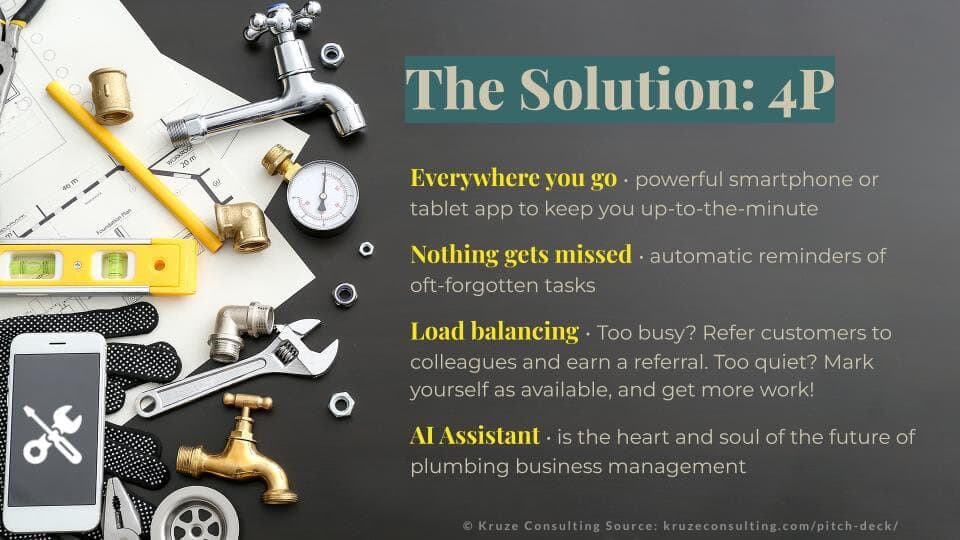
B2B Pitch Deck Solution Slide 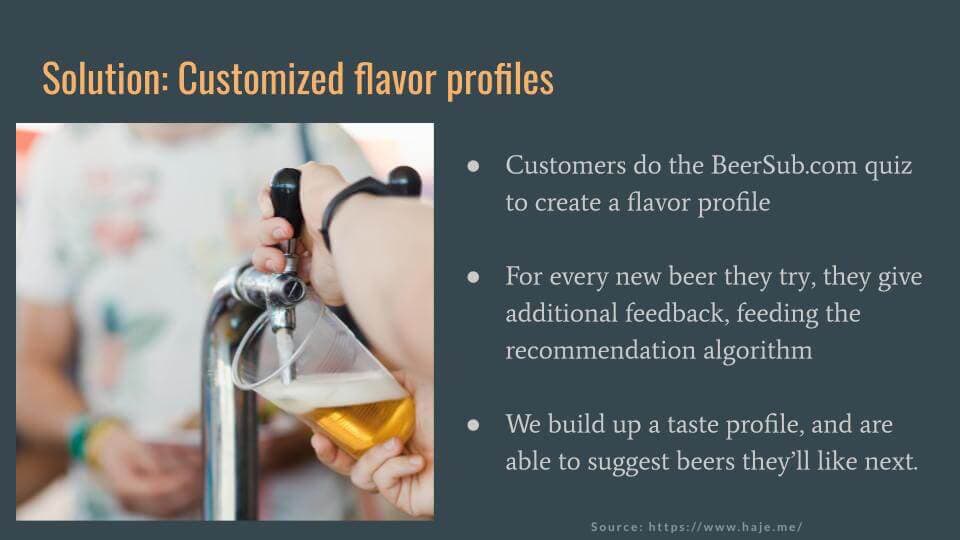
B2C Pitch Deck Solution Slide
6. Team
The founding team and its ability to attract the right talent is one of the most important pieces of the puzzle. Why are you the best people in the world to address this problem?
Healy Jones:
Hello, everyone. Welcome back to the Kruze Consulting Pitch Deck Course. Excited to be joined by Haje, yet again, as we walk through the slides that you use to raise early stage venture capital funding. Haje is joining us from… Where are you today?
Haje Jan Kamps:
I am in an animal sanctuary. So if you hear some weird animals behind me, there might be a rooster or something, that would be why.
Healy Jones:
All right, everybody add an extra slide to your appendix every time you hear a rooster.
Haje Jan Kamps:
It's a good game. It's a good game. I like it.
Healy Jones:
All right. So we're going to do the team slide today, which is generally a pretty important slide. I'm very excited to talk about this one. As we have mentioned before, we have an entire course outlining the important slides in a venture capital pitch deck. It's available for free, so please find it online, and you can also find it on YouTube as we share these videos. The course is available at kruzeconsulting.com/pitch-deck. That's K-R-U-Z-Econsulting.com/pitch-deck.
So we're going to talk about the team slide here today. We're not going to go over a background, because we assume you've already seen our background from going through this course. Why is this slide so important?
Haje Jan Kamps:
So I think, especially in the earlier stages of a company, there's only so many things that an investor uses as information to decide whether or not to invest. In later stages, you get away with anything. If you have traction and you're making tons of sales, nothing else essentially matters.
In the earlier stages, if you think about the information that an investor has available about you, the team you have, and especially the founder team, is basically it. If you are an inventor that invented a brand new technology, and you're starting a company in this field, your team kind of becomes part of your moat. It means that there is literally nobody else in the world who can do this. Or, similarly, if you were like a super senior person in a car company and you spin out and you do something else, well, your little Rolodex, your connections, your experience makes you uniquely positioned to build this one particular company. I think the way you tell the story of a company, especially on the founder team, varies a lot based on how good the founder market fit is for the particular company you're building.
Healy Jones:
Excellent. I think you highlighted a few important items there. One thing I will point out as someone who used to be a venture capitalist, who invested anywhere from the seed to the Series B and beyond, is that let's double down on the idea that this slide does change as your business matures. So at the very beginning, this is really important, because you're generally just a few people with an idea, and so the idea is important and the people are important. As you get bigger, you start to have metrics that the investors can use to judge you.
And just doubling down on what Haje is saying here, is your ability to attract talent really matters. So at the Series B and the Series C and beyond the investors are going to want to know what is that next layer of managers? Who are they? Have you been able to attract the best talent? So this slide is just going to change. It's going to change as your company grows so do not use the same slide for your Series C that you used for your seed. You're going to have to change it as you go.
Haje Jan Kamps:
And it changes a lot too, right? As the founder team, you are basically the people doing most of the work, until like the first couple of years of the company, the founding team, and maybe a couple of key employees, that's where you start. As you get further and further down the line, your individual skill doesn't really matter as much, even if you're a really good developer, hopefully, you hire better developers than you. That's the whole point. And so it shifts. In the beginning, the story is very much like, can this team get us to a point where we can raise more money and grow as a team? Later on, it's more a question of, is this team really good at hiring the best people in the industry?
I was working recently with a client who basically said, "Hey, we invented this new technology, in this super niche market. And I'm about to hire my entire old team with me, because they're the only people who can do this." And I was like, "Wait a minute. So if you are successful in that, then essentially there's nobody in the world who can copy your company, because the super niche skill to do this company doesn't exist anywhere else."
That becomes so powerful, because it massively increases the speed that you can build your company. But it also means that even if somebody has the same idea and a giant sack of cash, they can't build the same company. And I think there's something to that story, if you can tell that story.
Healy Jones:
I agree. In fact, I worked with a company very recently, that is in a regulated industry. And the founder had, for a similar business, already jumped through all the regulatory hurdles, and so knew which attorneys to hire in which geographies, knew which regulators would push back on particular things or not. And so that was one of the competitive advantages to this business. And one of the reasons why this investor was very successful at raising funding was, "Hey, I've already done this thing that you may not even realize is a barrier entry, but I've already knocked it down." So keep that in mind as you're building this slide, like, why are you uniquely positioned? Right?
Haje Jan Kamps:
Yep.
Healy Jones:
And so what is the slide for? As we've kind of talked about it here. It's like, can somebody else just walk in and do this? If someone else had the same amount of money as you have, can they just go and do this?
Haje Jan Kamps:
Absolutely.
Healy Jones:
Sometimes the team is not the barrier to entry, sometimes their network effects or there other aspects to the business that mean you get ahead of the curve and being the first to market matters. But we have time and time again, seeing industries where a lot of people have the same idea and a lot of companies raise money, and then they all kind of choke each other to death unfortunately.
One of my favorite examples is a company called Munchery, which delivered food, and was a great product. Unfortunately, this food delivery market didn't have a lot of barriers to entry. And so other smart folks raised a bunch of money and no one could get a sustainable business, there's too much noise going on. Everybody who wanted a meal order kit, thing type… Everybody was doing it, so it was pretty brutal. So the team didn't matter kind of as much there, but you want to show why you've got something special on the team.
Haje Jan Kamps:
Well, and what I think it boils down to is that your team as a founding team needs some sort of a superpower. If you were the best developer out there, great, that is your superpower. If you know every player in the market and that makes your sales go a 100 times faster, amazing, you can leverage that. If you know the industry, if you have patterns, whatever it is that this team brings to the table… This is where I always get a little bit skeptical, when you get a couple of people who kind of leave Facebook and start a company in a space that has nothing to do with what they were doing before, and where they haven't got any previous experience.
I recently spoke to a couple of founders who used to be in the AR lab at Apple. They spun out and started something in AR. And I'm like, "Yeah, no, that makes sense. You were at the-
Healy Jones:
It makes a lot of sense.
Haje Jan Kamps:
… sense cutting edge.
Healy Jones:
Yeah, exactly.
Haje Jan Kamps:
And now, as a team, you're free of the shackles of Apple. You get to do something else." If that same team went and started a food delivery service, I'd be like, "Okay, what are we doing here, guys? I agree that you're probably very smart, but you don't have the extra leverage that any other player in this market would have."
And I think this also affects where in the deck you put your team slide. If your team is uniquely positioned and the only people who can do it, front load it, this is an important part of your story. And so there's some companies that have really amazing teams, but that don't immediately strike you as like a slam dunk. And then in retrospect, they still did really well. Do you have an example of that?
Healy Jones:
Well, so a company that is doing very well right now, where the team didn't necessarily have direct experience in the industry, in terms of they hadn't worked at companies that were really doing this, is a company called Brex, which is a credit card solution for small businesses. And at this moment they're doing quite well. And they have raised a ton of money, I think it's over half a billion dollars or something like that. And a lot of Kruze Consulting clients currently use them.
And the founders were two young people who had done a few startups, their own small startups before with some success. However, they weren't slam dunk FinTech founders, but they way that they positioned it was they had experience in starting companies. And they'd also experienced this pain point firsthand. So that is a way that you can say, "Hey, listen, I've never done this type of company before, but I can tell you I've experienced this problem as a founder. So I know what the product needs to look like on the other end." So-
Haje Jan Kamps:
And I think the beautiful thing there is that essentially you're saying, "Hey, we are scratching our own itch. We are experts on the problem. Now, let's go and build the solution." And if then you can back that up with a story of, "Hey, we're very good founders at building solutions." Suddenly, the story comes together beautifully, even though you don't have that core little element.
Healy Jones:
Exactly. And there's a place where it becomes a little bit harder. It's easier to talk about this more on the enterprise business model side, on the consumer side, it can become a little more challenging. So you do need to be careful if you have worked at enterprises and you're starting a consumer company. Saying, "Hey, it's hard for me to cook dinner, therefore, I started a food delivery service." That isn't going to resonate as well as, "Hey, I worked for this large company and we always had a problem with our accounts payable. Therefore, I'm creating an accounts payable solution." That I think clicks a little bit better for investors. That's not to say all sorts of smart people can't try to start consumer businesses. It's just everybody's got an opinion, you know?
Haje Jan Kamps:
Yeah, totally.
Healy Jones:
So it's a little bit harder. Great, okay-
Haje Jan Kamps:
Well, and the place where you see that very well actually, and a lot is in healthcare. So I know one company that created a training tool for surgeons in VR. And they were surgeons, and they were like, "These training seminars are horrible and not good enough." And they were like, "We don't know anything about VR, but we think we can build a better solution here." Because they had such deep connections with the equipment manufacturers for the various types of like equipment, and they were like, "Oh, this is a real problem that's costing these equipment manufacturers so much money that we can sell this product at such a high value, because, otherwise, it has to be manual, in-person trainings." And of course this was before COVID, when COVID hit, they definitely just flew off the handle.
Healy Jones:
Yeah, exactly.
Haje Jan Kamps:
And I think having such deep levels of insights into a market that nobody else has or where there's not a lot of surgeons starting companies, because surgeries are really well paid job and people are not willing to leave the well paying surgery job. So you get these really weird dynamics, where it makes a lot of sense to start a startup, if you're brave enough to leave your high paying surgery job.
Healy Jones:
Sure. Exactly. That's kind of one of the paradoxes here of starting a startup. The other thing to think through is that let's say you're starting a telemedicine company and you are not a physician or a pharmacist or whatever, having someone who is that, with those credentials, who's joined your team as a co-founder or as an early employee, can help bolster your credibility. A slightly less good way to try to build up the slide is to bring on folks who are advisors.
However, I think VCs tend to look through that a little bit more these days, because a lot of folks will have slides that show a bunch of advisors. And then when they talk to those advisors, they're really not doing anything for the company other than maybe getting some shares. There's starting to be some skepticism around "what an advisor really is driving." So if you're going to show advisors, it probably makes sense to have them actually having an advisory agreement and providing some sort of services to you on a regular basis.
Haje Jan Kamps:
Yeah, absolutely.
Healy Jones:
Perfect. All right. Should we get into the meat of this here? Should we-
Haje Jan Kamps:
Let's do it-
Healy Jones:
… show some slides? We have two pitch deck examples that are Google slides that are free for you to download. Again, they're at the kruzeconsulting.com/pitch-deck. I'll show them right now, and we can talk through these two team slides.
Haje Jan Kamps:
Love it.
Healy Jones:
All right. Again, just to remind everybody, the example companies we've come up with are intended to be slightly facetious. We're not trying to actually sell you these companies. We're trying to show you how to build a pitch deck. So let's not get into the details too much on what these businesses are, or dig too much into that. But this first one that I'm showing is a startup focused on the beer delivery space. And, Haje, you want to talk about what you've got on this team slide? And why it matters?
Haje Jan Kamps:
So in this particular slide, I actually put the things on the slide in a slightly weird order. Normally, you would expect to see the CEO first, right? But what I was thinking here is like, look, there is something very specific about this, where you need to have a super deep industry expert. And in this case, our CEO is Espen, and he has built three startups and has sold one to Google. And so you can tell the story there about how he knows how to raise money, how he knows to run that kind of company operations and that sort of stuff, and that is super important.
But in this particular startup, what is more important is what the COO is doing. In this particular example, I made up a person who has been at a brewery for 15 years as the head brewer. Now, that is a very specific skill set with lots of deep knowledge about beer, about how to brew beer, and all that kind of stuff. And brewery operations are very operations heavy. And so you're kind of talking about, he doesn't have startup operations experience, but there's transferable skills in here. So you can kind of fudge it a little bit.
And then you have this husband and wife team, who are a CTO and a VP of Marketing, you'll typically not put them in the same picture, but I like that stock image, so that's what I used. But they're part of the original Netflix AI team. Now, the Netflix recommendation engine is incredibly well known. And so in these three people, you can start telling a really good story of how you have the startup building skills, the deep beer making and beer tech skills, I guess, and then the recommendation engine.
And so that's how you tell the story. You put together the elements of how this works. You call out whatever relevant companies there are. Now, if one of these had worked in an enterprise SaaS company and done something completely irrelevant, don't put it on the slide. It is part of their story, but it doesn't serve the story you're telling for this particular company.
Healy Jones:
And so put yourself in the shoes of the venture capitalist, they are trying to decide, do I want to give you money? Do I trust you to bring this idea to fruition? And, also, I'm going to be on your board, I'm probably going to be talking to you once or twice a month for the next five to 10 years. Do I want to do that? Are you someone who I want to be around that much? And one of the things that I think that this slide is showing is that, to the extent you are a consumer VC, who's interested in the beverage industry, these seem like people who would actually be pretty interesting to be around. So that's a really strong, positive thing. I can see-
Haje Jan Kamps:
I mean, look at that beard.
Healy Jones:
The beard is pretty impressive. Yes, they do look like they would be very fun to have at your cocktail party. I would definitely recommend you invite them over for New Year's Eve, but that's not necessarily what you're trying to prove. But, again, the VC wants to know, do I want to spend time with these people? And can they bring this idea to life?
Haje Jan Kamps:
And I guess the other piece worth noting is are they coachable? There are so many people, as a VC, that you work with that are… You have to be a little special kind of crazy to run a startup that is objectively true, but you also have to be a tiny little slice of humbleness. And there's this strange balance, because founders are the kind of people who see a future that doesn't exist and believe in it, but they also need to be able to take a little bit of feedback. And I think that balance is kind of important to try and get across as part of your whole presentation. The team slide may not be the right place to do that, but it's worth keeping in the back of your mind.
Healy Jones:
So one thing that's very interesting about being a startup founder is when a company's very small you're a doer, you have to get stuff done. There reaches a point where the team is growing, where you have a lot of people that are doing a lot of things for you, you're still doing, but you have to focus a little more towards strategy and also hiring and culture. And some of the founders that I work with, some of the best ones at the Series A, Series B, basically, say that their job is chief recruiter. That's mostly what they're doing, because the product is baked into the strategy, at least in the super near term, and everyone understands what they're trying to do. And so they're just trying to add people to the business.
And then eventually at the later stage, strategy is very important. There is a lot of politics, making sure everybody's on the same page, and it's working well together. And the team dynamics are strong. Culture is strong. And so your role evolves over time. So are you the-
Haje Jan Kamps:
Absolutely.
Healy Jones:
… person that can sit, and let's say, you're a developer, do the coding. And then later do the hiring. Are you personable enough? Do you have that sort of sales mentality? Are you going to be selling? Are you able to get in front of potential customers and push your product? And then are you going to grow up to be the person that has a big team and you can manage a big team? And it's pretty amazing, how much the role changes, the founder and CEO change as the company grows. So-
Haje Jan Kamps:
And the most extreme version of this is Zuckerberg. He started off as a one person dude making a Facebook for universities, and now he's in front of Congress defending his company. Those jobs couldn't be more different and he must have been coachable and taken a lot of advice and a lot of coaching all the way through. If he wasn't coachable, his board would've booted him off a long time ago.
Healy Jones:
That's right.
Haje Jan Kamps:
And I think that's a really interesting thing to keep in mind. Because if you are the perfect founder for the stage you are at now, and unwilling to change, you're not going to be the perfect founder when you get closer to IPO.
Healy Jones:
No, very good point. All right, let's switch over to the enterprise pitch deck example that we have. This is a software product, SaaS product for starting out for plumbers. And so, Haje, you want to talk about a little bit what we've got on this slide here?
Haje Jan Kamps:
Yeah. So with this one, I'm kind of making the same point as I'm making in the other slide deck, which is the CTO here has had incredible deep experience in the industry, eight years as an emergency plumber, the kind of person who shows up at 3:00 AM when there's poop all over your floor, without mincing words. But the part of the story here is that he had an accident. It's not specified what that accident was, but he had to retrain. So he has deep experience in plumbing, had to retrain, because he couldn't do physical labor anymore, and retrained as a software developer. Since then, he's been a founder two times.
Now, this slide should ideally at least say something about whether those were exits or what happened to those companies. If it just says, "2x founder," my alarm bell goes off immediately. It was like, well, you did it twice, but are you any good? So as a founder, you have to be prepared to defend that part of the slide. And then there's his co-founder Elise, who has an MBA, and clearly has deep business acumen, again. Four years of operations in the large plumbing firm. Again, has deep expertise for what the needs are of these customers. And then built her own house and did all the plumbing herself. Is that relevant? Probably not, but it makes for an interesting story.
Now, the thing that isn't on either of these slides is how big the rest of the team is. These slides are both extremely focused on the founding team. And most of the time that is fine, because they're the ones who are having the conversations with the VCs. But what you have to keep in mind is that this is going to evolve as the team grows and the founders, as we just talked about, take less and less of the hands-on experience, and more and more of the leadership positions.
Healy Jones:
That's right.
Haje Jan Kamps:
So what I would typically do is either, if you have a large enough team, I would add a second slide with like the VP level positions, and how many people are under each thing, or just put like a plus 19 on the bottom, just to get an idea of the team size in general. Because there's a very big difference in funding a 200 person company versus a nine person company. And I think headcount is a really good proxy for the type of conversations you're about to have with your investor.
Healy Jones:
And again, the venture capitalists realized that running a 10 person company as a CEO is very different from running a 200 person company. So if your company is getting larger in terms of headcount, having the org chart in the appendix is a way of proving to them that, "Hey, I understand how to build a scalable organization. This is my current vision for that." Now, to the extent the VC wants to challenge you on that. That's not a bad sign. That actually might be okay. They might say, "Hey, why is product and R&D in the same org? Why are they not separate?" And that gives you a change to, now-
Haje Jan Kamps:
Or why are you hiring 35 marketing people, when, in your type of company or marketing agency would make a lot more sense? Those are big strategic conversations that are great to have with your board. And so doing that is fantastic. What I really like to do in the appendix is to have two org charts. One is a snapshot of where you are now. And one is a snapshot of where you're hoping to be at the end of the runway for the current fundraise. So you basically have a hiring plan as two org charts, and it's such a good tool for having really powerful compensations. And it shows, as a founder, how good you are at planning into the future.
Now is your final org chart going to be correct? Absolutely not, because things change, but it's the thought process and your ability to plan ahead that is really being judged here.
Healy Jones:
Right. And what you're showing with that is a few things. Hopefully, one, you're showing that you're coachable. So if they challenge you on anything the response ought to be, "I'm excited to have this conversation with you. Here was the thought process that got me here, but I want to hear your thought process, help me understand what other things I should be thinking about, and put it into mind." So, one, be coachable.
And then, two, you're showing what the business needs to grow. If you're an enterprise company and you need sales people, you better show a lot of sales people coming on board, right?
Haje Jan Kamps:
Yep.
Healy Jones:
If you have a lot of hardcore product to build, you better show a lot of product people coming on. If you need a lot of customer service, you ought to show a lot of them coming on here. You're showing the investors how the organization needs to scale to support the growth.
Haje Jan Kamps:
Yeah. And the important thing about a team there is that, especially in the early stages, you'll hire for whatever is core to your company. So if you are a heavy software development driven company, don't use external software development agencies. But you could, for example, if you are heavy in software development, but the growth marketing doesn't really matter that much, you could get away with having a very lean marketing team, and then outsource the rest to an agency that does that for you.
Or similarly, if you are mostly a consumer brand, where the software doesn't really matter that much, you really are a brand and a marketing org, then you better have a lot of marketing people in-house, because that's where the weight of the company is. And so by showing the org chart, you're actually showing your hand as to where you think you need in-house people and core people and what you can outsource to agencies or freelancers, or what have you.
Healy Jones:
Great. Perfect. Well, so let's talk about some of the typical issues that we see on this slide. And we've highlighted some of these, but we'd like to try to kind of consolidate all of it.
I'm just going to throw the first one out here, which is just names with a bunch of logos underneath them.
Haje Jan Kamps:
I feel like=.
Healy Jones:
A lot of VCs don't like that very much. And particularly if it's not… If you're doing an enterprise company that's selling into the sales organization and that the logos are Salesforce and HubSpot and Marketo or something like that, okay, that kind of makes sense. But if it's Apple and some small company, no one's ever heard of, that doesn't really tell anything. It's just a pretty slide.
Haje Jan Kamps:
On one of my very first startup founder slide, I put the Nokia logo, and people got super excited and it's not a lie. I built the entire press website and press outlet for Nokia. But then when they dug a little bit deeper, like, "Oh, what did you do for Nokia? Did you build electronics?" I was like, "No, I built their press site." And they were like, "What the hell is this Nokia logo doing on the slide?"
So think about what the story is. I thought Nokia looked impressive, I mean, I have to admit this was many years ago. Nokia did look impressive, and at the time Nokia was an important company. But the thing I did for them had just no relevance whatsoever for the company. And I kind of shot myself in the foot. Everybody got excited about Nokia, and I talked about it and they were like, "Well, great."
So think about that too. I don't know, if you were a cleaner at Google, that's great, you made some money, but that doesn't mean you get to put a Google logo on your slide deck, because it just isn't relevant. And even the ones that are relevant, I feel like logos, they start the conversation, but they don't really highlight whether or not you're a highly skilled person or whether you are the best in your field.
Healy Jones:
Right. So what I like about what you've done in the example here, for example, is there's a story on here, a story about how this person was a plumber, which is extremely relevant. And then became a software developer. That's pretty tight. And then the CEO is showing a lot of operational chops and founding chops. And then again, on the beer slide, which I've just flipped over to, we're showing the brewery experience. It's very solid. Great.
I think I'll stop sharing now. Maybe I should have done-
Haje Jan Kamps:
Sounds good.
Healy Jones:
… this here, but, anyway, stop sharing. The other thing is not changing as the company grows. So your seed deck team slide should not be the same as for the Series A. It's pretty improbable that there haven't been some additions to your team, and it's probably different how you want to talk about it.
Haje Jan Kamps:
And I actually talk to all of my clients about this, and they, typically, when they come to me for a Series A, they've taken their seed deck, duplicated it, and changed all the data. And I'm like, "No, you have a completely different story now. If you don't have a different story, you failed as a company. You didn't learn enough." And I feel like it's actually much easier to just take a breath, throw away your old deck, and start over. If you love the template, maybe use that. But everything, everything about your company, if you haven't learned an incredible amount, both about the market, about where you're building and all that kind of stuff, everything is new. Everything is different. And in the startup world 18 months is an eternity.
Healy Jones:
But, again, like as, as your company is growing and hopefully succeeding, there are different elements that are changing. And one of the elements that should be changing and getting more professional and better and bigger is your team. So this slide ought to evolve, even if you don't throw away your pitch deck, this slide ought to evolve.
Haje Jan Kamps:
100%.
Healy Jones:
So one of the other issues that I have noticed is that there are, I don't know, one in 10 VCs have very strong opinions that are often a little quirky about the team slide. And so I highly recommend you search their website, or you do a Google search for that investor's name or that fund's name, and team and slide and pitch deck, just to see if they have said something really peculiar, so that you can adjust this slide before you go in to meet with them. So-
Haje Jan Kamps:
Really good point.
Healy Jones:
… just a caveat there. And, again, you never know which VC it's going to be, but there are a few who've just had really strong opinions about this slide, so just be prepared. One of the places that I've seen issues is with academics, who are say PhD or PhD candidates in a very specific field, wanting to found a company and many academics have been extremely successful. I could think of the founders of Google who were academics. They might have done a pretty good job there. But just being humble and understanding that being an expert in a particular, very complicated field is not the same as being the business person running an entity, I think is pretty important. I don't know, have you seen that before?
Haje Jan Kamps:
Yeah. Lots of times. And I think what happens a lot is especially in highly technical fields, like a lot of people spinning companies out of MIT or similar to that. MIT is actually kind of a bad example, because they have pretty good entrepreneurship program-
Healy Jones:
They're pretty good at that, they know what they're-
Haje Jan Kamps:
… with that. But they've identified it, right? It's like, "Hey, there are-
Healy Jones:
Right.
Haje Jan Kamps:
… opportunities here, but academia alone, doesn't get you there." And I think that is worth thinking about it as the… The team slide tells a story of how you have the complete package for everything that's needed to build a company. And if something important is missing from that package, you need to go find that or tell a story around it. It doesn't help if you have like two of the world's best engineers and like a PhD who invented something. If you have zero marketing and zero running company experience, that's not investible. Because as an investor, I would look at that and go, "Wait a minute. Great, you've got a prototype, but I don't believe that you're going to take this one prototype into 10,000 products that are out there." And so it becomes that believability piece. It's like, "Am I going to put my money behind this? And is there an opportunity for a 20 or a 100X return, or whatever the fund metric is."
Healy Jones:
Great. I agree. And so, again, I say approaching being proud and very clear about what you've accomplished and your qualifications. But being humble about the stuff you don't know or that the VC is asking or making noises like you may not know. And that applies to not just academics that applies to any founder.
Haje Jan Kamps:
Well, and we also see that from the other side, like people who spin out of very large companies. I used the example of a car company earlier. I saw a founding team once that had an extremely senior engineer from a car company. And I said to him, "Hey, when was the last time you touched a CAD package?" He goes, "Oh, ah…" I was like, "Right. Well, you have lots of experience in building cars, but you haven't done any of the actual work for 20 years." And so we were like, "Who is going to do the CAD build? Who is going to do that part of the work?" And he had a very good answer, which was, "Oh, actually I have an agency that does part of that for me. And we're about to hire a junior who has much more fresh experience." "Great."
But you have to think about that. And when the company grows and starts manufacturing, that person's skill set becomes more and more relevant and suddenly they are indispensable. ,But in the early days, it's kind of like, you have to match the current recent experience with where the company is now. It doesn't have to be part of the team slide, but you have to understand that is what the investor is looking for. It doesn't matter that you have all the senior people in the world, CEOs-
Healy Jones:
That's a great question.
Haje Jan Kamps:
… at a Fortune 500 company are terrible at doing startups, because they haven't done any of that work recently.
Healy Jones:
That's an excellent point. In fact, I can recall coming out of a large-ish company, it wasn't even that big. It was several thousand people in public, and the questions for me were, "Hey, can you still do things," right?
Haje Jan Kamps:
Right.
Healy Jones:
You have a big team, you have a big budget. The organization has an accounting team that helps out. The organization has all sorts of HR teams, recruiting teams. You are going to have to do all this stuff. Are you still a doer? And there are some companies, big companies, software companies in Silicon valley that are famous for having executives who spin out and try to join or start startups, and fall in their face because they don't have all the scaffolding that helps them be really good.
So, yes, do be careful, just because you've been at a huge company and had a big division with a big budget there's all sorts of minutia that you have to deal with and get stuff done. You have to roll up your sleeves. So make sure it's clear that you are able to do that, and you're excited to do it, because there's a lot of tedium that you start to avoid as you become a senior executive at a large company.
Haje Jan Kamps:
Well, and the big warning flag that often comes up for investors is people who call themselves 10X engineers. But without a DevOps team, ie, the people who can take the code and make it run on servers and be ready for production, they're, I'm not going to say nothing, but they're just very inexperienced. And that part of technology has moved on very, very quickly. And if you don't have that skill set within your company, you're not going to be successful. It doesn't matter that you have all this other experience.
So, look, the investors are not trying to trip you up. They're not trying to screw you over. What they're trying to do is to make sure that they're making sensible investments, that show that they show fiduciary responsibility to their investors. And realistically, they just have to be able to say that, "Hey, I have every faith that this team is going to be able to do what they say they're going to do." If you're able to say that with your team slide, great. That's a very short conversation. But sadly often it isn't, because people overlook that.
Healy Jones:
It's going to be very rare that a founding team has the exact perfect experience, right? I have started-
Haje Jan Kamps:
Yep.
Healy Jones:
… a company in the same industry and I grew it and sold it for a billion dollars, and now I'm doing it again. That doesn't happen very often.
Haje Jan Kamps:
And even then that is a seven year journey. So what was true seven years ago, isn't necessarily true today, so even that story isn't necessarily the perfect founder. And that is so hard to help founders understand. I have worked with that exact type of founder before, where they're like, "Oh, yeah, I built a logistics startup. I'm building another logistics startup." I was like, "Whoa, whoa, whoa, pump the brakes. 10 years ago, logistics was very different than it is today." And it's all storytelling. You have to just kind of be able to defend why you are still the right person to do this company.
Healy Jones:
Right? Yeah. You're telling a story about why your team is the right team. Perfect. Great. Well, I hope that this was helpful. I think we had to summarize this up. You want to summarize it up for us?
Haje Jan Kamps:
I will absolutely do that. I just have to pull up the notes.
Healy Jones:
Okay.
Haje Jan Kamps:
Okay. Yeah.
Healy Jones:
Well, I'll ask that question, all right?
Haje Jan Kamps:
Yep.
Healy Jones:
So Haje, you want to summarize the team slide here?
Haje Jan Kamps:
Sure thing. I think the most important thing to keep in mind is that ideas are dirt cheap. Like the two of us can come up with 1,000 ideas right now, but execution is everything. And the team slide really is a story about why your team is the right team to make this company happen.
Healy Jones:
Exactly.
Haje Jan Kamps:
I think it's about like, what makes you unique? The team should be part of the moat of the company. Because, otherwise, you're out there talking to investors, you're talking to everybody, if somebody thinks it is a great idea and they can out execute you by just raising a bit of money, that's sad, because it just means that you don't have what it takes to build this particular company. And I think we talked a little bit about where to put the team slide. It's actually a conversation I have with a lot of my clients. And in essence, the better your team, the further towards the front of the deck it goes. And if it's so-so, whatever, you still need a team that can execute. But if the investor is excited enough about the rest of the company, that they're kind of willing to go, "Okay, fine. We'll help you bolster your team," you can still successfully raise money, just make it a lesser part of your story.
Healy Jones:
Right. And you can compensate for not being a perfect overlap with what you're trying to do or your last startup having failed. For the passion that you bring, the knowledge that you bring, the number of customers you've talked to, traction, things like that. So-
Haje Jan Kamps:
One of the most powerful examples of that is a client I worked with recently. I said, "You don't have any startup experience. Why are you the right person to do that?" And he looked at me and he was angry. He was like, "My daughter died because this didn't exist. This will be my only startup. I will fight the rest of my life to fix this." Chills ran down my back. And I believed him. And I was like, "You know what? That's your story. Get angry, get defensive, and say, 'Look, this is what I'm going to spend the rest of my life doing.'" Because if your investor believes you are a really solid bet, because you know you're not going to give up. And of course, if that isn't true for you, then don't say that. But I'm just illustrating that founders come in all sorts of stripes, and they do things for all sorts of reasons. If you are motivated to build this company, this company is like the core to your life, make that part of the story.
Healy Jones:
That's great. Awesome. Well, thank you so much. So this wraps up our team slide, and please find the rest of the course at kruzeconsulting.com/pitch-deck.
Haje Jan Kamps:
Thank you all for listening.
Team slide: Why are you a winning team - and able to build an even better one?
In the earliest days of a company, the team slide is your holy grail of what you are doing. If the founders are uniquely positioned to start this company, you have what is called 'founder-market fit'. It doesn't guarantee that you'll be successful, but it does mean that you have an unfair advantage in your market.
As your company matures, the team slide becomes more about your ability to attract and retain talent. Either way, the human capital of your startup is one of the linchpins of your organization. How you tell the story of your team and its evolution is the topic of this episode!
Slides for the Team section
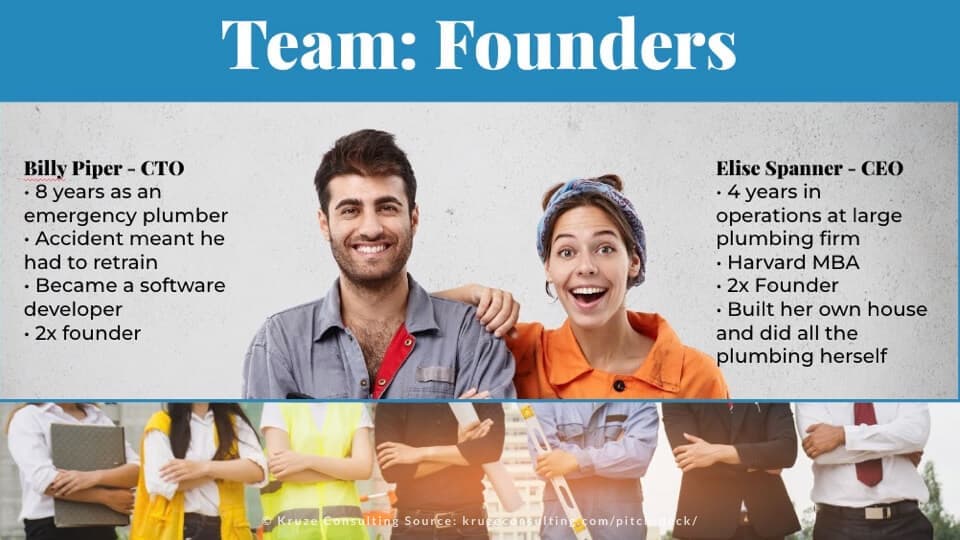
B2B Pitch Deck Team Slide 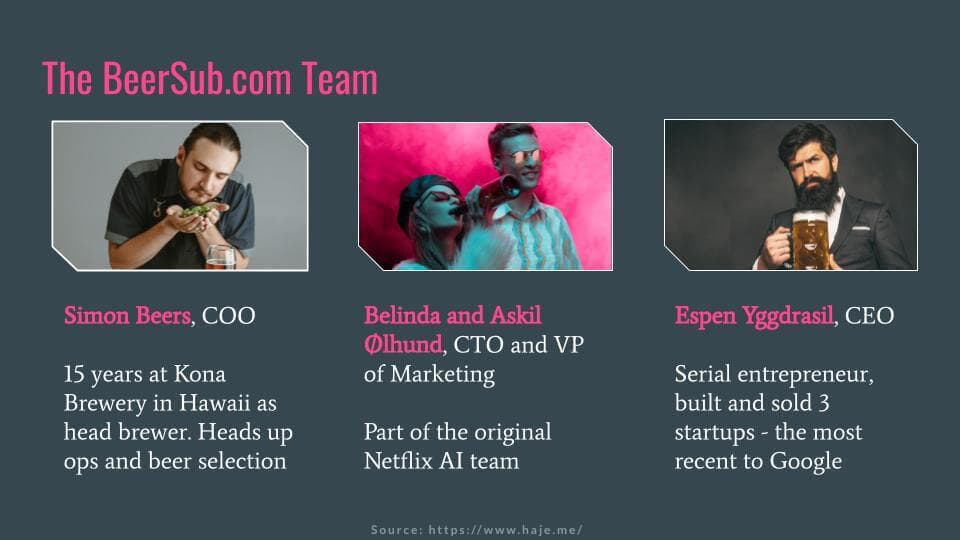
B2C Pitch Deck Team Slide
7. Traction
A business exists to make money, and to hit key milestones on its path to profitability. The traction slide shows how the history of how your company got to where it is today
Healy Jones:
Hello, everyone. Welcome to the continuation of the Kruze Consulting Venture Capital Pitch Deck Course. This is our free online course available on YouTube and our website at kruzeconsulting.com/pitch/deck kruzeconsulting.com/pitch-deck. We're going to be talking about the traction slide here. As always, I am with my wonderful co-pilot and partner Haje, who is a well known pitch deck consultant and tech crunch journalist, and also, he's founded multiple startups. He's raised venture funding. He's been a venture capitalist. So I've been a VC. I advise a lot of companies raising money. I've worked for startups. So we're not going to go through the details of who we are. We've done that in previous parts of this course. You can loop back to any of those to see who we are and why we're here, but let's dive in. Let's talk about traction.
Haje Jan Kamps:
Love it.
Healy Jones:
So let's just slide forward.
Haje Jan Kamps:
Good hands. So, yeah, I think the traction slide is actually super interesting. I talk to all of the people I work with, all my clients, about the traction slide. And kind of the rule of thumb is if your traction is amazing, front load it. In this kind of universe, if you have traction, you need nothing else. Because every other weakness in your company, if your team is kind of so so, if everything, if your product is so so, doesn't matter. If you have incredible revenue metrics and incredible traction, clearly, it doesn't matter that these things don't work. The reverse is also true. If you have the best team in the world and you have the best product in the world, but you can't get traction, it's a hard argument to invest in you, because clearly, something isn't working. The right kind of traction is a beautiful proof for whether or not you have found your product market fit. And so, that's where this slide is so important.
Healy Jones:
That's right. And so, this slide makes up for a lot of problems. And in fact, with this slide, you can probably fundraise, to the extent your traction is legitimate and amazing and growing. So I was talking about the up and to the right chart. The VCs like to see the up and to the right chart, because then, in their mind, they can extrapolate that up, even further. Every company is going to have different, or not every company, but different industries have different KPIs that will go into this. We're going to get into that. But one of the things that I want to make sure we emphasize here is that there are going to be companies that are fundraising that don't yet have traction.
It's not unusual for a pre-seed in angel rounds, maybe some seed companies, to not really have a lot of traction. So if that is the case, you may not even have a traction slide. And in particular, I advise just not having this, and instead you're putting the product slide, so you can talk about what you're building and what the market needs are there and how you're going to solve it. So you're helping the VC imagine what the solution will be. So again, if you don't have traction or your traction is weak, you don't want to hide it, but you don't want to pull the slide up to the front and spend a lot of time cheering about it.
Haje Jan Kamps:
Yeah. I think traction is important for growth rounds. If you're doing a serious A, B, C, beyond, like you say, essentially what you're saying is like, "Hey, we figured out our product market fits. We know how we're going to sell this thing. Look, this is the proof." Some early stage companies have that. But some don't. The interesting piece is there are some companies that don't necessarily have a measurable or a traction that can be measured in dollars or in users or something like that, but they may still have real progress. So I think what you're really talking about here is whether you really fully understand your industry and what the important milestones are within that industry. And if you have traction, if you have revenue traction, then do you understand your business model? And I think it is such a useful slide, to be able to poke into the various aspects of what you're building and to really kind of get to the meat of things, I think.
Healy Jones:
That's right. And so, let's talk about how the slide might be different, depending on the industry that you're in. So this is your moment to prove to the venture capitalists that you understand your industry, you understand the KPIs that are important to your industry, and you're basically making it clear that you're going to talk the same language as that venture capitalist is. The VC thinks about how a… Theoretically, you're pitching to somebody who knows something about your industry, or at least about your business model. There are particular words that they use as they talk about how companies are growing and how companies are hot or exciting, et cetera, et cetera.
Haje Jan Kamps:
Yeah.
Healy Jones:
You want to kind of tap into that and make sure everybody's on the same wavelength. And to the extent that you have a KPI that's a little different, you're going to want to highlight it here, so that you're not talking past each other. So your purpose here is obviously showing traction, proving to the VC, you understand what's important in the industry and you're avoiding vanity metrics, which we'll talk about in a little bit. So let's talk a little bit about how this varies by stage of the company. So, Haje, what about a seed stage or pre-seed even?
Haje Jan Kamps:
Yeah, I think in the pre and seed stage, as you mentioned, if you have no traction, don't show traction. I feel like traction is kind of the most operational slide in this deck. And I think when you're thinking about your board meetings, further down the line, the KPIs you report to your board are probably the KPIs you're going to want in this. So in the super early stages, if you're building a, you mentioned a suggestion before this call, we're going to steal it from you.
If you're building a med tech company and you need approval for regulatory reasons, for example, the progress through that path may actually be a reportable metric. If you are a company that really has a huge breakthrough that needs extensive FDA approval, then you're going to be in that loop for a while. And you're not going to make any revenue. And that doesn't mean that your company isn't showing incredible traction and being successful. So I think those are the kind of things, the type of stuff you would report to show real measurable success is the kind of stuff that shows up on this slide, even if that doesn't mean dollar signs.
Healy Jones:
And so, I used to work for a venture firm that had a big biotech arm. I was not a biotech investor, but I was always fascinated when I got to sit in some of the pitches just to try to see. And even at the very early stage there, so as the company is developing a drug, it starts to talk about how they're approaching regulatory approvals, which are very clear gates or milestones, in terms of traction for a biotech company. But at the very early stage, the traction was not around that at all. It was around what the molecules are and the thesis behind how those molecules might drive the clinical outcome that's desired and discussion around where the research was along the path. So that's kind of an extreme example of a company that doesn't necessarily have the sort of traction that we would think of, in terms of revenue growth, or user growth, et cetera, et cetera.
But each industry is going to have their particular flavors. For a software to service company, which I spend a lot of time with, or marketplace company, a traction is potentially going to have some numbers at the seed stage, but it's also possible they're very dinky. And if they're super tiny and it's too early to tell, and it just doesn't sell the company at all, you don't want to hide anything, but you could just mention it somewhere else in the deck, but not toward the front, not kind of really upfront. And we are sharing outlines of what we think the ideal pitch deck structure will be. So you'll want to look for our outline or intro podcast or YouTube videos around that to try to see kind of how we recommend you outline your pitch deck, but just at the seed stage, there may not be a ton going on here.
Haje Jan Kamps:
And you can get a little bit creative. So we'll talk about vanity metrics in just a moment, but I've worked with one company that does self-driving car technology and they were going through a regulatory process and then, an OEM process. Now the regulatory process is probably going to be years. And OEM, so getting the technology into production cars is anything from five to 10 years. And it is a huge amount of journey towards that. So this particular company had two metrics that I kept reporting. One was, how fast can we get this self-driving car around a particular track? And so, their goal was to shave off a couple of minutes every time. And basically, that was a proxy for them to show that their technology was improving. It's a pretty fair proxy, right? It stands to reason that if the car goes faster around a track, safely, that is improving.
The other thing they kept showing was like, okay, how far along are we in these discussions and conversations with our OEM partners? And so, is there a letter of intent? Is there a proof of concept? Is there a MVP type thing being tested somewhere? And they'd kind of mapped out the process from, at which point does this get shipped with, say, BMW? And what are the steps to get there? And so, those two things combined were actually really helpful as proxy metrics, because if you start falling behind your plan on those, then that has a real impact on the business.
Healy Jones:
Great. To the extent, you're an industry that has users or paying customers, those are the types of metrics you want to talk about at the seed stage. Again, there may not be much there, so you may not want to pull this slide forward. But I do pretty regularly see seed stage companies that do have legit traction and it makes sense to show them. And so, the other thing to think through here, and we're going to talk about this a little more in a second, but the VCs also want to feel confident that you know what numbers you need to have to raise your next round. When they put the money in, they want you to get somewhere. And that somewhere is to the next round. So you want to be able to extrapolate up to what that next round is.
And you want to kind of prove that you know what metrics you need for your next round, which leads me to an increasingly popular fundraising round that I'm seeing, which is the seed extension round. So this is after a seed round, and before a series A, I'm seeing a lot of founders start to do this now. And most of the ones that are doing this are ones that have some of the traction figured out, but not all. And in particular, a place where I see companies raise a seed extension is they have often figured out the customer acquisition side, but they have a churn issue for a softwares or service product.
And so, they're coming in and they show the positives and you've got these exciting up and to the right type diagrams or charts, but they also do mention, "Hey, this here is why we're raising a seed extension at A. This is the problem we have to figure out." And there may be a whole slide that talks about how they're going to figure it out. But the goal of that part or that pitch is to show, "Hey, I am sequentially knocking down the pins that I need to knock down to get to the next stage. And so, I've knocked down these few and you should feel very good about me. Because I figured that out. Here's the next ones. I know what they are. And I'm making progress toward them. And I've got a plan."
Haje Jan Kamps:
And I love that you use that as an example, because I'm working with a startup right now that has the exact opposite problem. They have incredible lifetime value, but they can't figure out their customer acquisition cost. And so, what they're doing is they're saying, "Okay, what we're going to do is we're going to raise 3 million dollars to extend that seed extension piece." And it's like, "Okay, we know that once we have our customers, they generally don't churn. We make a lot of money. Now we just need to crack the nut of finding new customers." And both of those sides, it's kind of two sides of the same coin, two sides of the [inaudible 00:11:48] LTV arbitration piece. But if you manage to get to that, if you solve one half of the metric, you don't have a repeatable business model. So you're not ready for a growth round, but you've definitely found something.
There's one important piece of the puzzle that's clicked into place. And if you manage to crack the customer acquisition cost nuts, and then, you'd better have some slides in that deck about how you're going to do about that, what your theories are. And it could be like, "Oh, are we going to do PR? Are we going to do a payback? Are we going to hire a sales team?" Whatever the solution is, you need to have some things and then say, "Give me 3 million dollars and I'll go and crack this nut." And if you have a compelling argument there, then that's actually a really good pitch.
Healy Jones:
Venture capitalists are used to taking risks. Are used to taking risks. What they don't like is they don't like it when a founder doesn't understand that there's risk. And then, when a founder doesn't have a credible plan to fix that problem or to not take care of that risk, to address the risk. So trust me, if you're hiding something, the smart investors are going to figure it out, although maybe not at the seed round. There's a lot of pretty unsophisticated money from the seed round. But the A, which is the next one we're going to talk about, the series A.
Haje Jan Kamps:
Yeah.
Healy Jones:
And for particular industries, particularly software as a service and a lot of the crypto companies I'm seeing, a lot of the hardware companies, you're going to have to start to have some traction here. And the traction metrics that you want to show have to be up and to the right. You've got to be able to defend the important KPIs that matter for your business. So software as a service, it's going to be user growth, customer acquisition cost, LTV, which is also part of your churn rate, your LTV to CAC, your revenue payback. Those are the metrics that are going to matter there. And again, it's going to vary by industry, but I'm just drawing one out…
Haje Jan Kamps:
And bear in mind that all of this is benchmarkable. If you're doing a hardware company, you have certain benchmarks in place. And companies like Kruze are really good for being able to help you there, because you guys work with 30, 40 companies in each of these verticals. Which means that if I'm running a SaaS company and I say, "Hey, how am I doing?" You could actually go, "Well, Haje, you need to do a little bit of extra work" or "you're best in class, so make sure you put that on your slide deck."
And I think it's actually really helpful to work with companies like Kruze or other kinds of advisors who can help you benchmark. If you have, especially as a first time founder, you may look at your numbers and you don't know how good or bad it is you have it, this is a good place to shout about it. Because you can bet that your VC will know. If you put a set of numbers in front of them, they will go, "Holy crap, this is amazing." Or "Ehh, go and fix this, because otherwise we can't invest." Getting that benchmarking in place and knowing whether or not you have good or bad numbers is crucial in order to be able to tell the story properly.
Healy Jones:
Amazing. So that leads into the next point about why the slide is important. So from my perspective, when I was an investor, we always wanted to make sure the company was building a bridge to somewhere is what we would say. So basically we're putting money into the business and when the money's running out, the company needs to be awesome enough to raise a successful next round, which means the founder needs to know what KPIs or traction they need to raise the next round and they have to be marching toward it. And so, the purpose of this slide, it's very important for you to know what you need to look like at the next round. You may not put it on this slide, but if an investor starts to ask you about, "I see what you have now, what will you look like in 12 months?"
Or "what will you look like when you have to hit your next fund raise?" This is where you prove to them that you've got your head screwed on straight, you know your industry, you know your KPIs, and you know what you need to look like. Now, how do you figure out what those metrics are? So one, thank you, Haje, is working with someone like Kruze Consulting. We have a ton of clients who are raising money all the time. So we have some ideas here. Two, ask VCs. Don't necessarily ask the VC you're about to pitch. Ask your friendly VCs, your existing investors. And then, the third thing that I think is really powerful that the best founders do, the best founders do this so well, is they find other founders in a similar industry or similar vertical, who they periodically meet with and ask for advice.
So they find somebody who's just a little further down the road than them, or maybe a couple stages or a few years ahead, in terms of growth. And they just ask them all sorts of questions like, "Hey, when you raised your A, what were your metrics? When you raised your B, what were your metrics?" Get to know those other founders, because they can really help you be very credible, so that when you're talking to the venture capitalist and you say, "Hey, listen, for my series B, I'm looking to have 8 million dollars in ARR with a turn rate of sub 5% annually, because my friend, who's got an enterprise SaaS company and this other enterprise SaaS company, all had metrics around that.
And I'm pretty sure I can get there. And I feel like that's the market for B." The VC will kind of say "Yes, that makes sense." Now, as we're recording this, in January of 2022, the market for B is actually even hotter than that. We're not going to get into the specific metrics here, but just knowing what's common in your industry and having relationships with founders who are just a little ahead of the game with you, who can help you think through this and articulate what the KPIs are, is a really smart idea.
Haje Jan Kamps:
Yeah. And there's a super good insider tip in there, which is worth highlighting. You didn't quite go there, but if you make sure you have two or three founders that you talk to regularly, remember, they have a board, they have investors. They're out there talking to their investors. And if they see that you're doing something very special, that's an incredibly powerful way to get in front of investors. If an existing portfolio company jumps ahead and says, "Hey, have you talked to these guys over there, because they're doing something super interesting and those numbers are impressive?" You bet you're going to get a call from that VC. So I wouldn't do it for that reason, but it is a fantastic side effect to building out your network. And for the sake of spending three hours a month talking to people, 100% worth every second of your time.
Healy Jones:
Agreed. That is the best way to get introduced to a venture capitalist is serve somebody they've already backed.
Haje Jan Kamps:
Yep.
Healy Jones:
Beautiful. Why is this slide important? So we just mentioned that you're proving to the VC what you need to look like now and that you speak the right language and you know where you're supposed to go, what your KPIs need to be. Too, traction really is everything, particularly as you get further and further down the stages. So if you've got amazing traction, you don't need anything else, besides what you need to fundraise with, right? So this is it. And you probably want to make sure that you've structured your FinTech stack and your marketing stack, or if you're running clinical trials, you've structured yourself internally, that it's easy for you to produce these numbers, so that when you go into a pitch meeting, you have up to date numbers and the most accurate ones. No one wants to look at numbers from three months ago. You want to try to get the really accurate ones, set yourself up to be able to be successful with this slide internally, in terms of how you collect your KPIs.
Haje Jan Kamps:
Yeah. And a small kind of asterisk on that. Absolutely, 100%, make sure that this reporting cadence you have is absolutely solid. Because if you say something at this point that it was slightly fudged or slightly kind of jiggled about or whatever, it does happen. They're going to do due diligence. They will find out. And at that point, you get nailed to the wall. Be super careful that the numbers you use are the real numbers and you don't get to lie. You don't get to exaggerate. These are hard numbers, measurables that need to be real and correct.
Healy Jones:
Exactly. That's right. And then, the other reason this is important is, what does the VC do with these numbers? Well, they have an internal rubric. They may have models that they're in Excel or some other type of models that they've developed. They're going to drop your KPIs into those. So it's either mentally, they're clicking them into place, just based on their pattern recognition or more formally, they have actual models that they put them into. And they're going to evaluate you around how you're comparing to the types of companies that they think are successful. So this is a really very, very important slide, particularly in the later stage. So let's get to the meat of this.
Haje Jan Kamps:
And that's doubly true for the blue chip investors who have huge portfolios and have seen companies grow through multiple stages of investments and that kind of stuff. They have an army of analysts and associates who look at this stuff. And the more institutional the investor becomes and the more assets they have under management, the more professional the organization becomes, the more these numbers actually do a lot of the talking for you.
Healy Jones:
Perfect.
Haje Jan Kamps:
Or against you. So there's that.
Healy Jones:
True. All right. Well, let's actually get into this now. Let's share. So we have two example venture capital pitch deck templates available on our website, kruzeconsulting.com/pitch/deck. We have two businesses that we invented, please don't judge us on the businesses. They were supposed to be slightly silly. We're not starting these companies. We have a consumer focused business and we have an enterprise focused business. I'm going to share the screen for these two. And we feel like one of these is actually a pretty good looking slide. And the other one is actually on the weaker side. So the enterprise one, which is our, we call the Four Ps Company, has a good-looking traction slide. The traction slide for the consumer facing business, which is a beer delivery service, is actually kind of weak. So, Haje, let's compare these two and talk about them and talk about what you would do with these companies.
Haje Jan Kamps:
Totally, let's start with the weak one. So this is the one for BeerSub, which is a super, super early stage company, right? It started in the first half of 2018, and it's been running to the second half of 2020. So it's a relatively short run for a company and they only have 30 paying customers. If you look along the bottom here, in all of 2018, they had no paying customers. They only raised 300 K friends and family round. So really this is less of a traction slide and more of a milestone slide. And this particular thing, what they've shown is that essentially they're building a concierge MDP. Now, concierge MVPs are super helpful to learn about your industry, right? So the founding is in there, you raised a friends and family round. That's at the top. Then they hired a team from Netflix and launched in a second city.
So you show that there is real progress and you can use this slide to kind of tell a linear kind of temporal story of what happens here. And there's nothing really here. Paying customers just 30, nothing about this slide says a number of dollars. And it is nice explosive growth from nine to 15 to 30, but those numbers are so small and there's so much noise to signal ratio there, that essentially this entire slide is worthless, which is a painful thing for me to say, given that I made it. But it's garbage. I wouldn't suggest for a founder to go out and build with this.
Healy Jones:
So this was a made up company. You should just make these numbers grow really big, really fast.
Haje Jan Kamps:
Well, it's interesting. So I feel like when I was working with a lot of startup companies, once you have a bunch of traction, this slide becomes so easy. And a question I kept, and I covered this in my book, why this slide is so bad, but once you have your metrics and you understand how to tell that story, this slide becomes easy. Where it becomes really hard is for super early stage companies. And they keep downloading templates that have a traction slide on it and go, "what do I put on the traction slide?" Well, we've just covered that, which is don't. Delete it, get rid of it. And I think that this is actually a funny side effect of writing this book, essentially for first time founders, who run into this problem. By the time you do raise a growth round, you probably know how to do a traction slide, because you're doing your board decks.
Healy Jones:
True. True. Yeah. And as I think about this as an early stage business, particularly the consumer side, I'm not sure these numbers are even that impressive. I don't think the doubling over a quarter is really impressive.
Haje Jan Kamps:
No, it really isn't. And it's not even a quarter, it's a half.
Healy Jones:
Oh gosh. Yeah. So this business is…
Haje Jan Kamps:
They're awful.
Healy Jones:
Okay, perfect. So now, it makes sense to talk about the enterprise slide. Enterprise is different than consumer. So let us share this one. This is for our example company, our Four Ps Company that sells to the plumbing industry enterprise sale, like small business enterprise sale, and to customers. And Haje, let's talk about what we got on here. So first of all, I love having an ARR up and to the right. It's amazing. We've got users as well. This is really attractive. Talk about it from a design perspective. What's the thought process? Why does the slide look like this?
Haje Jan Kamps:
Yeah. So what I really wanted to do here was to kind of cram several pieces of information into one slide. For one thing, the stock image in the background makes it look plummery. So I like that. But from the data point of view, the ARR, the annual recurring revenue, is really one of the big driving forces behind any sort of SaaS company. So in this particular case, you can see that the spend per customer has gone up. So I'm calling that out here as a part of the number. So it's growing from 240 to 290 per month. Now, in a later slide, we'll be talking about what the business model is. And we're actually about to do a price change, which is a really exciting thing. But because this is looking back in time, it shows what the company has done so far, and it looks like it was charging $20 per customer.
And that gradually started going up throughout the year. The other thing we're showing is the user growth. So that's the blue number with the buyer on the right. They have grown on average 9% user growth week on week. Now 9% user growth week on week is really impressive. That is really high exponential growth, when you're talking about a weekly level. I know that in the early days of Y Combinator, they were saying that in the course of Y Combinator, they wanted to see 15% growth week on week. That is pretty ambitious, but it does happen in super high growth startups. And so, what that means, in terms of actual hard numbers here, is that they grew from 20 to 530 customers in a year. That is pretty impressive growth.
Healy Jones:
It's amazing. So there's a couple things going on here that I want to talk about from a design perspective. So first of all, I love up and to the right charts. Venture capitalists tend to be very visual with these types of charts. These are the charts that catch people's attention. Having something like this front in your pitch deck, and one of the first few slides, will make everyone put down their phones, stop doing emails or whatever, and start focusing. So this chart is a chart that you use to get everyone to just focus on you. And you're going to have everyone's attention when you're showing a slide like this. It's really important.
Haje Jan Kamps:
I've seen that happen literally, which is amazing. A founder who throws up a slide like this, and people literally lean in and put their phones away. They're like, "Oh."
Healy Jones:
They put their phones down. People just…
Haje Jan Kamps:
Like, "Oh, wait a minute." It is amazing. And I think, if you think about what the VCs are doing, they're trying to invest their money to make a lot more money for their LPs. This is the kind of thing where they go, "Wait a minute. If this is what they've done so far, imagine what they can do with more money and our help."
Healy Jones:
Sure. There's two pieces of a story on here. Well, actually there's multiple pieces of story. So you could spend a long time on this slide. So I'm actually going to kind of double click on the ARR growth and I'm going to slightly contradict Haje, in terms of what's happening with this company, because I'm kind of thinking back to the early… Remember, this is a made up company, right? So it's not like, if you're an executive, you really ought to know what's going on here. We invented this company for fun a few months ago. So I think what's actually happening with the ARR growth is the company has introduced higher pricing tiers. So the reason this is marching up is because they're selling into larger and larger enterprises. It's a really nice story. You have a moment to talk about how your traction is improving and because you're executing and your product is getting better, you're moving up market.
So the newer customers you're bringing on, you're able to sell to bigger entities and therefore, charge them more. It's a story that you have here. And there's also a story around the CAC, which I think is really amazing. The CAC is coming down, so you could spend a while talking about that. Haje, when you're presenting this, do you want to tease the story here? Or do you want to tell the story? Or do you want to flip to another slide? Because there are going to be questions they can have, like, "Why is your CAC coming down?" The VC's going to be like, "Whoa, it's a great improvement. You cut it by a third, how?"
Haje Jan Kamps:
Yeah, totally. And I think blended CAC is an interesting one, right? So blended CAC, in case you're not familiar with that, means the customer acquisition costs across all channels. So all your marketing spend, all your advertising spend, all your everything you add up and then, you divide it by the number of customers. And then, you get a number. Now you typically break that down further. Paid acquisition costs tend to be very high. Earned media and word of mouth tend to be almost nothing. So the blended CAC is a really good approximation for this. But if you really start talking about how you're going to improve your CAC further, which is, I'm literally putting it on the slide here, "more improvements to come," you'll want to see a separate slide for, "Okay, what's the plan here? Which channels did you find where the customer acquisition cost is surprisingly low or particularly low at least?
And then, from that point of view, how are you going to start amplifying those channels specifically?" And I think you would definitely flick to another slide specifically about your go to market or about your customer acquisition cost or something like that. But on this traction slide, your blended CAC going down is important traction, same as ARR growth, same as per customers spend. And of course, your user growth. So I think all of these four metrics are each individually impressive, but together, they tell a story of a company that has found something that really works in its own market.
Healy Jones:
Yeah. This slide is showing execution. And again, in terms of managing the meeting, any of these bullets could make the venture capitalists start to try to dive in and go deep to figure out what's going on there, because it'll be exciting to them. And so, just keep in mind that you want to make sure that, as you're presenting this slide, they know the most important things, that up and to the right revenue, up and to the right user growth. So if they cut you off on this 9%, like "oh, 9% is great. How are you doing that?"
And you're like, "Well, hey, first of all, I'm proud of that, because our ARR per customer is also going up. So revenue, ARR growth is huge and our CAC is even getting better. So it sounds like you want to learn about things like, how's the sales and marketing engine firing so well? Should we just jump to that slide right now?" But as you answer their question, and don't forget to answer the question, as you answer their question and potentially go to another slide, don't forget to do the humble brag around the revenue growth part. So if they latch onto that, just don't forget, because you want them to come away with that revenue growth number after the meeting as well.
Haje Jan Kamps:
Yeah. And the thing that I might suggest is worth highlighting in particular, because there's two numbers here that show change over the course of the year, right? So the blended CAC started at $300 and the average ARR spend per customer started at 240, which means, at that point in one year, in the first year, you're losing money on a customer. Towards the end of the year, the numbers are 220 for acquisition and 290 for spend. And the story you're really telling there is like, "Hey, those lines have crossed over. We went from losing money in the first year on the average customer to making money on the average customer."
That, I think, is the real highlight of this particular slide. And that's something that you can point out or what is really amazing for storytelling, if the investor actually notices and tells you, you can sit there and smile and nod, and go like, "Yep, that's what we did." It's a really good storytelling point. And with these kind of things, a lot of investors are incredibly finance-forward. That's what they do day in, day out. They will notice. And if they point it out to you, you've scored yourself a bunch of points there.
Healy Jones:
Yeah. So that does speak to understanding what metrics you need to know. So for SaaS companies, revenue payback. So how long it takes you… Sorry, sales and marketing payback. So the CAC payback period matters quite a bit. And so, essentially, what that is is you spend a certain amount on sales and marketing to acquire a new customer. How many months of revenue do you need to pay it back? Now I could get pretty deep in the philosophy here where I'm seeing a lot of VCs make mistakes with that number, because some VCs are investing in services, businesses that may have subscriptions, but have low gross margins. I think those VCs should not be using revenue. They should be doing a gross profit payback period, but hey, it's not my money. But anyway, I do think a lot of VCs, in a year or two, are going to be a little disappointed when they realize that they didn't do very good math there.
Haje Jan Kamps:
Well, and I think it is also worth pointing out that there is an important number missing from this slide. It doesn't say anything about churn and it doesn't say anything about lifetime value, right? So those two are very closely related. So all of these numbers could be true. But if you are losing customers faster than you're making them, then your customer acquisition costs suddenly become really important. Now, if this business turns out to be super sticky, so once they sign up, they're not going to leave for 10 years, then at that point, you have a really important and really powerful business here. Now, the truth is that a lot in these early stage businesses, you just don't know how long your customers are going to stay around. The early churn will start happening. But if your business has only been around for one year, you can't project much further into the future than that, because you just don't know.
Healy Jones:
So let's, for a second, talk about the different metrics that can be on this page. But I do want to throw a little tidbit out here. If you are an early stage company and you've only had a few customers churn, I suggest… I don't suggest. I strongly tell the founder that they need to know the names of the folks that churned and the reason why. So if your customer, if your client, your company is relatively new and you've only had five clients churn, know who those people are and know why. So for this business, if I had churned, I would say, "Listen, we've had 10 companies churn. Four of them went out of business. One of them, the founder lost his phone and decided he didn't want to use it. Three of them were missing these features. So we've got that at our roadmap and then, two others…" I don't know what that would be, but basically, I would literally know every single one. I would know their names and I would have a really good reason to explain why they churned.
Haje Jan Kamps:
And that is so, so… I'm just saying the same as you now, but that is so important, especially in enterprise businesses with relatively low numbers of customers. If Instagram churn some customers, they may throw a survey your way, but they don't really care about the individuals. But here, especially in the early days of this, we have less than a hundred customers. There's no excuse for not knowing your customers pretty well.
Healy Jones:
Exactly. And for a consumer business, it has a lot of users. You should say, "Hey, I've talked to X and we've done surveys. Here's why people are leaving." 100%. So you need to know this. Other metrics that you could put onto the slide. So obviously, revenue's king, which again, does not matter for a biotech company or maybe some hardware companies that have yet to launch a product, cause they're still producing it. But revenue, deposits, or pre-orders, subscriptions. People committing dollars, like actually dollars coming into your business, that is the ultimate form of traction. Other things are like user acquisition metrics. And then, Haje, you like to talk about leading indicators for a business and this helps you prove that you know what the KPIs are for your business and you understand whatever funnel drives to the right traction. Do you want to talk about some of those?
Haje Jan Kamps:
Yeah. A lot of the challenges you have with traction is that it's, "Oh, you're standing where you're standing, you're looking back." And the hope is, can you figure out a metric that actually helps you look forward? So can you predict the future using some of these metrics? Those are called leading metrics. And the idea, looking at this graph, and I see what's happening here where customers and revenue are going up pretty much in lockstep. It isn't completely unreasonable to overlay another graph on this, which is marketing spend. And if your marketing spend actually goes up in a similar kind of graph as this, then you can very realistically say to an investor like, "Hey, our marketing spend goes up the same pace as our user growth, which means if we 10 X our marketing spend, our user growth will probably 10 X as well.
We did an experiment. We tried for a couple of weeks to spend a little bit extra. And it looks like that is true." That makes for a really compelling argument that you have a tap that you can turn on for rapid user growth and turn it back down when you need to kind of focus on product or whatever. And then, you could have a conversation with your investors about, "Hey, where do you think is most strategically important right now? Should we go for hyper growth with customers? In which case, give us 10 million dollars and we'll spend it on ads and we'll get those customers. Or are we building something else here? Are we building products? Are we building a team? Where do we focus?" And that makes for a really interesting strategic conversation with your board, but it also means that you have a few levers you can pull that have a direct impact on how your business grows.
Healy Jones:
Exactly. That's right. And so, thinking about other metrics that you could use, depending on an industry, like you mentioned the CAC, LTV, sales pipeline, potentially, if you're selling into large enterprises.
Haje Jan Kamps:
Well, and some them of them… Go on.
Healy Jones:
I want to think about, you mentioned a sale, I think it was some sort of self-driving car technology. So like logos of, let's say, you hadn't finished your product yet, but Toyota and BMW and Ford had paid you a hundred thousand dollars each, for some sort of development contract or something, just putting those logos on there. Like, "Hey, we haven't finished our product, but basically the biggest companies in the world that could be our customers are already paying us money, because they're so bought into what we're doing." That is a traction slide that actually works for a company that doesn't have that hardcore product revenue traction yet.
Haje Jan Kamps:
Yeah. And you can think about macro metrics too, so things that are happening outside of your business. Now, for example, if you are Netflix and suddenly the unemployment rate spikes, because, say, there's a pandemic or something, there's a pretty good chance that if you're running a cinema, that's a leading indicator for you having a very bad time. If you are Netflix, that's a leading indicator for you having a great time, because people still need to fill their time with something. And Netflix is a lot cheaper than going to the cinema, for example, also lower infection risk. So you can have some of those things. Or if you are a company that is operating in the EV charger space and you see EVs increasing rapidly, that's probably a sign that there will be a little lag while people figure out how they want their charging situation to be.
There's a pretty good chance that your market is about to grow exponentially, when EV sales go up exponentially. And if you're able to prove that. Like, "Hey, we've studied this over the five years, there's a six month lag. But when there's a spike in sales, there's also a spike in chargers. So we think that becomes a really good leading indicator for where you think your business is going to go." You can back it up with real data. That doesn't mean you've made any sales yet. But over time, as your sales start mirroring that, then you can use that as a leading indicator for where you're going. And later funding rounds in particular, you can get more aggressive about how much money you raised, because you can say with a certain amount of certainty, like, "Hey, we see this happening. We think that is going to mean X, Y, Zed."
Healy Jones:
Sounds great. And then, I just want to make sure we're listing a couple other metrics that might make sense. Downloads may make sense. Installs may make sense. Monthly or daily active users may make sense, depending on your industry. But then, that gets us to our next point, which is you do want to avoid vanity metrics, metrics that are just big enough and to the right that mean nothing for your business.
Haje Jan Kamps:
Yeah. There's a lot of those. And I always think that if your metric doesn't have a direct impact on your bottom line or on one of your indicators you do care about, they're vanity metrics. It doesn't matter that your website suddenly has a 10 X spike in traffic. If it doesn't equate to some sort of extra amount of sales, it's just a cost to you. It doesn't matter if you get inquiries, for example, for sales, if you suddenly get 30 times more inquiries, that's a real cost. Somebody has to sit there and reply to all those emails. But at the same time, if that doesn't convert it to sales, it doesn't matter. Same thing. We can get super meta here. This very podcast, this very video series, costs us time and money to make.
And if that doesn't convert into, say, sales for Kruze or book sales for me, then it's a waste of time all around. Now I really believe that it will do both of those things. So that's great. But you have to measure the right thing and hand on heart, be honest with yourself. It feels great to get press coverage. It feels fantastic to get a bunch of customer inquiries. If those things don't convert into business metrics you care about, you're focusing on the wrong thing and I've seen a lot of founders do this. They report, "Oh look, we got coverage here and coverage there." It looks sexy. And it's fun to share on LinkedIn, but it's not actually going to move your business along. So avoid those if you can.
Healy Jones:
Other things are to not ignore problem areas in the business, like high churn rates, problems you're having with your scientific discovery. You want to, again, during diligence, good VCs should figure this stuff out. So don't ignore those issues. Make sure you're ready to address them. Make sure you have a plan to fix them. Just be ready.
Haje Jan Kamps:
Yep.
Healy Jones:
Oh, well I think we've done a nice job talking through this slide, Haje. Anything you think we missed?
Haje Jan Kamps:
I think that seems pretty comprehensive.
Healy Jones:
That's great. That's good. Well, then, let's wrap this up here. So the traction slide is quite possibly the most important slide. If you have good traction, you should be able to raise. Hopefully, you're developed the internal controls and systems and operating procedures you need to easily collect the KPIs you're going to put onto this slide. If you're doing well, don't bury the lead. This is the lead. Get it up near the front of your deck. Get ready to talk about it. Get excited, know the KPIs in your industry, so that you're not talking about the wrong stuff or look like an idiot.
Know what you need to look like in the next round with these KPIs, so that the VC has faith that you know where you're supposed to be pointed. And just be excited. This is a really great slide. Now, if you don't have the traction yet, this is not the slide you want to highlight. You're going to want to go with a product slide or market slide upfront, and then, you'll definitely want to have a plan to address any of the issues or knock down the milestones you need to get to. Any other thoughts here, Haje? I feel like…
Haje Jan Kamps:
I think that's pretty much it. There's like a hierarchy here, right? If you have revenue traction, that is everything. If you have other important traction, that is everything. If you have nothing, don't use the slide.
Healy Jones:
Awesome. Well, thanks so much. Again, kruzeconsulting.com/pitch-deck for our free templates and we are doing a series here. So stay tuned for the next one. Thank you.
Haje Jan Kamps:
Thank you for tuning in.
Traction slide: What have you accomplished so far?
We have seen companies raise money with a single slide; when that happens, it's either the team slide (because the founders are mega-famous) or with a traction slide.
Traction - ideally measured in sales and predictable recurring revenues in a curve that's growing exponentially - is the holy grail of startup slides.
There are a few things you can use to tell the story of your traction, and we discuss them here. If you don't have traction yet, or if your traction is lacklustre, you need to have a good story for how that's going to change.
Slides for the Traction section
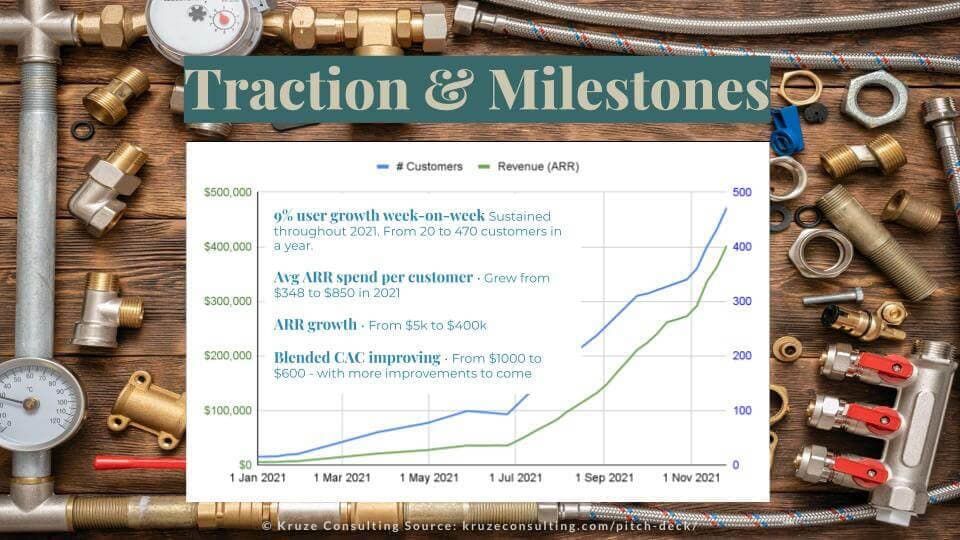
B2B Pitch Deck Traction Slide 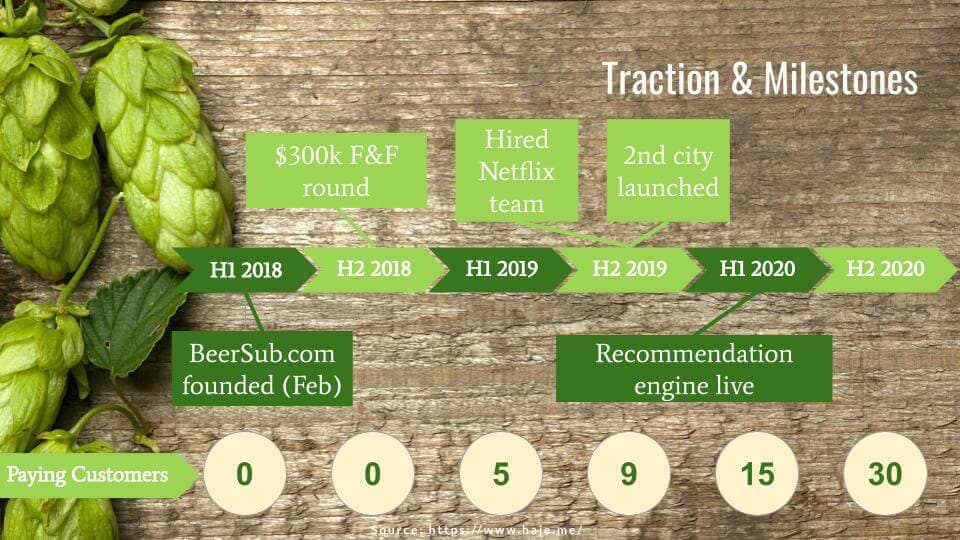
B2C Pitch Deck Traction Slide
8. Sales / Go To Market
You've got to find your customers, or they have to find you. Either way, the strategy and tactics of how to do that will be of interest to your investors.
Haje Jan Kamps:
Hello, and welcome back to another installment of our pitch deck course. We have been doing a few episodes of this and so you know both me and Healy really well by now. You can find the example decks we're using on kruzeconsulting.com/pitch-deck. That is Kruze, K-R-U-Z-E, consulting.com/pitch-deck. You can find all sorts of great resources as part of this course and more on that URL. And we're super excited to talk to you today about the go-to-market slide. It's sometimes called a sales and marketing slide, sometimes it's called the growth slide, but it's a super, super important slide, especially as you are progressing in the company. From a pre-product slide, it's one thing. And then it evolves quite a lot throughout the growth of the company. Yeah, should we get started?
Healy Jones:
Sure, sounds great. And I'm just going to double down on that. As your company advances, one of the things that the investors are going to expect that you're spending money on to learn and to build out is the sales and marketing function. Obviously this is going to vary by industry, so biotech is going to be extremely different than a hardware company selling to enterprise versus an app company selling through Apple Store and Android Play and things like that. This is a muscle that your investors are going to expect you to build and as your company matures they're going to expect that it gets better and better and better. And they're going to expect you to start to have metrics here, you start to have a team here, you start to be able to articulate your strategy. Very good growth with the slide. The killer sales and marketing or go-to-market slide can really carry a company with what a VC might perceive as a mediocre product all the way through to the finish line in terms of getting invested.
The best VCs don't necessarily think that they're experts on product, although many do. If you have this killer go to market slide and you are clearly getting a lot of traction on the customer side, they will check their thoughts around the product. And maybe I didn't understand this product, but clearly the market is getting it and clearly they know how to sell it. So make sure the slide is great. Let's talk about what you need to do to make this slide amazing.
Haje Jan Kamps:
Yeah, I'd love to think about the go-to-market slide as the flip side of the traction slide. The traction slide takes today and looks back and the go-to-market slide looks at today and looks forward. The story you're telling here, the really important piece of the narrative, is how are we going to get our next generation or next fundraise worth of traction?
Healy Jones:
That's right. And obviously do need to talk about, though, what you've already done and what's working, what channels are working for you. And one of the things that, as your company matures, that this slide should have on it, I think we can all agree, is the customer acquisition cost. So how much is it costing you right now to acquire your customers? And so the easiest way to do that is to take a total number of new customers in a period and divide it by the amount that you spend on sales and marketing. Things can get very complicated. I'm not sure we're necessarily going to get into the nuances, but to the extent you have a land and expand strategy or you have a 90 day sales cycle, this can get pretty messy, but do your best to come up with a CAC that is clearly and accurately and honestly articulating what it costs for you to pull on a new customer.
Haje Jan Kamps:
Yeah. And some of your acquisition channels will be super cheap and those will look great on your slide. And some of them will be very expensive, but can scale better. And so we'll get to that in a little bit, but don't fall for the trap of thinking we found a way of acquiring a customer for $1 per customer. That is great if you can scale that to millions and millions of customers for a B2C company or scale it to large numbers for a B2B company, but it is extremely unlikely that the most effective channels keep working as you keep tapping them for customers. One great example is your own newsletter. Your newsletter is likely to convert lots of customers and be in effect extremely valuable as an acquisitions channel or as a sales channel, for sure, but you only have so many subscribers and spamming people is not a great way of getting customers in general. So be careful on that one.
Healy Jones:
For sure. So who is this for? You're producing this slide for the VC that wants to understand as they put money into your sales and marketing engine what's going to start to come out the other end. And what are the activities that happen in the middle that produce those new customers at the other end at an attractive price point, right? So you can really deep six your fundraising process if you miss this slide up.
Haje Jan Kamps:
Yeah, totally. Well, it's interesting. So, really, what you're saying here is that you understand what the market is and who your customers are. You're explaining where you can find those customers. Where do they hang out? How can you reach them? And you're really showing what is your acquisitions funnel on a very basic level for a very early stage company. Even if you're doing something like mobile phone cases, you could say our customers are everybody with a mobile phone. If you haven't shipped a single product, I don't believe you because that's such a huge market. So you're talking about what is your beachhead audience? Where are you going to go after first? And so if you happen to make San Francisco Giants covers for your phone, the obvious place is outside of a stadium. You're probably not going to start a huge business there, but, to use a very specific example, divvying up by some sort of cohort that you can start going after and being really, really good.
And using that as your test cohort is a great way to do, especially for early stage companies. Think of it as your beachhead audience. Think about where you're going to start learning first and then hopefully the learnings you get there you can expand them into other audiences or other geographies.
Healy Jones:
Yeah. Do you know where your customers are? Do you know how to reach them? Do you know how to convince them to put down their credit card to purchase your product? And so credit cards are perhaps a bad example. If it's an enterprise play and it's a quarter of a million dollar software product that gets purchased by Fortune 500 companies, this slide needs to reflect the sales motion that works to get into those companies. Now, that being said, there's certainly companies like Salesforce that succeeded in getting into Fortune 500 companies by having individual salespeople pay for tiny licenses and then growing. So that's a strategy and you could explain that strategy, but if you're right off the bat trying to get a quarter of a million dollar sale, that's the base level entry price for your product, you need to probably have a sales team.
You probably need to have high touch marketing. You probably need to have brand marketing, et cetera, et cetera, trade shows. So just understand what it takes. What steps does it take to sell into the customers? And so to the extent that you've already done this successfully, just write them down. Let's say you only have a couple of customers. Write down every touch point as you're preparing the slide. Think about it. You should already know this, but the exercise of writing down how we get into this customer, how do we get them to pay, who do we have to talk to, who are the decision makers, how long was the sales cycle? These are important questions that you should know off the top of your head if you only have a few customers. So these are things you'll want to put on there.
And conversely, if you are advertising through Facebook to consumers to try to sell something, it always pays to have some understanding of what's working, what the audiences are, how big those audiences are. And then if you really want to wow VCs just in terms of any type of way that you're selling, having some super clear anecdotes that are true about how you sold to big company X or how particular consumers found you. And then having those be essentially templates that you've done quite a few times, those are really powerful, those examples where you walk the VC quickly through the story of how you sold into an enterprise, assuming that is in fact reflective of how you intend to continue to sell. Where I think some early stage companies have problems here is where the founder perhaps knows a few people in the industry and sells to those three people. And suddenly what's the next sale coming from?
Those examples don't work anymore. You're building muscle here. Venture capitalists are giving you the money to build the muscle to do the sales and marketing, so you need to be able to articulate what you've done and what you're about to do to get there.
Haje Jan Kamps:
Yeah. And there's a big difference here between a business model and a repeatable business model. Right? And so that repeatable piece is really what you're looking for here. And once you have that nailed down, we can use this sales playbook day in, day out and can get more customers. That's really the ultimate goal of this. Now, that isn't to say that, if you haven't got a repeatable business model, that you can't have a go-to-market slide. You still need it, but it's worth highlighting. It's like we know we have some idea about what we can do in this market or we have some idea how we can reach those customers and we're going to continue to do that, but we also know that there's six or seven other customer profiles where we don't really know yet.
And this is a conversation, especially for super early stage companies. VCs see so many different companies at so many different stages. This could be the beginning of a really fruitful conversation where you say, "Hey, we figured some of them out." We have five or six more in a pipeline where we don't really know yet fully how we're going to do it. Do you have anybody we can talk to? And that can be super powerful and there's so many different go to market strategies. You can do partnerships, you can do distribution to retailers, you could do direct to retailers, you could do direct to consumer. There's licensing deals, there are Software-as-a-Service subscription models. All of these different models exist and this slide should probably outline where you're going to start your journey.
And the reason I'm harping on about this is that I speak to a lot of founders, especially in the hardware space, who are like we have one distributor who's going to do this for us and we also do direct to consumer and we also started selling into Amazon. And then there's this corporate deal where we sell so many thousand. And I'm like, "Whoa, you're describing an organization here that needs at least 15, 20 people just to keep the wheels on the wagon and you don't have 15 people. How is this going to scale? Because all of these distribution channels and all of these different sales channels need different amounts of touch and different expertises. So as a company, you want to find one that is your core focus for sales and then maybe a couple of bonus ones for experimentation, but, really, your main sales channel needs to be one and it needs to be working.
Healy Jones:
Right. And another thing that I think works very well here is sometimes companies have geographic expansion plans, where they figure out how to execute in a particular city and then they move out or they are located in, say, the Northeast and they have sales people who travel around and focus on that. And they can mirror that as they move across the country and internationally. Those work really well. Other places where I've seen this be really successful is when a company is focused in a very particular vertical, so let's say selling to insurance agents, but they also think that they can sell to wealth managers who might be tangential. This is where you can actually have a problem, where your product is very broad.
It could be hard to find a niche to focus on, but if you have a niche that you're in and there are tangential ones that you can get into pretty easily with very minor product changes and it's just the same playbook, those tend to work really well because the investors can get their head around what you've just done that's working and then the next thing you're doing is very illogical and it feels lower risk.
Haje Jan Kamps:
Yeah, 100%.
Healy Jones:
Great. Well, let's talk about how this does change as the company matures. So an angel or maybe even a precede company with the product not launched yet, no revenues. What do you think about the slide?
Haje Jan Kamps:
So I think this is one of the most interesting instances of this slide. As a company evolves, the team evolves and the type of people involved with the company, it all changes and evolves and up levels as you go through. And at the earliest stages, you don't really need a sales operation. You don't really need a marketing operation. You're building a product, you're getting ready to launch. And if you had a bunch of people doing Instagram, it's just a waste of time at that point. And as soon as you change gears into selling, you need to show that you know what is changing in your company as that happens. And so I think for the earliest stage companies, it is counterintuitive, but this slide becomes super, super important because I'm sure you have seen this happen, Healy. I've definitely seen this happen.
A really promising company in a huge market with a great product completely falls over as soon as it starts selling because they're completely stacked with incredibly talented engineers, really good product people and nobody knows how to sell anything. And so you've got to show that you can do it or that you can hire the right people.
Healy Jones:
So a way that you can succeed as an engineer, or a product person, or maybe a very young or inexperienced founder who's attacking an industry that you haven't been in before is to go out and find advisors and mentors who have the experience in industry and figure out what they did successfully. So you're an engineer and you are trying to produce some sort of software tool to sell into the biggest banks in the world. Work your way into salespeople who have sold software into big banks and ask them questions like how did you do it. What was the marketing action? How are the sales connections made? Do the buyers make decisions? Who are the buyers? Go find mentors or advisors who are targeting the same customer base, but selling a different product and figure out how they've done it.
Haje Jan Kamps:
Yeah. I don't want to go too deep into strategy here, but a lot of very good product people like making user personas. Well, you can have user personas for your sales targets, too. And having those in place and thinking, like, "Hey, our customers are actually the SVPs at banks," that is a really good thing to know. Now, the next step is how do you find them? If you know how to find them, how do you reach them? If you know how to reach them, how do you sell to them? And having a very clear sales funnel in mind, especially if that's backed up with somebody who's done this 100 times before, as you just said, Healy, that can be a really powerful narrative. Even though you haven't made a single sell yet, you can get to a place far down the line there.
Another thing we often see for B2C companies is creating a shadow company. So create a company that sells the thing you are selling and you could start doing some of your marketing. Whenever somebody makes a sale, you just refund them. It doesn't matter. That wasn't the purpose of the exercise, but it means you can get some ideas about the customer acquisition cost and that kind of thing. So by the time you go and raise money, you can say, "Hey, we actually set up a company that does what we did just so we can start experimenting." We have our entire end to end sales funnel figured out and we think that this is our customer acquisition cost. We just need to switch over to campaigns and we're good to go. I've seen that done extremely successfully with aggressive B2C companies, but of course you can't really tap your entire network for SVPs at banks and do the same. So think very carefully about how you're running your experiments and this slide should reflect all of that.
Healy Jones:
Right. So additionally, talk about what you're going to try. So either through the mentors, or through your network, or through your previous experience what tactics or channels you're going to try with the money that's coming in order to prove that or build the muscle around the sales and marketing engine. So that's for really early stage companies that haven't really launched a product or are just starting to get a little bit of sales, but as your company starts to have more and more sales this slide gets to be a lot less. You still want to look forward, but you start to be able to base it on a solid foundation of what's actually working. Then after you start to sell, you hopefully have some channels that are working at attractive costs. You should mention those.
And you should mention them in terms of what the costs are and how scalable they are, how you expect them to grow over time, and how you want to continue to invest in them. So as you approach the A, there's got to be a lot more meat on here. And in particular, you should be prepared if you have to go deep into particular channels. And if you're not the sales and marketing leader of the organization, you want to make sure that you've really been briefed adequately by whoever's running that. Now, as an early stage CEO, you probably have to have your hands and everything, but you should be prepared for VCs to occasionally go really deep on this slide, even in an initial meeting. And it just may have to do with that VC's particular experience or what they're really good at.
So just as you build the slide, just be prepared for them to double click on anything that you have on here. Just be ready. And that becomes, again, more and more important. And then by the series B, this slide should be very baked. It should have information around a sales cycle or what channels are working and the cost per channels. Elasticity may be too technical of a term, but how big those channels can flex into or how fast do you think they can grow and then a list of where you're going next. So series B, this slide, is going to be pretty darn robust.
Haje Jan Kamps:
Well, and for series B, really, you're raising money to execute this slide. That is really what you're raising money for. The product is more or less there, your team is more or less there. You're really saying, "Hey, pour $10 million or $100 million into the top of this thing," and $50 or $500 million fall out the bottom. We have it nailed down, we know what we're doing. And so at the later stages, this slide is the “how we're going to spend our money” slide for a lot of companies.
Healy Jones:
Exactly, great. Well, why don't we jump into the two examples that we have?
Haje Jan Kamps:
Yeah, let's do it.
Healy Jones:
I will share the screen. So as I get the sharing up, just remind everybody the caveats I always say about these two slides we produced or these two decks.
Haje Jan Kamps:
Yeah, so we put together two companies and they're both pretty silly. One of them was a beer subscription company that I made a slide deck for for my book called Pitch Perfect. And the other one is called 4P, which is a plumbing company. And, again, they're both pretty silly companies, but the idea is to really use this as a tool for having a conversation about why these slides work and what doesn't work about them.
Healy Jones:
Exactly. Great, so let's take a look at them. So, again, the beer subscription, one is the one I have pulled up now. This is direct to the consumer. It's a very early stage, not really having generated a lot of sales. So what we're talking about here is who the customer is and how they're reachable. And got some blurbs around the customer acquisition cost and mentioning a geographic rollout, which makes sense for a business that is shipping a perishable item. So, Haje, talk through what your thought process was as you put this slide together and how a similar direct to consumer company might think about building their slide out.
Haje Jan Kamps:
Yeah, so on purpose this doesn't say everybody who likes beer because that is a very large group of people. And unfortunately, or fortunately, depending on your opinion on beer, in this country a lot of beer that's sold is not actually very good beer. And so it doesn't help to say everybody who's ever drunk a Budweiser is our target audience because that is patently false. So here, what this slide is trying to do is to explain a little bit who the type of consumers are that we think we can go after. Now, discerning hipsters, the kind of people who will seek out interesting flavors, who might make their own beer or who might make their own kombucha or whatever could be an interesting market to tap into. For one, you get a lot of free word of mouth, but they are out there looking for new things to try.
And that puts you on the front foot. In this particular pitch, I also thought about foodies specifically, people who are very specifically into trying new foods and trying very good food. And making beer a more accessible thing where otherwise they might try wine pairings, for example. And, again, if this company were to become very successful, you would have a lot more target audiences for that underlying, but this seems like a sensible place to try. And if it completely falls flat, maybe that says something about the market or your product. And what I'm doing here is saying this is reachable through advertising. So paid acquisition with a pretty big range on this particular site. It says 80 to 180. Now, that's a big range and as an investor I would go, "What's going on here? Why is this range so big?" This slide is actually modified from a customer I had once. So this range actually showed up on their slide deck and I challenged them on it. And they were actually well. We have multiple channels.
The $180 range they thought would scale infinitely and the $80 range they thought this is going to get tapped out pretty soon. So this actually makes that into a pretty interesting conversation. So if you quickly want to get a bunch of customers, you pump the $80 acquisition channel.
Healy Jones:
$180 you mean. You pump the $180, right, if you want to get them quickly?
Haje Jan Kamps:
Sorry, yes, if you want to get them quickly you pump the 180. And if you want to get more experimental customers or you want to wiggle your way through or save some money potentially, you can tap that other channel. I think because the cohort of potential people to advertise to in that smaller range wasn't that good, it means that you exhaust that channel really quickly.
Healy Jones:
So this particular pitch deck is for a company that's in a really early stage and hasn't gotten a lot of traction. Now, if this company actually had thousands of customers they were adding every month and the new customer growth was accelerating really aggressively. So maybe they had 1,000 customers last month and then this month they're going to add 1,100 customers and continue insane growth on that trajectory. And they had a high LTV, so the customers were worth $1,000 or something like that. The range here would be incredibly attractive, actually. It would be really appealing. Maybe 5X is your worst LTV to CAC, so these acquisition cost ranges are amazing and let's push go more on it.
Instead, this is an earlier stage company, so what's happening here is that the founders are given the VC a chance to have a dialogue about how we get customers. Let's talk about it and we'll prove to you we're thoughtful around having different channels and exploring different channels and understanding what the different channels are capable of. And then it's also teasing the influencer, which is saying, "Hey, we have this other thing we want to try out with the money you're going to give us." So this slide is actually relatively powerful for the stage of the company that this one is, but if you could imagine that this was a company that was firing on all cylinders in terms of actually getting customers, then this slide would be excellent.
Haje Jan Kamps:
Yeah. And I think because you're shipping, again, perishables around and they have a little unit that they're shipping out to people, which is like a little beer tap thing. It makes sense to have a concierge service to start out and to do that only in your local area so you can talk to your actual customers. Maybe observe them set up the system and see if there's any product issues there. So they're actually thinking about this or this company is thinking about it in a way that doesn't scale, but that's on purpose. That's by design so they can really keep a close eye on the customer. And then they say ready for rollout and you'd better be ready to defend that. If you've just got a list of companies, that's not ready for rollout. What would be ready for rollout is we have hired one or two people in each of these locations.
We know how to ship, we know how to get these customers. And if you look at this list of cities, they all have a bunch of things in common. Mostly that they're full of hipsters, but also that they have strong beer cultures and all that kind of thing. And so as an investor, if I'm looking at this, it's like, "Okay, well, that it is a pretty widely distributed set of markets. So it's going to include some logistics challenges, but clearly the founders have thought enough about it that they're able to do a phased rollout. Then the next question that would come out of my mouth is, okay, now what about the rest of the country? Because you can't keep hiring people in every single city where you're going to start shipping.
Healy Jones:
Yeah, it's true. And you also want to make sure that this slide doesn't make it feel like your opportunity is too small. If you're selling a $10,000 product and there's only 100 companies that could buy it on the planet, you have a problem. So you just want to make sure that this slide doesn't accidentally peg you into having too small of a market size for a venture capital investment.
Haje Jan Kamps:
Yeah. Well, if you think about it, there's a couple of companies out there. Peloton, for example, have this hands on setup thing where they send a van to your house, they install the Peloton for you. It's a very, very expensive product, but it's a very white glove, hands on experience. It used to be anyway. I don't know if they still do that, but they had that as part of their service. And that meant that they could only ship to certain cities for a while there until they went national and started doing it that way.
Healy Jones:
Great. Why don't we switch over to the B2B example?
Haje Jan Kamps:
Let's do it.
Healy Jones:
So I specifically wanted to have two different types of pitch deck templates. One that was more consumer focused and one that could actually rely on a sales team. So this is a better way to look at a company that potentially can have a sales team. And I think one of the powerful things on this slide deck is that it's helping you see how the sales team helps drive a really attractive customer acquisition cost. Sales is a channel that works really well, particularly for B2B. And I've worked with companies that have high growth sales teams and VCs understand that go-to-market and they understand that method. So this is a really great thing to put on here. And if you're going to have a sales team, you're going to want the double click. Next question is around sales cycles, sales compensation. You'll want to make sure you have those numbers and that information in the back of your head or an appendix slide so that you can show it to the investor and you understand what you're actually saying here. You're not just reading off the slide.
Haje Jan Kamps:
Yeah. And one pro tip there, as well, I've seen people do this wrong and it's really interesting, where they confuse account management with sales. Now, if I saw this slide, I would say, "Okay, what happens after you've made a sale?" If the answer is the salesperson continues to help the company or help the new customer, I'd be like, "Wait a minute, how many sales can they make once they're looking after 100 customers?" So that has to be a really good handover from the sales team making the sales and they get really, really good at that and then figuring out what happens after. So you have an account management team or a customer service team or an onboarding team or something like that. So the pointy end of the spear is your sales team and they do their job really, really well. The other thing I would challenge here is your customer acquisition cost is less than $90 per customer.
Does that include the wages of the sales team and the bonuses and all that kind of stuff? Because if it's their actual cost, as in the cost of acquisition, again, this should be super clear, but some founders get this wrong and it makes you look pretty bad if you have to backpedal.
Healy Jones:
So the other thing that a sales driven growth strategy gives you is it helps make your pipeline a little more predictable and it helps make your forecasts a little more predictable. So if each salesperson can close five deals a month and you have two salespeople, then you better be closing 10 deals this month and 10 deals next month, unless you've just added a lot of salespeople already ramped. So a place where it's not necessarily gotcha, but it will make a VC cock their head and question you a little bit is if they say how many salespeople do you have. Two. How many deals can close? Five. How many deals are you supposed to close next month? And then your model and your projections say that you're closing 50, but you only have two salespeople, so it should be 10. That's where they're going to ask you. I don't understand, this doesn't make sense. How's that happening? So keep in mind that if your growth is predicated on the sales team, you've got to have those people working for you.
It's called butts in seats. They've got to be working for you and they've got to be fully ramped so they can close the number of deals you're supposed to do in your projections.
Haje Jan Kamps:
And the other thing worth mentioning here, so the sales team has one customer acquisition here, $90 per customer. It's great. The next one is word of mouth, where you say we offer a $500 referral fee and more than 250 new customers have joined us as a result. With incredible retention, only 11% churn after 12 months. That is wonderful, but now suddenly you're looking at a $500 customer acquisition for this particular channel. Now, if this is a particularly sticky channel, that's great. If it can be split out from not having to do a bunch of additional advertising or if it just means that the sales team doesn't have to look after those customers, if this reaches customers that the sales team can't, that becomes a really valuable channel. And all of these get multiplied up into your blended CAC to figure out what is your overall customer acquisition cost.
Healy Jones:
Right. And so there's one thing on here that's the press side that I want to talk about a little bit as a potential gotcha or issues. So I'm going to jump ahead to common issues. A mistake that I see is that unsophisticated founders, so founders who don't know a lot about sales and marketing, will just say PR is how they're going to get customers and they'll not really understand what that means. If the press and PR is what's going to drive your customers, you ought to have a very clear connecting the dots in terms of we have these press events that have occurred and it's led to particular customers. A lot of times, press or PR as your go-to-market strategy shows an unsophisticated founder. Particularly, more companies that have yet to actually generate any meaningful sales. So you should be careful of that.
Haje Jan Kamps:
Well, I'm wearing my press hat. So I'm a journalist at TechCrunch and it is extremely peaky. I write about something at TechCrunch, people read it, they get lots and lots and lots of traffic and sometimes they even see a bump in sales, but there's a pretty high bar for getting covered in the press. It has to be new, it has to be interesting, it has to be interesting to the readers. So even if you manage to get one press bump, that doesn't mean you're guaranteed another one. The one exception for that, and the less peaky one there, is if you ship a product that is reviewable. So if you have a hardware product or a service or something that people are actually interested enough in that they're reviewable, or, say, if you're shipping cars, people read car reviews all the time because it's such an important purchase.
Now, suddenly you're talking about a market where reviews become super important. And if you have a very robust reviews program, making sure that you're reviewed in all the press outlets, that could potentially be a go to market. As Healy just said, this is almost impossible to pull off and certainly in the long term it's almost impossible. So it's often that this falls in the bucket of vanity metrics. And there's a big difference between earned media, which is where people write about you because you're inherently interested. So, for example, right now Tesla actually disbanded their entire PR office. They just don't care anymore because they know they get so much press no matter what they do that their press works fantastically well. And, be very honest with yourself, are you a Tesla? Chances are no. And in that case, you can't rely on that.
Healy Jones:
That's right. And so the other aspect or angle of that is understanding how customers actually purchase your product is important. We mentioned that. And so the press maybe works for small business sales and for consumer sales, but if this is a half a million dollar hardware sale into a large enterprise, that press piece is not going to be the thing that makes somebody wake up in the morning and say I'm going to buy this thing. It may help along the way and it may be the reason they first call you, but there's got to be many steps in between that, from the awareness to the actual purchase happening, that the press is not necessarily going to be the primary reason that's happening. So in terms of making sure you're thinking through this slide and avoiding some of the common pitfalls, be really careful if you're mentioning press. Just be pretty careful because that's a place where, if you do it wrong, it can be a tell for you being an unsophisticated founder.
Haje Jan Kamps:
And it's funny, as well, because I have a counter example, too, which is, one of my previous companies, we get covered in Good Morning America right before Christmas in a Christmas roundup. Our sales went through the roof. It was the best Christmas we ever had. It went absolutely bananas and there is no way we could have predicted that. So we actually had a completely opposite problem, which is that our entire warehouse was empty at the end of that sale. And so we left a lot of money on the table because we had this press coverage that we didn't predict. It was completely organic. Somebody just thought it was cool and we got covered. We didn't know until it was announced and then we were like, "Oh, crap." So don't count on press. It's good to have press as part of your media mix and as part of your marketing mix, but I wouldn't count on it.
Healy Jones:
Right. And so other common issues we've seen on this slide are certainly B2C in particular, but also B2B companies, not having a good grasp on their customer acquisition cost. Actually, I shouldn't even say this, but if you're really, really good at sales and marketing you may be able to convince a venture capitalist to exclude certain numbers from your customer acquisition cost, but you have to be really good. In general, they're going to expect that all the sales and marketing expenses are lumped in there. Even salaries, branding expenses, PR expenses that are not designed to drive sales, even ramping sales folks and sales trainers, et cetera. So just be prepared to really understand your customer acquisition cost and talk about it. And if you are a company that is just starting out and you don't have anything here, just understand how much the sales team … If you need a sales team, understand how much they're going to cost.
If you're going to understand the conversion rates on Google AdWords, you might be able to buy a Google AdWord for two bucks, but that doesn't mean you're going to get a customer for two bucks because they have to come to your website and fill out a form. So what's the form completion rate? So just think through every step of the way here and don't get caught up and look really naive around your customer acquisition costs.
Haje Jan Kamps:
Yeah, it's worth being very good at that. The other common issue that I see a lot is, as a consumer, you are very used to consumer marketing and consumer advertising. So you might be driving down the freeway here in San Francisco and you see an advert for Twilio or you see an advert for Salesforce. Now, that is known as customer awareness or branding campaigns. That is not the way to do marketing for your very early stage B2B company. So don't over index on your customer awareness. You can spend so much money without it converting that it shouldn't be part of your mix, really. So you can't necessarily do what the big companies are doing because you're not a big company. So it's a good idea to make sure you have your strategy really buttoned up so you can double down on that.
Healy Jones:
Exactly. And so the other major issue that we've already mentioned a little bit is when the founder, the CEO, your engineer or your technical and sales and marketing is not something you have a lot of experience with, you need to prepare yourself. And as you move into the later stages, even if you're not naturally a sales and marketing person, you need to be able to speak to this stuff at the series B and to the CEO. Even if you were the founding engineer, who's the CEO guy now, you got to have a handle on this stuff, even if you don't love it. It matters.
Haje Jan Kamps:
Yeah. And remember that your CFO has less to do with sales than you would think. So I've seen founders who try and pull their finance person in. It's like that's not sales. Sales is sales. Finance is finance. So get the right people and get the right people around the table. And there's nothing wrong with it if you do an early pitch to a VC. If they start asking questions, like, "Hey, I am the product and tech CEO, I have a really good sales team. I can answer what I can, but in a later meeting let me pull my salespeople in." That's a perfectly fine thing to say, especially in early screening meetings.
Healy Jones:
Yeah, if your revenue growth looks good, you could definitely get away with that.
Haje Jan Kamps:
Right. If it doesn't, yeah, you're right. And the other thing, we've mentioned this a couple of times, acquisition channels get dried up. And what I mean by that is imagine you have a company that you have access to five or six really high end companies that buy your product. By the time you've worked your way through your Rolodex, your Rolodex is empty. You can't reach out to more people. And that means that that acquisition channel is dry. The same happens for the pay deck. You might find this really specific niche group of people to advertise to on Facebook. The customer acquisition cost is fantastic, but eventually everybody who was going to buy has bought. And at that point, you can pump as much money into that as you want, you're not going to make another sale or sales drop off precipitously. So think about how big the cohort is and how you can make new cohorts or new groups of people as you work your way through that channel.
Healy Jones:
Exactly, and it's very normal. And it's actually great for companies to initially sell to people that they know, but that does not make for a very powerful go-to-market slide, saying, "Hey, I'm just working my way through the contacts in my iPhone and I'm selling to them." Eventually, you're going to run out of contacts on your iPhone. So you need to build a real system here at some point. Yeah.
Haje Jan Kamps:
[inaudible 00:39:58] too, with your hiring. First you tap up everybody you know who you've worked with in the past who would be a great match, but you very soon run out of people you've worked with. And now you have to do the hard part of hiring, which is throwing a wider net. Same thing with sales.
Healy Jones:
That's great. All right, so, again, this slide is really important. I think we've worked through all the issues here. Do you think we missed anything?
Haje Jan Kamps:
That's good.
Healy Jones:
Yeah. Okay, great. So let's talk about why this slide is important. So you, the founder, get to talk about your sales and marketing strategy. You get to show some numbers around how you've been successful at acquiring customers at an attractive cost. You're proving that you understand how customers purchase and you understand the structure of the market, if there's distributors or value added resellers, or if it's going through retail or app stores or whatever. Proving that you understand that and you're packaging it up in a way that the venture capitalist can file it away in their brain so that it fits in with their rubric. And you're also showing where you're going to spend the money that you're about to get. You're showing them the muscle and the experiments that you're building with that money. And Haje, I think we hit pretty much everything here. Anything you want to summarize?
Haje Jan Kamps:
Yeah. I think in summary, this is your opportunity to shine and to show that you know how to pivot and experiment in the earlier stages and that you know how to execute in the later stages. It shows that you really understand your audience and your target customers and the obvious stuff. Where do they hang out? How do you reach them? How do you convince them to buy? And that you understand your different channels, your go-to-market channels. If you manage to do those three things on this slide, you've nailed it, basically.
Healy Jones:
Yeah. And a very powerful thing that I've seen work on this slide are specific examples of customers that purchased that are essentially indicative of how many customers will purchase. So a story of how you sold into a large enterprise that is similar to several other enterprises that you're selling into are already sold into or a story of how a particular consumer or group of consumers found you and started using the product that is extrapolatable or is templatizable into other consumers. So those stories actually really help pull the investor in and help them understand a lot more tangibly what's going on in the slide. So to the extent you've got a story plus the data and then the strategy and the template, pulling those things together can really make this a compelling slide.
Haje Jan Kamps:
Yeah. And these are just all different playbooks for different types of customers. And so for this customer, that works, for this customer, that works. And showing that you'll have enough wherewithal to capture that information and to really put together the information that your sales team needs, that's goal dust because it shows that you really deeply understand what the levers are and what the mechanics are in the sales part both strategically and the operations side of sales.
Healy Jones:
Yeah. Perfect. All right, everyone. Well, thank you so much again kruzeconsulting.com/pitch-deck where you can get the whole series of venture capital pitch deck materials that we're putting together. And until the next episode, happy pitching.
Go to market slide: How will you find your customers?
Your go-to-market strategy is exactly what it says on the tin. When you have something you can sell – whether it's a product or a service – how are you going to get in front of your customers? For some companies, the answer will be a sales team and a set of prospecting tools. For others, it'll be marketing and advertising activities. Some strategies involve going region by region, customer segment by customer segment, or other gradual approaches. Either way, you need a plan and the ability to build some conviction that you can execute on that plan.
Slides for the Sales / Go To Market section
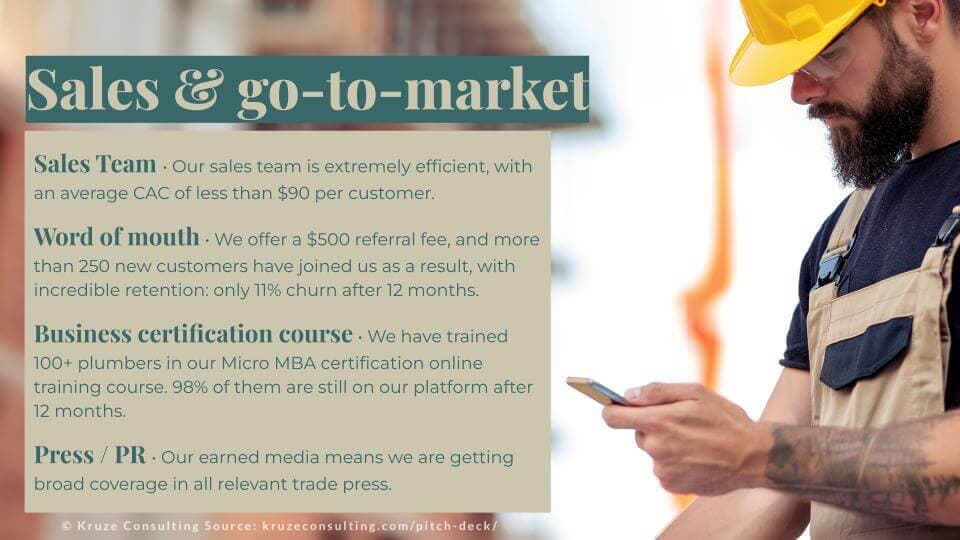
B2B Pitch Deck Sales/Go To Market Slide 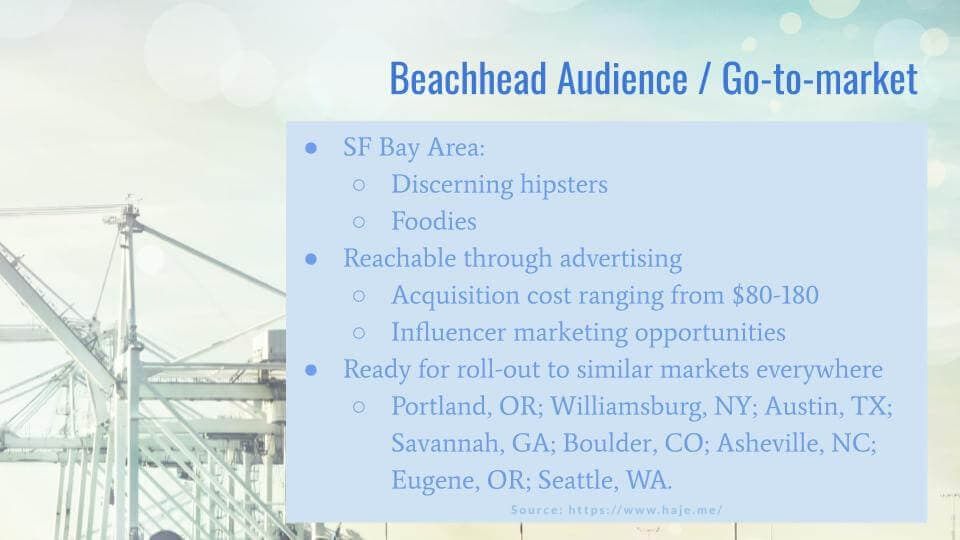
B2C Pitch Deck Sales/Go To Market Slide
9. Market Size
For a VC to invest, they have to believe that your company can potentially grow big enough to make it worth their while. This slide is your chance to make them see dollar signs.
Healy Jones:
Hello, everybody. Welcome to the Cruise Consulting free Pitch Deck creation course designed to help people raising venture capital put together their pitch decks. This particular video and podcast is on the market size, which is one of the most important slides that the venture capitalists will be looking at. For those of you who have been following along with this free course, skip ahead about 30 seconds or so, while I do the intro that you've heard a few times.
Healy Jones:
I am Healy Jones. I am the VP of FP&A at Cruise Consulting, former venture capitalist, and have been at startups that have raised a lot of money, and have gone public. And my day job is advising companies as they get ready to raise funding. I am joined by Haje Kamps who is not only a well known venture capital pitch deck consultant, he is a reporter with TechCrunch. He has written a book on how to build a venture capital pitch deck called Pitch Perfect, which you can get on Amazon. And he's also been a startup founder and has raised money and has been a venture investor with the Accelerator Group. So he is very qualified. Hi, how you doing?
Haje Jan Kamps:
I'm doing great. How are you?
Healy Jones:
I'm great. Thanks for joining us. Let's talk about the market size slide, which is a bit of a tongue twister, but what is this for?
Haje Jan Kamps:
Well, it's actually pretty straightforward. The market size is a really important thing to prove, because if there's no market for what you're doing, you're never going to make sales. We don't make sales, there's no chance of raising money. So for some markets it's super obvious because everybody goes, "Yeah, duh, of course this is a market," but especially if you're doing something quirky, proving that your market exists and that there's a big enough market to be worth investing in may actually take up a chunk of the investment pitch.
Healy Jones:
That's right. And this is a place where VCs are going to spend time if they don't already know the market really well. Of course, if they do already know the market really well, then you need to be careful because they may ask you some pretty intense questions and you're going to want to either have a point of view or you're going to be humble enough to try to learn from them and understand what their point of view is and what their experience is.
Healy Jones:
Now, I say in general, you need at least a billion dollar market for the most part. And that's at the bare minimum, that is barely, barely clearing the hurdle. Ideally, your market is several billion dollars in size so that there's a lot of TAM to go out there and get. That's not to say that you can't be creating a new market, but your pitch is going to be a heck of a lot harder if you have to convince somebody that you've got to startup with an unproven business model, with a team of founders who may or may not be experienced, who was creating a new market. That's really hard.
Haje Jan Kamps:
Well, a famous company that really struggled with that was Airbnb, right? They went around all the investors trying to find somebody who would believe them when they said, "Hey, people actually want to pay to stay," well in the beginning on an air bed in your living room, right? And get breakfast. That was the whole name, air bed, and breakfast. And I know they've spent a long time trying to change that name because that's not what they do anymore but in the grand scheme of things, nobody believed it. It was like, "Yeah, sharing economy, whatever, but really inviting people into your home?" Of course now it's very obvious that there was a market there, but they had to fight hard to let people believe that this was a thing that people would do.
Healy Jones:
Exactly, yep. And we're actually going to show that as an example and we'll discuss what they did there, which was smart. And there are ways to show that you have a big market, even if your particular solution is not sort of the cookie cutter thing that people in that market want. So we'll talk about that in a little bit here. So there's a few terms that VCs will throw around that it's pretty important for founders to know. There's TAM, SAM, SOM, what the heck are these things? Can you define them for folks?
Haje Jan Kamps:
Yeah. So TAM, SAM, SOM is a quick trio that gets thrown around a lot. And the TAM is a total addressable market. That is basically when you think about market size, that is probably what you're thinking of. It's worth being careful here because your total addressable market or total available market, sometimes people call it that, it needs to be what the actual business does. So if you're creating tax software, your total addressable market isn't the total value of all taxes collected in the US. It's very tempting to use that enormous number, but that is not where you're going after, you're going after the tax software slice of the tax market.
Haje Jan Kamps:
The next one is the SAM, so that's the serviceable available market. Now you've taken your entire market and you're saying, "Hey, these are the customers that I can actually serve with my industry." To use the tax example again, if you do corporate tax software, then the small businesses and individuals are just out of the picture, you can't serve them. So the entire available market might very well be every taxpayer, but there's different types of taxpayers that are served in different ways. Similarly, if you're looking at fitness equipment, for example, all of fitness, and then as a subset of that, you have all bikes and as a subset of that you have all road bikes. If you make road bikes, you can't make a claim to all fitness equipment. So you have to be pretty careful about what it is you're going after.
Haje Jan Kamps:
And then the final term that gets thrown around a lot is SOM, that is a serviceable obtainable market. And sometimes it's SOM within a certain timeframe, so serviceable obtainable market within the first year. Now you've really drilled down to this is the size of the market, this is the part we address and this is the part that we are going to address first, right? So your TAM might actually be a global market, but your SOM might be okay, we're starting just in the Bay Area or we're starting just in San Francisco or just the US. And so you're actually restricting the amount of market you're going after to begin with. And that really helps with the planning when it comes to marketing, sales and all these kinds of things. But it also shows even in the smaller market that you're going after, there still needs to be a billion dollar plus market there, right? Because if not, it doesn't make sense to invest.
Healy Jones:
That's right. So think about your revenues will be whatever percent of the market you can actually capture. So if there is only a billion dollars worth of revenue in your market available, in order to be a venture scale business, you basically need to get 10% of that, which is hard. It is very hard to get 10% of a market. Now, be very careful because there are companies that have done this, like Google, Google has, what, 92% of the search market share in the United States. That is really rare. So just be prepared for an eye roll by a venture capitalist if you say you can get 100% of a market or 90% of a market. That is really, really hard to do. So best case scenario, you have, let's say a 10 billion market and you get 5% of that. Oh my gosh, you have a huge revenue line item, that is amazing.
Haje Jan Kamps:
Totally. And it has to be realistic, right? So if you're talking here about, if you're go-to-market strategy doesn't reflect what you're doing here. So that's a different slide, but you've got to pay attention to the two of them connecting. There's this saying like, "Oh, sell something to 1% of other people in China," yes, but how are you going to reach them? How is that actually going to happen? So if your SOM is very disconnected from your go-to-market strategy, you're going to get some very difficult questions.
Healy Jones:
I think we're probably going to mention that five or 10 times during this particular slide, like your go-to-market strategy needs to very tightly overlap with what the addressable market is and how those people want to purchase a product, full stop. Just remember that. Be prepared on this slide for people to question your go-to-market strategy and your sales and marketing. So just be ready. That is very likely, I would say that's probably going to happen at least 25% of the time that you talk about this slide.
Haje Jan Kamps:
Yeah. And there's another important thing that I like to talk to my customers about or my clients about, which is sometimes you have an incredibly niche business that can be fantastically successful, so enormously profitable. But if your SOM is very small, you're very simply not venture investible. That doesn't mean it's a terrible business, but it means that when a venture capitalist looks at your numbers and sees, "Well, actually there's no way I can get a 10x return out of this," then you're dead in the water. So you really have to pay attention here that this slide should shout: This is an enormous opportunity. Because if it doesn't, you're going to have a bad time.
Healy Jones:
You've got to make it a no brainer. The VC should not have to do any math or have any cognitive thought process to understand that big number. Now I want to put a nuance in here and we're probably going to talk about this again as well, but it is totally normal and actually it's often an excellent strategy for a startup to start in a particular niche. So using your tax software example, perhaps your company starts by making tax software for small businesses, and then that's a certain size market. And then next to that is tax software for enterprises, that's your next step that increases your market. And then the next item is, oh, we're going to make tax software for small accounting firms and then for large accounting firms and then for personal taxes. And eventually you get to this huge market.
Healy Jones:
Most venture capitalists understand and actually like the concept of a niche strategy at first expanding. And I've seen concentric circles used for this to make a really big TAM number and help the VC kind of understand your progression. It's a lot easier on the sales and marketing side to start in a niche and to grow from there. Many, many companies have done that successfully. So don't be afraid to do that, just make sure you're showing those layers of onions I like to call it or concentric circles of a bigger and bigger market that you're going to step into as you kind of get that beach head into the first one. So don't be afraid to start with a niche market just make sure on this slide, it's a no brainer for the VC to see like, "Hey, there's actually billions of dollars of market out here. I'm just starting right here, but I'm going to go there."
Haje Jan Kamps:
Yeah, and from a go-to-market strategy point of view, this is actually a really good strategy to get a foothold in the market in the first place, right? Doing something very niche and making sure you serve that audience incredibly well. For example, there are some really good CRMs or customer relationship management systems, right? But the more niche they are, the better they do. So you have a CRM specifically for dentists, you have a CRM specifically for hairdressers, you have one for beauty salons and because they're so focused on the thing they do the best, they have a really good sales strategy there. They can go to every beauty salon and say, "Hey, this is exactly what you need, has exactly everything you need."
Haje Jan Kamps:
And then from there they can do brand extensions, they can do product variations, which is like, "This one is for beauty salons, this one is for hairdressers, this one is for another type of beauty product." But because they started focusing, you can build out that way. If you say, "Hey, we're going to take on Salesforce," nobody's going to believe you, even though they're also a CRM system that could be used for hairdressers. So think about it that way as well.
Healy Jones:
So a lot of times for the slides we've been talking about, like our traction slide, they change as a company matures by stage. How does the slide potentially change, Haje, at all, for the stage of the company? Does it change?
Haje Jan Kamps:
I think the actual market size itself is probably pretty stable unless the market itself is evolving. But as you become a more mature company, you actually have other opportunities that become possible, right? When Google started, they started as a search engine and now they do everything, right? Calendars, email, all the other things. But if you come to a VC and say, "I'm going to take on Google on every front," you're going to have a pretty bad conversation there.
Haje Jan Kamps:
The thing is eventually if you're an extremely successful company, you're just going to grow so big that you've essentially gobbled up the whole market in theory, right? And so in order to grow further, you have to think about where you can still find growth. And you can do that by thinking about the market differently. I know we briefly talked about Uber in previous episodes, but I'd like to mention them again, because they're actually really good at this kind of thing, right? They started out kind of taking on the taxi industry head on with their own taxis, then they kind of borrowed Lyft's drive your own car model, but now they're doing so much more stuff, right? They're doing parcel delivery in some markets, they're doing food delivery and those are huge extensions into all sorts of directions.
Healy Jones:
Let's share that pitch deck slide, actually, we've got an example. So let me go ahead and share that right now. So this is in theory, Uber cabs either series A or seed deck. They were very early. And they are claiming the overall market is essentially the amount of taxi spend and limousine spend in the United States. So a $4.2 billion market.
Haje Jan Kamps:
Which is a big market, it's more than a billion.
Healy Jones:
Yeah, and basically they're pointing out there's not a lot of concentration here. And so they're basically saying like, "Hey, listen, big market, it's growing, it's highly fragmented," and this was attractive to VCs, this worked, they raised a ton of money. Now I do want to point out that Uber's revenue, I think in 2021 was almost 15 billion. So they have grown wild.
Haje Jan Kamps:
Clearly it isn't growing there.
Healy Jones:
They have grown the pie. It's dangerous as a founder to claim that you're going to grow the pie that aggressively. You can say that you expect to grow the pie, it might be something you want to show verbally to prove to the VC that you're thinking big and that there's a lot of opportunity here to get them excited. I wouldn't necessarily put that on your slide though, because you can induce a little bit of eye rolls if you're not careful.
Haje Jan Kamps:
Yeah, totally. And even Uber's baby brother or sister Lyft, they're running $2.3 billion now. So Lyft is now doing half the market that Uber thought was the size of the market. And this is a beautiful dynamic about seeing these types of companies, as you say they, they grew the market. People use Ubers and Lyfts now in ways that they wouldn't dream of using taxis. And I don't think they predicted that when they started out on this journey, but now the entire transportation infrastructure has just changed because these companies exist.
Healy Jones:
Yeah. But again, I would be very careful, I would not say, "Hey, it's a $5 million market right now, but we're going to grow it to a $5 billion market." And that's really hard. That is a really hard thing to do. Now, again, there will be moments where you actually are creating a new market, a new product, a new service that has never existed before, but hopefully there's something tangential that you can show. So let's say you are pitching Amazon Web Services, AWS, basically the dawn of cloud computing, you would do the overall server market, overall data center market, you would use that as your tangential market and you say, "Hey, we're going to deliver this thing, but in a different way," right? So you want the big numbers on this slide so that there's no math required, no leap of faith required. It needs to be like, "Yeah, it is a big market. Wow. I'm excited."
Haje Jan Kamps:
Yeah. Well, and hilariously Amazon, everybody thinks of the shop, but AWS in itself generates $45 billion per year. It is ridiculously valuable. And it essentially started out as a footnote because Bezos was being angry with having to pay all these hosting fees and like, "Well, maybe once we build out all the infrastructure, maybe we can help other people." Well, turns out that wasn't a bad idea from selling books to selling other things.
Healy Jones:
Great. So anyway, kind of going back to the core topic here, does this change based on the stage of the company? Potentially as you mature and work your way into other companies or industries or tangential markets, okay, potentially, but every company should have one of these things, okay? I don't care if you're a biotech company attacking a particular cancer, or if you're a consumer product or if you're an enterprise company selling into the Fortune 500, you need to have this slide. It is very important.
Healy Jones:
And so again, why is it important? One, you're proving that you're going after a venture scale space and that you're that ambitious founder that wants to build a VC scale business. This is definitely one of the slides I see people trip up on. In fact, when we do our top pitch deck mistakes, I think having too small of a market is probably one of the top mistakes I see founders make.
Haje Jan Kamps:
Yeah. And I guess the other thing, I think it's one of the most important slides, but it's also important to talk about market trajectory, right?
Healy Jones:
Ah, yes.
Haje Jan Kamps:
I've mentioned tax software a few times, tax software is pretty flat, right? Everybody who was going to buy tax software has probably bought tax software. It's probably not going to grow exponentially. Which means if you want market share, you have to fight for it, you have to take over that kind of thing. You have to take over other people's market share, or create a new market. And we've just said, those are the two hardest things you can possibly do.
Haje Jan Kamps:
However, if you're doing metaverse stuff right now, or web three or crypto or one of those things, it is a large market, but is probably going to grow. And in that universe, you kind of get this whole rising tide raises all boats syndrome, where if you manage to cling, do an early land grab, get 5% market share and then grow with the market, like to use the Uber example, they thought the market was going to be 5 billion now it's at least 20 billion, if you manage to just cling onto 3%, your business is going to be on an incredible trajectory. So think about the market trajectory, think about what the larger context is of the market you're in.
Healy Jones:
Right. And again, remember how it relates to your sales and marketing and your go-to-market strategy, right? So if you're selling it to large enterprises, they're going to expect a sales team, right? Big companies don't kind of click to auto agree to terms of service and put a credit card down for a quarter of a million dollar or a million dollar product. There's a sales cycle where a salesperson is going to have to schmooze, et cetera, there's contracting, et cetera. So just keep in mind that sales and marketing is intimately tied to this, okay? So this slide is important because you're showing size, you're showing scale, you're showing your ambition. That's two fingers. You're showing a trajectory. So hopefully something is growing really well. And three, you're reinforcing who the buyers are and who you're trying to sell to. And then five, it is connecting with your sales and marketing slide in a way that's very logical and is a no brainer. So you don't really want people to have to think too much about the slide, you want them to get very excited.
Haje Jan Kamps:
And these slides typically have a lot of numbers on them, right? So there's a couple of ways of getting to the market size. Do you want to talk about that a little bit, Healy?
Healy Jones:
Yeah, I think it's time to start showing some examples and getting into the meat of the slide. So we showed you the Uber one and the source on that was a research study from NCI, right? And essentially there's the top down and the bottoms up. So I'm going to share my screen and I'll kind of jump up between the two and then we'll dig into what they are. So this is a bottom up market size. Hopefully everybody can see this. And then this is an Airbnb example, which is more of a top down. We do have pitch deck examples available for free on the Cruise Consulting website at kruzeconsulting.com/pitch-deck. So we have an enterprise one, okay, here's an enterprise one, and then we have a consumer one. Haje, why don't we start with the bottoms up? It's a really great way to do a market size slide.
Haje Jan Kamps:
Yeah, this is the time TAM, SAM, SOM thing we talked about earlier. At the bottom there, you have your total addressable market. That's like the number of gyms in the United States for this one particular thing, right? Serviceable market. So in this instance, this company is going after multiple location gyms. So not independent gyms so basically gym chains. And so they've said, "Okay, the serviceable market, we're going to ignore all the single boutique gyms and we're only going after multiplication gyms." And then they're saying, "Okay, what are we going after in the first year?" That's their SOM. In this case, a thousand gyms that have online class sign ups and stuff and then put some pricing around that too. I think this is actually a super elegant way of doing it because if you believe the numbers, if you think, "Yeah, there are two, 200,000 gyms. Yeah, sure. There are 4,000 gyms that have multiple locations," the last step there, it's kind of impenetrable, right? As long as you believe the numbers that are the basis for this projection, you end up with a really good story around this.
Healy Jones:
Yeah. And again, this is pretty powerful, right? You're saying, "Hey, I know exactly where I'm starting. I know the exact customer who's correct for me right now and it's not big, but don't worry, right around the corner is this next opportunity and I'm going to be able to step into that. And then right around the corner from that is the next opportunity and it is really big, right?" So there's no leap of faith required here. It's just, "Hey, this is a logical way for me to advance the ball."
Haje Jan Kamps:
Yeah. And I think this is actually my favorite way of presenting this. So if you can do it this way, A++, because it is so hard to argue with, right? And I think just shortcutting that would be very helpful.
Healy Jones:
So let's go to a top down, that's potentially arguable against. This is Airbnb, which again, we mentioned was kind of hard because you're basically couch surfing initially, that was their initial market, right? So a lot of travel is booked, a lot of people buy stuff online and we think we can get to 84 million worth. It's small numbers, but then there's… I guess this is probably trips as opposed to dollars.
Haje Jan Kamps:
This was trips, yeah.
Healy Jones:
It'd be a lot more powerful if there were dollars on this slide, to be honest. But this one is a little bit tougher, right? They're trying to say where they're starting from and how and how it's actually a big overall market they're going after, it's a little tougher. I think what I really like for us, Haje, let's talk about an overall big market is the 4Ps example pitch deck that we have created together, right? And this one, we're throwing out a massive number in terms of plumbing businesses in the United States, right? A huge number of plumbers and how much is spent on plumbing. Now here, this one is a little wishy washy, right? Because dollars spent on plumbing does not equal dollars spent on plumbing software, but basically saying that there's like 350,000 small businesses that are addressable here, that's a big number at the price points that this company's talking about.
Haje Jan Kamps:
Yeah, totally. And so there's an assumption here, which is that plumbing is a really solid and predictable market, right? As we said earlier, I don't think realistically that plumbing as an industry is going to be a hugely growing market, that's what I would've thought. Then I did a bit of research. It turns out it's growing at a 3.5% CAGR, that is not awful, right? It has some growth, which means… So CAGR is a compound annual growth rate, but it means that you actually have a market that is growing. And what that probably means is that the industry in general is growing, the kind of installation of new plumbing in buildings is growing. And so the story you're telling here really is that there is a very large number of businesses that are available.
Healy Jones:
That's right, yeah. And so please don't get hung up on this particular example. We made this company up in order to create a free pitch tech template. It might be pretty easy to pick holes into this and we obviously are not plumbers or software sellers in the plumber industry. But the point here is that there's a lot of big numbers on here and it's not particularly hard for the VC to think that you've got a lot of folks that you can sell to. And again, this is going to match with the go-to-market slide, where we talk about the growth and the sales team and things like that. So this clicks nicely in with that strategy and reinforces how the company expects to grow.
Healy Jones:
Now, I'm going to switch to a different top down one that we created that I actually think is a little too hand wavy.
Haje Jan Kamps:
Yeah, that's garbage.
Healy Jones:
And maybe a little off the mark. So I think if you were to present this one, this is for our beer subscription consumer service, which is a challenging sounding business model. And so this is basically saying, "Hey the craft beer industry is really big."
Haje Jan Kamps:
And well, more importantly, if you look at the shape of that curve, it is flattening, right? It had rapid growth and then it flattened out. As an investor, I would look at this and go, "Wait a minute, this market is plateauing. Why are you trying to do something here?" And I actually go into that in the book where I'm saying, "Hey, this slide in this one particular instance is an actual warning sign to investors." So you've got to think very carefully about how you are going to get some of this market. And how does that show up in terms of the storytelling in your pitch? Yeah, I would be very worried if somebody put this in front of me and wanted to raise money.
Healy Jones:
Yeah. No, a better way to do this might be to do the food delivery market because there are a lot of food, beer, and actually alcohol delivery services. So that might be a better thing to put in there because it's probably decent size and growing pretty aggressively. And then you can attach your competition slide later, but you're kind of starting to attach yourself to hot companies. At the moment these companies are hot, who knows when you're listening to this presentation, in a year or so, perhaps some of these home delivery companies won't be as hot, but right now they're considered hot. So to the extent you can help the VC connect your idea with other examples that are doing really well, that's really powerful. And this is a slide that can help you do that if you do this correctly. Again, I don't really love the way this one was done, but it's a free template so you should take it.
Healy Jones:
Awesome. Okay, great. So let's talk about some of the most common issues that we have seen on this slide. And I have to say that again, this is a slide that does kill a lot of venture deals. If you do this wrong, you can basically shut the meeting down pretty fast.
Haje Jan Kamps:
I think one of the things that is worth noting is that market sizing is done a lot by consulting firms, right? There's a lot of really big businesses that are doing a lot of things like investment analysts, brand extensions for big businesses, which means a lot of the consulting firms are out there doing research on this. They have probably come up with a market size for almost anything you can think of, projectors sold, helicopters, whatever. So make sure you Google it because if an investor is really serious about wanting to invest in this, they will do that Google search, they will buy whatever reports they need to as part of their due diligence and if your number is really far away from what this consulting firm has come up with, you have to be really well prepared to defend why your number is so different.
Healy Jones:
Yeah, you should have a story there and you should be aware of those major research reports that have been published. And personally for really big, well understood markets, I generally think it's okay. Just use a third party research as your market size. There are some VCs who don't love that, they strongly prefer the bottoms up. I would suggest, again, you always Google and look at the Twitter feeds and the blogs of the folks you're meeting with before you meet with them to see if they have any weird nuances on this. But again, if it's a big industry, it's really well understood, those reports are usually pretty okay to use on this and then you're using this slide as a foil to talk about kind of where you're going and how big of an entrepreneur you want to be and things like that, right? You're selling so big and you're focusing less around is the XYZ market huge? It's like, "No, everybody knows the X, Y, Z market is huge. Here are the numbers, it's growing. I'm really excited to take on this market, it's going to be a big company." That's what the message is, okay?
Healy Jones:
I think the next issue that's pretty common, which we've talked about a little as well, is measuring the right thing. That's where the beer slide didn't do a great job because it was showing overall craft beer sales, which is not really one for one what the company is, right? Again, it's like overall tax revenue for the US government does not equal what the tax software market is, right? So that's the next thing ,I think, make sure you're measuring the right thing.
Haje Jan Kamps:
Yeah, 100%. And I think it's also being very careful about making sure that the thing you are defining as your market is actually realistically the market you're going after. I mentioned a sports equipment thing earlier, but especially when you're doing stuff in pro sports or when you're doing stuff in gambling or really, really big sounding markets, be super honest with yourself. Is what you're defining as the market here something that your product actually addresses at all? Because a lot of the time, founders get so tempted. They're like, "Look, it's an enormous market," you're like, "Well, yeah, but your product is definitely not going to fully address this," and it means that it just gets shot down and you end up with so much pain trying to explain why that is the number you're going after. It shows you're not a sophisticated founder, it shows that you don't know what you're talking about.
Healy Jones:
So here is where if you're pitching and you're getting hung up on this slide, if VCs are really pushing you hard on this slide, they're probably not going to tell you why they're not going to invest, it's just not what they do unfortunately. But the reason is they might not have faith in your market slide. So you might want to go iterate and if you have some investors who you're very friendly with, you might want to ask them, "Is this slide working for me? Because maybe it's not because I feel like I'm getting pushback," and then you just go and you find a different way to do it. SO if it's not working, it's not working and don't let this thing be the hill you die on. Figure out what's going to work here, right? Make sure you're attacking something big, but figure out if this is going to work. The other place where there's a problem is if the market is too small. So let's say-
Haje Jan Kamps:
I have a great example for that.
Healy Jones:
Oh, go for it, go.
Haje Jan Kamps:
One of my previous companies is called Life Folder and it was basically end of life planning and our idea was like, "Well, everybody dies." Turns out that the number of people who plan for the end of life is very small and people who are willing to pay for it are vanishingly small. So we had an enormous TTAM, but the SAM was tiny and the SOM was essentially nonexistent. So be super careful on that kind of thing.
Healy Jones:
That is a huge problem. That's a huge issue. The other place I've seen a problem is where let's say you have a product that costs $10,000 a year, but your market is there's only a hundred companies that can purchase that. You don't have a big market, your market is tiny. You have a problem, right? So be careful that you're actually not by design going into way too tiny of a market because you're not venture investible. And the VCs will definitely do the math around that, if you say something like, "Hey, my product is useful for the top three pharmaceutical companies in the world and that's it and the price point is half a million dollars," well then your market size is 1.5 million, that is too small. So that math is really easy to do by the venture capitalists so make sure that you've thought through that.
Haje Jan Kamps:
Yeah. Yeah, and this is the nature of VC, right? You see so many pitches, you see so many slices of the market and you might be able to trick people on other slides. This one is not one of them, right? It is just not going to happen because this is so crucially important to whether or not it makes sense to the VC's business model at the very heart of it. So yeah, do your homework.
Healy Jones:
Yeah. So another thing here that kind of leads nicely into, sometimes you might be pitching a VC who has been a founder in this industry or has an investment that they exited in this industry or that failed in this industry or it is possible the VC is a true expert on this space and you probably ought to know that before you get into the meeting by researching who they are. But it could be an issue if the VC knows more than you do. And I'm not necessarily saying that… It's okay to not know everything, but when the VC is telling you stuff that you don't know that is blowing your mind or is dramatically changing your impressions of the market, you maybe have a little more work to do as a founder and it's going to be really tough to get that investor to want to invest in you because you've come to them with this idea and a space and they're kind of poking holes in your market size or how the market is structured, you got a problem. That is something I'd really be careful with. So basically you have to actually do your homework.
Haje Jan Kamps:
Yeah. Well, and the flip side is also true, right? So if you do come across one of those VCs, they might be an incredibly powerful board member because they have connections, they have ideas, they have insights, you got to convince them that it's a good idea to invest in you, but then once you get them to that point, they could be incredible leverage. So it kind of works both way, but clearly you're not going to close the investment unless you convince them that you know what you're doing.
Healy Jones:
Right. And to the extent you do get in a, in a meeting and you realize that venture investor actually is incredibly knowledgeable, be humble, ask them a lot of questions, be excited about their knowledge, acknowledge where they have a view that has been different than what you'd been thinking about and thank them being humble because they're looking for someone who's coachable. So if you can show that you may actually turn the issue of the market slide not really working out perfectly based on this person being more knowledgeable than you into a little bit of an advantage where them realizing that you're the type of person that is humble enough and is self-reflective enough to learn and wants to be coached because again, VCs want to be coaches.
Haje Jan Kamps:
Yeah. And I was going to mention this in the summary actually, but I think there is an interesting flip side to that too. If you talk to a VC who really understands the market or if the market size is really obvious, they might take one look at the slide and go, "Yeah, move on," right? Sometimes-
Healy Jones:
That's fine.
Haje Jan Kamps:
That's fine. Next slide. You've been so prepared for this slide and to defend it, but they just go, "Eh, yeah. That makes sense. Next." Listen to them. There's no point in trying to drive home a point that's already been made.
Healy Jones:
Yeah, exactly. Unless there's some particular nuance in here that is important on your go-to-market, if they're like, "Yeah, of course it's a big market, moving on," no problem.
Haje Jan Kamps:
100%.
Healy Jones:
And then the final point or the final issue that we've mentioned a few times is this is going to have to match or go-to-market or your sales and marketing slide, okay? So essentially if you're like, "Hey, it's a $10 billion market enterprise software," and then your go-to-market slide says you're going to spend all your money on Facebook advertising, guess what? Large enterprises don't make decisions based on what's on Facebook advertising, right? So just keep that in mind, be really thoughtful about that.
Haje Jan Kamps:
Yep.
Healy Jones:
All right. Well, let's wrap it up here. This is perhaps one of the most important slides, I think we've said that several times now, but this is where I would say a huge percent of pitches die. So what do we got to do? What's the summary here, Haje? Take us out.
Haje Jan Kamps:
So I think it's a really good idea to pay very close attention to the reaction you get, right? If they look skeptical, be prepared to dig in, if they look like they kind of believe you, great move on, right? It's very tempting to spend a lot of time because it's important. But if you don't have to, you don't have to. It's particularly important for if you're doing a very niche company and your SOM is very specific and maybe a little bit small, spend a bit of extra time here to show that, okay, your current SOM is small, but here's the ways you're thinking of expanding the company, whether vertically or geographically or whatever. Show that you are realistic, but also that there is a huge opportunity. You can do both, but you've got to kind of work on the story with that.
Haje Jan Kamps:
And realistically, what this all boils down to is the answer to a really simple question, which is if everything goes to plan, how big can this company get, right? And if you end up with an enormous number, fantastic, that is what they want to see and now it's possible to invest/ if they don't believe you, or if you turn up with a tiny number, it's like, well, it's just not VC investible.
Healy Jones:
So that is the most important thing about this slide. Proof that you're going big, that you're ambitious,, you're trying to build a venture scale business. That's what the slide is for. Make sure that story is told here.
Haje Jan Kamps:
Yeah, love it.
Healy Jones:
All right. Well everyone, thank you so much. And again, go to cruiseconsulting.com/pitch-deck to get the free templates and all these recordings. And we hope that you find this helpful.
Haje Jan Kamps:
See you again soon.
Market slide: How big can your company possibly get?
It doesn't help to have 100% of a market cornered if the market isn't worth a lot of money.
For a company to be investable at a venture capital scale, you need to build a consensus that your company can be worth 10-100x what it is today.
To do that, your startup pitch deck needs to explain:
- That you have a great product solving a real problem, and 2) that you're able to get meaningful market share in an enormous market.
Explaining how you see the market – even if it might seem obvious to you – is a crucial part of that narrative.
Slides for the Market Size section
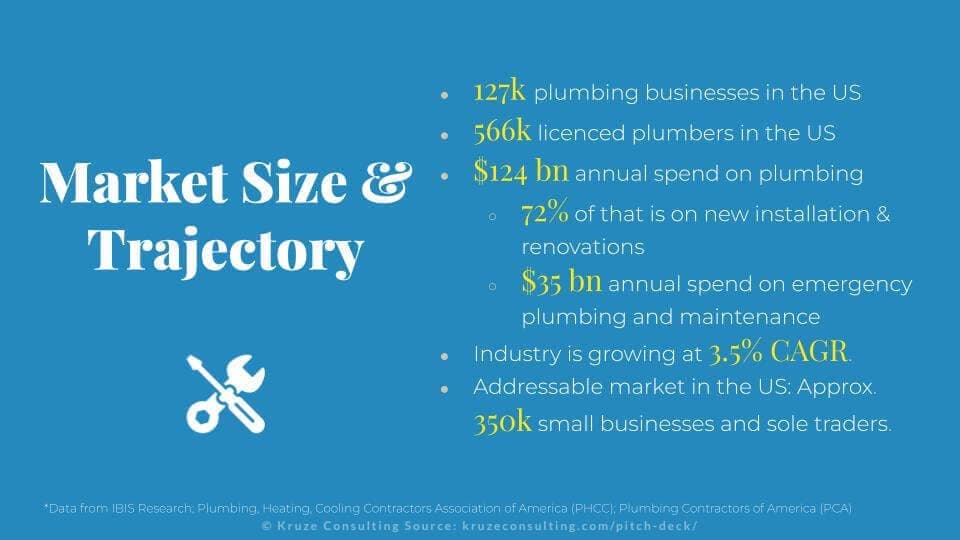
B2B Pitch Deck Market Size Slide 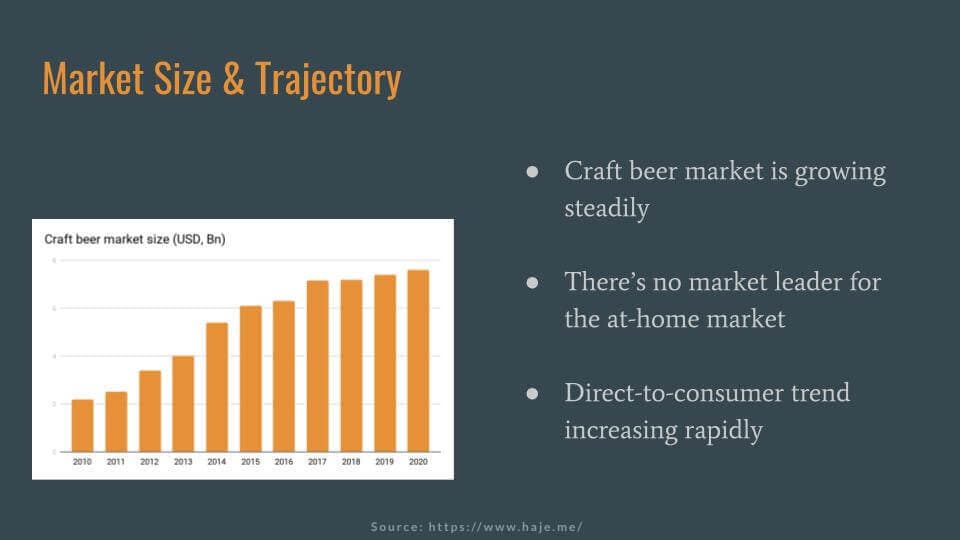
B2C Pitch Deck Market Size Slide
10. Competition
No company exists in a vacuum, and the competitive landscape will affect your chances of success. We discuss a few ways to present a map of what's happening in the market.
Healy Jones:
Hello and welcome to the continuation of the Kruze Consulting free Pitch Deck Creation course. Today, we're going to talk about a relatively important sometimes somewhat underappreciated slide, the competition slide. If you are new to this course, we'll give you a quick background on who we are there. If you have been following along, just skip ahead about 30 seconds and we'll get into the meat of the discussion.
For those of you who are new, I am Healy Jones. I am the VP of FP&A and Kruze Consulting. One of the leading accounting and finance consulting firms serving venture capital backed startups. Our clients raise over a billion dollars a year. It's part of my job to help prepare our clients for the fundraise. I am joined by Haje Kamps. Haje is not only a tech crunch reporter, former venture capitalist, and startup founder, who has raised money, he's also one of the better known pitch deck consultants in Silicon Valley and the author of Pitch Perfect, which you can get on Amazon. Haje, how are you today?
Haje Jan Kamps:
I'm doing great. How are you?
Healy Jones:
I'm great. This is the competition slide. I love it. Let's dig in here. Everybody follow along on kruzeconsulting.com/pitch-deck. Let's do it. What is the competition slide for, Haje?
Haje Jan Kamps:
The competition slide is your opportunity to kind of… Typically, you've done your market size and that kind of stuff. Now you get to really position yourself against the other operators in the market. I think it's a really helpful slide to help remind people why this even exists. I occasionally work with founders who say that there is no competitors and they're almost certainly wrong, right-
Healy Jones:
Yeah, that's a big red flag, that if you're a venture capitalist… When I was a VC and I heard someone say, "There were no competitors," my first thought was, "This guy, person, may not know what they're talking about." Or the second thought is, "Well, maybe there's no market." Neither of those two little flags are the ones you want to go up in somebody's mind there while they're talking with you.
Haje Jan Kamps:
Yeah, absolutely. This is the thing, if people are willing to pay money to solve this problem, there is a competitor. It may not be obvious. There might be some really obscure ways that these things are competitors. But if people are not willing to pay for solving the problem, it means that you essentially don't have a market and you don't have a product.
For most companies, they know that there are competitors and it helps to prove that there's a market that people are willing to pay. It proves that you have somebody to steal customers from. You can compare yourself to the other competitors. Like, "Are they using a slightly different business model? Are they using a different customer acquisition funnel? What are they doing for customer acquisition?"
Just looking at their advert and what they're running can really help you shape how you run your advertising campaign. It's a really good way to kind of find out both what the market looks like, but also to develop your blue ocean strategy. Don't go and fight in the red bloody ocean with the sharks, find out where you can compete, where they are less active. If it's early enough in your business journey and you can actually carve out a slice of the market that way.
Healy Jones:
For sure. Sometimes I found when presenting this slide, nothing really happens, that everyone nods and you move on. Other times, this is a gateway to a pretty important strategic discussion around how the market is structured, what features or go-to-market strategy customers want, willingness to pay, market size and things like that. This slide can sometimes start some pretty important strategic discussions. Sometimes those discussions should be held on different slides. If the VC really is digging in on the go-to-market of the competitors, after you're on the slide, it may make sense to jump to your go-to-market slide so you can showcase how you're going to market. Then, keeping in the back of your mind, you're differentiating. You can compare your differentiators, but overall pretty much every company should have competitors or alternatives.
This is thinking of the famous example of course of Ford saying his customers would want a faster horse instead of a car, but Ford's competitors were horses. So, it would've been completely acceptable for him to have mentioned horses on his slide. Then additionally, if there were companies that had brand recognition that we're doing cars probably should mention those as well, but everybody should have competitors. It's a sign that there's a real market. It's a very positive sign to have competitors. Competition is good.
In my mind, the best kind of competition for a startup to have are the big, slow incumbents who are probably not likely to embrace technology, faced with innovators, dilemmas, etcetera. In an ideal world you're innovating in a space where there's big, slow incumbents where you can come from underneath them or from a different angle.
Haje Jan Kamps:
Yep, absolutely.
Healy Jones:
So, talk a little bit more about putting alternatives on this slide. So instead of just saying, "I'm selling spoons and here are spoon competitors." Maybe spoons is a silly analogy, but that does make sense to kind of talk about how the market is currently being served, if it's a different type of a solution.
Haje Jan Kamps:
Yeah. I think there are two things here. One is predicates and one is competitive alternatives. Predicates are like, "How can you compare this market?" I love using Peloton for this because when Peloton came along, there were already exercise bikes and there were already spin classes. And, they kind of said, "Hey, what we are doing is we're taking the spin classes that people have in person and the exercise bikes that you have at home and we're smushing them together with content."
It was kind of genius. It was very hard to explain, but by using the two predicates you can explain how the product makes sense and how it makes sense in the marketplace. Because you can kind of say, "Okay, what's the market for exercise bikes? What's the market for spin classes," and you kind of fudge something in between there. For their particular thing, I'm getting a little bit into the product here, but for their particular thing, they're like, "Look, there's lots of stay at home moms who really want to go to spin class, but can't do it. And, it's very hard to get on an exercise bike without any sort of encouragement."
Another one, I think in one of the previous episodes you made a joke about sock folding robots. I feel like there are a lot of competitive alternatives for sock folding robots. Maybe you have a laundry service, maybe you have a maid, maybe you just keep your socks in a giant pile at the foot of your bed, whatever works for you.
Healy Jones:
Great idea. I am going to follow that one, yes.
Haje Jan Kamps:
It works great for me. But, there are lots of alternatives here. So the question becomes, "Are these alternatives good enough?" They don't have to be perfect, but if you're starting to charge money for something, your product had better be a lot better than the other alternatives for people to go, "Oh, yeah, that habit I had, I'm now going to change into using your sock folding robot." So, all of those kinds of alternatives and these are slightly silly, but there are pretty much alternatives for absolutely everything out there. For cars, there are alternatives, there's public transportation. So if you're the first person developing a new type of car, you better explain why your specific car is better than any other car out there or better than public transportation.
Healy Jones:
So again, for this slide, what you're doing is you're proving that there's a market. You're proving that people are willing to pay for this solution or to solve this problem. That's a good thing. You're helping the investor become comfortable with, "Hey, I'm not just shouting it to a void. There's actually something out there that people are willing to pay for." You're showing your differentiation and perhaps explaining why or how you have a moat to or some sort of a unique, competitive advantage.
I think just as importantly as those first two things, you're showing to the investor that you understand the market. You understand the market dynamics. You understand what customers are thinking about when they're making a purchase. You understand how they want to make the purchase and go-to-market. You're understanding what the major competitors are doing. Now, you don't have to get into all of those details on this slide, but if you're challenged on any it would probably happen or may happen on this slide. Use this slide as a foil for you preparing yourself to answer those questions regardless of where they come up inside of your presentation. Regardless of what the investor asks you, think about it as you put this slide together.
Haje Jan Kamps:
You touched on this slightly earlier, but occasionally you are entering a market where there is an enormous competitor. That's a household name that everybody's heard of. If you're about to start launching an electric car, somebody's going to mention Tesla at some point. So, you have to be able to describe how you're different. If you're exactly the same thing, then the incumbent is going to win. There has to be some sort of edge that you have over your competitor and that edge runs pretty deep. You have to understand their business models. You have to understand their products. You have to understand their sales strategy. You have to understand maybe even their fundraising. How much money do they have? If they've raised 3 billion and you're showing up and going, "Yeah, cool. We can do this." You're going to have a really hard time because even the investor looks at this and goes, "Well, unless there's something really special here, you're not going to be able to take on this enormous incumbent without a formidable amount of funding."
Healy Jones:
Yep, I agree with that. So, in general, every time we talk about the slides, we try to explain what stage company needs to have the slide because sometimes it's not necessarily applicable for a very early stage company or later stage company. However, every stage business pitching to raise venture capital funding needs a competition slide.
Haje Jan Kamps:
Yeah, agreed.
Healy Jones:
Everyone needs one. Now sometimes, they're almost folded a little bit into the market size. Uber did that in an example that we shared earlier, where they talked about the taxi market. However, I would recommend you have an explicit competition slide unless there's something super unique about your business. You want a competition slide. So, let's talk about what you are trying to prove if you're at an early stage and not really generating much revenue yet.
Haje Jan Kamps:
It's interesting. I think the slide might look exactly the same for those two stages, but the story is different. At a very early stage, the story you're telling is like, "This is the competitive landscape and here's how we're going to get a foothold in this market." You just need a toe somewhere so you can start climbing.
When you're much later stage, now you're talking about, "Okay, we have a foothold in the market. We are real players. How are you going to do conquest sales, i.e. steal customers from your competitors, or how we're going to do market expansions, and what does that mean to do competitive landscape?" I think really thinking about how you tell that part of the story is a helpful way of structuring this slide.
Healy Jones:
Right and so at the early stage, you'll probably use a lot of "We believe, or we think that XYZ will happen." Once you're generating significant revenue and more likely you can be a later stage company raising funding at that point. You should be able to talk to more specific anecdotes or data around how customers appreciate your product or differentiate your product versus the competition.
You should be able to say things like, "20% of customers choose our product over this particular competitor because of this reason and the other 80% choose it because of this." As you get later stage, you should have data backup, at least in your mind, that you can use to really explain why, "Hey, this is the feature that's doing it." Or, "This is the sales process." Or, "This pricing." Or, "This messaging." These are the things… Hopefully, they tie to something that again is a moat or a key differentiator that is sustainable over time.
Haje Jan Kamps:
If you're a consumer product, of course, this is where you make sure you keep an eye on your own reviews and those of your competitors. If you are a B2B company with smaller but larger deals, you will have people in your pipeline where you lose the sale. Make sure you pick up the phone and call them to find out, "Hey, you picked Google over us. No hard feelings, but we're a young company, can I just talk to you briefly? I want to figure out why."
If you start getting in shape like, "Hey, the companies who have this particular need actually end up going to this particular competitor." That means you need to do one of two things. One, stop marketing to them. You're going to lose all those sales. There's no point, or shift your product. You can actually have a more compelling argument for the customer choosing you. When you're in an investor meeting and they say, "Okay, well, you have a huge incumbent here that gets lots of sales. Why are you losing sales to them?" It's a very good idea to have a good answer there.
Healy Jones:
Exactly. Great. One thing that we definitely want to point out here, like a big red flag that we're going to mention again, is it's a huge risk if you say you have no competition. It's really tempting to say that as a startup founder because you probably are creating something unique. You probably are creating something that hasn't exactly existed in the world before. That's what you're doing. You're a startup founder, but you hopefully are solving a real problem and businesses who might buy that or people who might buy that are not stupid. They would be solving that problem somehow already. It's not as if they have a bleeding wound that they've been ignoring for their entire life and that has been ignored for the past 20 years. If there is a critical problem that you're solving, folks must have attempted to solve it in some way, shape, or form.
Haje Jan Kamps:
Totally. We talked about Airbnb in our market size slide, and I think it actually makes sense here too. Airbnb had a real challenge because nobody really believed that there was going to be a market for this, but there was no risk. They could very clearly point to competitors. There's hotel chains. There are youth hostels. There is even couchsurfing.com. I don't know if that still existed, but that existed back then. So, they could say, "Look, these are the alternatives that people are using. We think we can start scraping off some of those customers and putting them on a platform and adding some safety and adding all these extra features that you don't get." That is a really clever way of talking about your competitor when you are in that very rare situation where the market doesn't exist. But in most cases, there's going to be probably direct competitors or solutions that your customers are already using to solve the exact problem you're trying to solve.
Healy Jones:
I'm going to actually jump into the Airbnb competition slide. Am I sharing the right screen? I hope I am.
Haje Jan Kamps:
Yep.
Healy Jones:
Can you see? Okay, great, perfect. We link out to some pitch decks that we think are really great and this is one. Let's focus a little bit on what Haje is saying here. Airbnb really was pretty unique and actually slightly crazy, like people are going to stay in your house. "What?" They did a nice job with their two-by-two. We'll get into the structure of the slide in a second, explaining how there are existing companies and how they're different. Like hotels.com, Orbitz, I don't know if VRBO was big then or not, but Craigslist…
The VC can orient themselves on this slide around those well-known logos. Just having the logos correctly spaced on this slide can help tell the story to a certain extent. Folks understand Craigslist, folks understand hotels.com. They get Orbitz. Seeing them triangulated like this can help the venture capitalists start to feel more comfortable that people are willing to pay money for this and that there's a possibility of differentiating. They understand that Craigslist is very different from Orbitz. Therefore, it seems possible that you could have something that is differentiated against those solutions as well. It's a really helpful slide. I think it probably is-
Haje Jan Kamps:
Sorry, go ahead.
Healy Jones:
I was going to say, you start to get into the meat of how you actually build this slide now.
Haje Jan Kamps:
Yeah, totally.
Healy Jones:
I think two-by-two is the most popular, right?
Haje Jan Kamps:
And, that's what this is. It's the two-by-two, or sometimes known as the crosshair. You typically have two axes, in this case, offline and online transactions. Reading this now in 2022, it's kind of hilarious to think that anything would be an offline transaction, but there you go. Then, affordable and expensive, it makes perfect sense to split it up that way for the story that they're trying to tell. Then they've just lobbed everything into these categories.
Now, personally, at this point, I would probably think security is much more important. "Are you staying with a serial murderer or staying with somebody who is safe?" So the online/offline doesn't make sense anymore today, but people are worried about their safety. So, you could have the same crosshair, but tell different stories depending on what you put in the different categories. So, think really carefully about how your company differentiates itself. You're always going to be in the top right because that's how these things work. But then, think about how you tell this part of the story.
And what often happens is that people say, "Okay, we're looking at offline to online. We're looking at affordable to expensive. Let me quickly talk you through them." You start top right and you kind of go counterclockwise around. You go, "Okay, this is what happens here. This is what happens here. This competitor is interesting. We're keeping an eye on them, but we think they're moving in that direction. They're getting more expensive because they're taking that slice of the market. We found a way here that by leveraging empty bedrooms and by leveraging online platforms and booking and Ebay style reviews, we think we're creating something here that is completely unique."
By telling the story that way, you can actually really draw people in and say, "Okay, well you're not saying anything bad about any of the competitors," which we'll mention later, but there's a really interesting way that you can use this as a narrative device to really kind of nail home this part of the story and say, "Look, yes, there are competitors, but we are offering something that nobody else is doing."
Healy Jones:
That's right. So hopefully, this helps reinforce the fact that you've got a market and how your product is different and how you're going to go-to-market. This slide really is one of those ones that's sort of like a linchpin. Let's show a few other examples. As we've mentioned before, we have created two free pitch deck templates that you can download off kruzeconsulting.com/pitch-deck. One is a consumer focused and one is a B2B focused pitch deck example.
Again, don't judge us on these businesses. We're not starting these businesses. We're just trying to make some slides you can use. The first one is a beer delivery service, possibly a questionable business model, but does create the opportunity to show how to build a competitive slide in a market where there's not a ton of direct competitors. So, Haje, do you want to talk about how you built this slide here?
Haje Jan Kamps:
Yeah, I was kind of thinking about this admittedly very silly company, "How do you tell the story of the competitive landscape?" So, it's the amount of work you have to do so ease of use or convenience is kind of the value. You can think about all of these things as USPs. The unique selling point or the value proposition of your product. BeerSub is top, right. The value prop is premium quality and no hassle. If you think about the Airbnb one, the value prop was online. Are you switching to it?
Healy Jones:
Yep. I'm switching to it.
Haje Jan Kamps:
The value prop is it's affordable and it's online. It makes it a very simple way of talking about the value prop or the USP of your company. Now for the BeerSub company, premium quality and no hassle at all. Then now, with this one I would actually tell the story that way, "Hey, we're completely unique. We're the only premium quality microbrewery delivery service that makes it super easy for you to discover new beers." What are the competitors? "Well, you can go to your local brewery, but that's a pain in the butt. They have weird opening hours. They only have their own brews. You don't really get that much experience. You can go to your local supermarket, but it's lots of work. You have to go there. You don't really get any guidance. The liquor store, well maybe they have some people who are beer enthusiasts, but it's really hit and miss. And, they're generally cheap for a reason."
Then there's, Hopsy. Hopsy is the one direct competitor that exists in this space and because it's such a competitor, for this particular slide, I created a second slide that does a direct one-to-one comparison for how it's different. Now you should be prepared to talk to this, as we said earlier, for all of your competitors, but because Hopsy is such a straight up direct competitor. Well, okay, "How is it different, and how can we tell the story?"
Now, I'm being a little bit flippant here, like at the bottom, "good for impressing, LOL, are you kidding." Would I put that on a VC slide? Probably not, but it depends on the voice of the company. If you have a company that is kind of loosey goosey about how it uses language, it is maybe okay to use that, but you have to be very careful about how you-
Healy Jones:
You want to be careful. I think-
Haje Jan Kamps:
Very, very careful.
Healy Jones:
… actually, if I was to do this slide, I might go to one of those online review sites where maybe they have a three star rating or something and say three stars and then something in parenthesis that's clearly you've taken for one of the reviews that a person has put there. However, you want to be careful because you don't want the VC to say… If you don't have a solution for that issue, you're going to get egg on your face as well. So, if you say something like, "The beer is delivered stale. That's why they stink," and you don't have an answer for how your beer gets delivered, not stale. Guess what? You just shot yourself in the foot.
Haje Jan Kamps:
Absolutely. In this one though, the reason why this kind of works is that you have a very specific differentiation and value prop for your company. The beer dispenser is different. The kegs, it works out way, way, way cheaper, because you're working with bigger kegs. The selection, what is the selection for the different things. Recommendation engine, I think for this particular company, the recommendation engine is actually the magic sauce and Hopsy doesn't have that at all.
So, you can kind of talk to each of these and you say, "Look, when we do our marketing for some of our customers, they care about cost. We can do cost-based marketing. For some of the customers, they care about the recommendation engine or about beer connoisseurs. They're not for random keg parties. There are people who really care about beer." So, you can actually talk a little bit about here, "Yes, there are competitors, but here's how I would market to the customers using our differences." You can treat this slide however you want, but you can get really good conversations going with your VCs and sometimes they will also come up with really insightful questions at this level.
Healy Jones:
From a design perspective, if I was to have built this slide and the recommendation engine was the key differentiator that I wanted to hang my hat on, I would've put that either at the top or the bottom of this table, so that it's easy to have your eyes linger on it instead of bearing it in the middle.
Haje Jan Kamps:
Yeah, I completely agree with you and this ladies and gentlemen is why I don't offer design services. I got an awful designer.
Healy Jones:
But from a design perspective, I'm very happy that you shared this slide because a matrix like this or a table comparison table is a great way to do your competition slide as well. So, if you have a few competitors, you could put them in here. I also recommend that if you think that the competition is going to be a big part of your discussion, that maybe you have a two-by-two in your main part of your deck and then in the appendix, you have something like this where you're laying out the critical competitors. It's also okay to say, "Group some of the competitors together, if they're similar ones." So, if they're three incumbents that have relatively similar solutions, lump them together in one column and then put the more interesting ones into the other columns. That's fine. You get to use your judgment on that, but it is possible that-
Haje Jan Kamps:
I have a story there.
Healy Jones:
Okay, go for it.
Haje Jan Kamps:
Healy, I have a story there. In one of my previous startups, I was doing something in virtual events. Every single VC conversation I had, they were like, "The competition, the competition, the competition." Back then, Hopin, which wasn't big yet. They were about to become a multi billion dollar company. We saw them coming. My competitor slides were two slides long and had 50 competitors on it. I grouped them together. These looked like they're competitors, but Zoom really isn't a competitor because it's used for this kind of thing. These look like they're competitors, but they're not because they're used for collaborative work and that's not really what we're for.
So, I was able to put away something like 40 competitors by just grouping them together and explaining why they were different. Then, I had one slide that just talked about the direct competitors and it turned out to be a really powerful way of… Because otherwise, we just kept getting stuck on a competitor's slide and were like, "Oh, have you thought about or have you done?" I'm like, "Guys, we're having the wrong conversation here." So, it's one of the very few times where I ended up having two competitor slides just because there were so many of them.
Healy Jones:
So, in the venture world, there are occasionally and they're often consumer companies although I was trying to see it also on the enterprise side, they're copycat companies. So, if you are launching a business or raising funding for a business in a market where there are a dozen competitors who've all raised funding in the past year or so, that strategy is a good idea because you are going to get questions around, "Is the market too crowded? How do people differentiate? What's your moat?" So, being able to clump together and potentially having two slides can show that you're paying attention to the market and help prove that you feel like you can differentiate in what is becoming a crowded market.
Haje Jan Kamps:
And, in that-
Healy Jones:
That's really great. I'm glad you mentioned…
Haje Jan Kamps:
In that very specific example, actually, what we ended up doing was white label events. So, there were a small handful of competitors and they were 10 times more expensive. So what our leverage ended up being was like, "Well, yes, we've run hundred thousand dollars events, but you can change everything. It can be completely customized. It will be completely indistinguishable from your own platform, except it's a platform."
So for people who really cared about brands and people who really cared about owning the full story, the full narrative, all the way through. I'm under very strict NDAs, but you will have definitely heard of the brands who used us. But yeah, it was really powerful and that became a really powerful story for us, for the VCs. Like, "Hey, you know who uses us? These three brands you've heard of. You know-
Healy Jones:
That's great-
Haje Jan Kamps:
… why, because nobody else can offer what we offer." It turned out to be a really good part of the story.
Healy Jones:
So, if you're in a competitive market, just be prepared to go on this slide. This is really important. Now, there's one other structure. We showed you the two-by-two and we showed you the comparison table. There's another structure called the market map, which I haven't found a good example of in a long time. I did one a very long time ago when I raised funding for one of the companies I was with, but I don't have that example. That is a third way to do it that is probably the least common. If that's something you like, VCs will be okay with it as long as you're able to speak to it.
Now, let's flip over to… We showed a couple examples that are consumer focused. Now, let's flip to the enterprise example that we made. This is for a company called 4P, which is selling a CRM customer management booking solution into plumbers. Again, don't judge us on the company. We're just trying to make pretty slides that you can use to tell a story so that you can create a great pitch deck. So, Haje, here we have a classic two-by-two, talk to me about this thing.
Haje Jan Kamps:
Yeah, the idea here and again, please don't judge us. I don't know that much about plumbing. The idea was to keep… So plumbing is a very kind of vocational job. The few plumbers I know tend to not be particularly technical. So, the assumption I'm making here is that in order to make a product, it has to be super specialized so it really works for the use case and it has to be relatively easy to use. I was looking at the landscape and it turns out there are some direct competitors.
Service Titan is a very well reviewed product in this space and it takes some setting up. It takes some configuring to get it running. It is pretty specialized. Then, you have things like FieldEdge and Jobber that are more for general contracting work. I guess you also have kind of the thumbtack type apps where it's just for dispatching and getting work.
Then further on the left, the more generic tools you could use SAP for this, it would be fantastically overkill to use an SAP CRM for a plumbing business, but you could. Salesforce again is infinitely customizable. You could probably build a very good solution based on Salesforce, but you have to be technical enough to be able to build your solution around that.
Then, there's more generic CRM tools like Zoho and all the others… There's thousands of CRM tools. You can probably use most of them for plumbing, but the argument we're making in this particular pitch is like, "Look, for this one you sign up. The next day you're ready to go, It's easy to use, and it's super specialized for plumbing. You give us the profile of the kind of bus plumbing business you are and you give us the name of your various plumbers and their availability and you're good to go." I think in this particular competitive landscape story, if I also do the research on the pricing points and the marketing and all that kind of stuff, you can tell a really compelling story here for why four 4P is actually a really compelling competitor to this pretty crowded landscape.
Healy Jones:
A few awesome things on here. One, we're showing very large companies as competitors. I think SAP and Salesforce are probably top 10 global software companies. That's not a problem. In fact, the secret undertone here is, "Hey, we could exit to one of them if we really do well."
Haje Jan Kamps:
Oh, absolutely.
Healy Jones:
So, that's actually pretty amazing. The secret undertone of this slide is, "If there's big companies on here, who can I sell to in 10 years if I'm kicking butt?" So, that's pretty cool. But also, you're saying, "We understand this market better." So on the one hand, it's speaking to what the customer would want. "Our understanding of this customer is that they need something easy to use and that's what we're focusing on."
I think the second part of this is that it's talking about the niche or the go-to-market and now this company will eventually expand into stuff that's not plumbing, but we're starting with plumbing. This slide ties neatly into several other important parts of your slide. I guess, as I'm looking at the one design thing I have with this slide is the 4P logo is actually almost too far up and to the right. It's almost invisible. In fact, I guess I could probably just edit this right now. Can, I just edit this and [inaudible 00:30:16].
Haje Jan Kamps:
Yep.
Healy Jones:
I probably would've put it right here and maybe even a little bigger.
Haje Jan Kamps:
Welcome to live editing on slides.
Healy Jones:
There we go. Oh, no, I messed it up. I got to move the format. But anyway, this is probably where I would put it so that it's super kind of clear what you're doing.
Haje Jan Kamps:
I like that logo better anyway. You did a good job there. See, you were hired as a designer.
Healy Jones:
All right. That's good. Well, that's what I'll be in my final life. I do have another example that I'd like to show. We link to this off of the Kruze Consulting pitch deck as well. This is for a company that I don't know very much about called Front, but the CEOs was kind enough to write a nice medium post about their slide deck that I think is really helpful. Again, I link out to this, and I'll just make this bigger so you can see it.
A thing that they do that I think is great, is that… They compete with Salesforce and they compete with Amazon and they compete with Microsoft, but they don't just put the Salesforce logo and the Amazon logo and the Microsoft logo. They actually put the specific division that they compete in. Which on the one hand, you're proving that there's big competitors who potentially could buy you and when big competitors do stuff, there's a market, particularly when they have divisions. But on the other hand, you're narrowing down the scope to the point where it feels a lot more achievable and understandable. So, if they had just put Amazon on here, it would take the VC a few minutes to really orient to like, "Well, Amazon does all kinds of stuff."
Haje Jan Kamps:
Are you opening a book shop?
Healy Jones:
Yeah, exactly. "Is it books?" Or, "My kid watches the cartoons on Amazon, is that what it is, or… " "Oh no, wait, it's Amazon web services. I got it now." Instead, they just put AWS on here, and it's like, boom, VC can hone in on the specific thing that the big pipette company does that you're competing against. That is the reason why I wanted to show this slide. I thought they did a really nice job with that.
Haje Jan Kamps:
It's interesting too, because the axis here is good or bad messaging experience and business writer or consumer. So, really what they're designing here is a business ready, great messaging experience company. Well, I know of a company that exists in that space now. Slack is huge there and Hipchat is huge there. There's a whole bunch of other ones that showed up and are doing stuff there. And interestingly, Twilio, which is now a bad messaging service and consumer has actually fully moved up to the top right now. Twilio has really good deep integration type services. So remember, like we've mentioned before, don't just reuse your competitor slide. Well, if they were trying to raise another round of money here, Twilio has moved. AWS has moved. Messenger has now got a business product so that has moved to business-ready. Slack should be on here. So, don't get lazy-
Healy Jones:
Slack was acquired by Salesforce as well so as part of proving that you know what's going on in the market, if you're in this… This slide deck is from 2016, so…
Haje Jan Kamps:
Yeah, I'm not giving the guy a hard time-
Healy Jones:
It makes definite sense for the time that it was built. But, if you are in this space and you are not aware that Salesforce acquired Slack, the VC is going to look at you kind of funny. You need to know what's going on in the competition. In fact, Haje, you mentioned when we were doing a warm up call, that you had an example of a company that talked with you that was not aware of the competition and it would've been very bad for them in a pitch if they-
Haje Jan Kamps:
They would've actually been laughed out of the room which would've been very sad. After my book came out, I had a ton of 20 minute calls with founders, and many of them are not really ready to start raising money yet. But, I love talking to founders. I love having conversations. So, I'm very happy to take those calls. There's this one guy who came to me super enthusiastic. He was clearly a gym buff. He was sitting with a bunch of exercise equipment behind him. He was like, "Okay, I've got his great idea for an exercise bike, where you can put an iPad and then the iPad can play exercise type videos to keep you motivated because that's important." And I was like, "Oh, that sounds really cool. How do you compare to Peloton?" And he looks at me and goes, "Who?"
I was like, "Very funny." He goes, "No, seriously, who?" It turns out he had never heard of Peloton. He built most of a product and had the full idea. I was like, "Okay, at least Google the market you're in or occasionally… " That was at the time when Peloton advertising was absolutely everywhere. I was just like, "Okay, how did you not find your biggest competitor?" My heart went out to him because clearly he'd done a lot of work here, but a couple of Google searches could stop him from having to try and found a company that has a really powerful incumbent.
Healy Jones:
Also, you would hope that this individual was talking to folks and throwing his idea out to people-
Haje Jan Kamps:
Who say, "Sounds like Peloton."
Healy Jones:
This is sometimes a problem for founders who are so secretive that they won't tell anyone what they're working on. Therefore, they miss common market intel because they're so focused internally and not listening and getting input from people in their network.
Haje Jan Kamps:
But just to kind of extrapolate slightly from that, that was an extreme example. But, I do get examples like that both on the competitor slide and in general quite a lot where it turns out that you need to be out there talking to people, talk to customers. If this guy had spoken to five customers or had one advisor or anything, somebody would've mentioned Peloton to him. So, the fact that he got far enough to build a product, build a pitch deck, and then contacted me to go and raise money. That was the first time he found out about Peloton. It's a really, really bad sign. I actually declined to work with him. I was like, "Hey, I'm really sorry. Do some more research and go do your thing."
Healy Jones:
I think that gets us to the common issues here. That is one of the top issues where you're missing major competitors or heaven forbid the venture capitalists knows a lot more about this market than you do.
Haje Jan Kamps:
Yeah, if you get to your competitor slide and the VC mentions… This actually happened to me with the virtual events platform. Every time I had a conversation with the VC and mentioned a new competitor that I hadn't heard of because there were 90. At some point I just gave up, I was like, "Okay, right, I'm going to spend two days researching every possible competitor out there and do all the research and write up a full thing." But, you have to know your competitive landscape. That doesn't mean that every single competitor has to appear on the slide, but you can't get blindsided by somebody mentioning a brand new competitor to you in a pitch meeting. That's just really unprofessional-
Healy Jones:
Agreed. Then, I think the second part of that is, if this is a huge problem, and the market is solving it in some other way with some other solution, not being able to speak to that solution or not being aware of that solution, so not considering what the alternatives are.
Haje Jan Kamps:
Competitive alternatives are crucial to know about, and you can actually put them on your slide. There's nothing wrong with taking a kind of competitor and putting it on there, just to say, "Look, I'm aware they exist. I'm aware this is how the problem is currently being solved, but it's 10 times more expensive than what we are doing. So, don't worry about them." It works really well as part of our conversation.
Healy Jones:
Great. The other major common issue I've seen is where you bash the competition. You just rip into them. You shred them. You're cruel… I'm trying to think of the right word here, but just to the point where you almost seem like you're blind to what your potential faults might be.
Haje Jan Kamps:
I think it's really unclassy, and there's two big ways that this will come back and bite you. One, it's a really small world. If you're talking to an investor in this space, there's a pretty good chance that they've met or know the other founders. They are not stupid. They got this far. They're not stupid so calling them stupid or calling clueless is not helpful especially if they're a little bit ahead of you. The other thing is this founder might potentially be an exit for you at some point. If you are bad mouthing a competitor who might eventually buy you, they may just choose not to buy you out of spite. I think if you were a jerk, people wouldn't want to work with you. That could actually get in the way of your acquisition. If that rumor gets out that you're a horrible person, don't be a horrible person. It's really easy.
Healy Jones:
In particular, bashing startups is… You could look very petty if you're not-
Haje Jan Kamps:
We're all just our best.
Healy Jones:
Right. However, you do want to be able to say why you're different from the competitor. You want to say, why do customers choose you? So, there is a fine line here when you're asked about a specific customer… So, for Kruze, for example, we have a few competitors that are pretty well known and we don't bash the competition. But, we do say that we have a thousand clients and we've only lost two to this particular competitor and yet we get five of their customers a month. Maybe not bashing the competitor, but we're kind of making it clear that there's… We're a little bit better.
Haje Jan Kamps:
There's a really good expression in British English that is fit for purpose. You don't ride a road bike on a mountain bike path. You don't ride a mountain bike to do the Tour de France. There might be competitors out there that solve a similar problem, but for a different clientele. That is fine. You don't have to bash them for it. You can just say, "Well, it's a different competitor. They're doing something slightly different. I wish them luck, have fun. We're going to go do our thing over here." That is a much better way of approaching this part of the story. Especially, if you can link that with your strategy for go-to-market or your fundraising strategy or your customer strategy. This is a very strategic slide. It's not just a list of companies you Googled in the last 10 minutes.
Healy Jones:
So, if this slide is just a bunch of logos and even a bunch of logos kind of in a two-by-two and that's it, it's not far enough. You need to be prepared to have this slide be very strategic. You need to have thought about this. You need to understand how you will politely differentiate your superiority versus the competitors. How you will politely and hopefully convincingly explain why there's a moat. It's really important. Then again, this is important for your story arc. It needs to mesh with your product, your go-to-market, your traction, all that. So, this is an under appreciated slide, I'd say.
Haje Jan Kamps:
In particular, make sure you know the business model. I think a lot of the time, especially if you're differentiating on that front, if you're a SaaS company in a traditional software space, or if you have a rental model or a subscription model in a space where it's usually people buy to own, make sure that you know what your competitors are doing. If they're launching something new that encroaches on you, you need to be able to speak to that. Why that is a problem for you, or why it wouldn't be because this is the kind of stuff the business model piece that is so important for how your company's going to work vis-a-vis your competitors. And, the extension of that, how venture fundable you are. Ultimately, this is all about the investors seeing an exit. If they can't see an exit happening in their wildest, most wonderful dollar color dreams, it's going to be a short conversation.
Healy Jones:
That's awesome. I think that actually can bring us to the summary here. This is a critical slide and there may not be a ton of design work that goes into this slide but the thinking that goes into this slide, you should be thinking a lot as you put together this slide. Investors know that competition is not the end of the world and the best VCs actually like competition because it's proving that there's a market and there's potential exit as you just highlighted.
This slide should be used to help advance your story, to explain how you're better and different, explain how you know the market really well and if needed, tie or jump to other parts of your presentation. Don't be afraid to have an appendix where we have a lot more detail on the competition and how you're different. But, I think the most important takeaway of this is don't be afraid of having competition. You want to show competition. You want to show the alternatives. You're going to prove how you're different, better and get the market. Perfect, love it. Well everybody thank you so much and hopefully you're enjoying this course and following along.
Haje Jan Kamps:
Thanks for tuning in.
Competition: Who else is doing what you do, and how are you different?
We sometimes see founders who say they have no competitors. Trust us; that's not a good thing. First-mover advantage is not really a thing; Google was the 19th search engine, and there were many smartphones before the iPhone came along. If nobody is doing what you do, it is harder: People aren't currently paying money to solve the problem you are solving, which means that you both have to educate the customers that you are solving a real problem and selling to them at the same time. A good competitor slide, along with an explanation for how you are different from the existing solutions, is an important part of a good startup pitch deck.
Slides for the Competition section
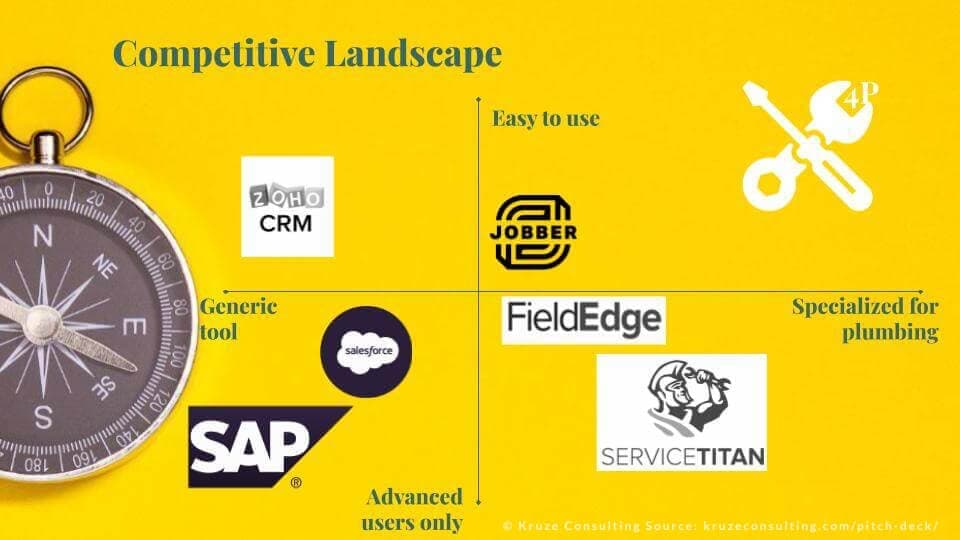
B2B Pitch Deck Competition Slide 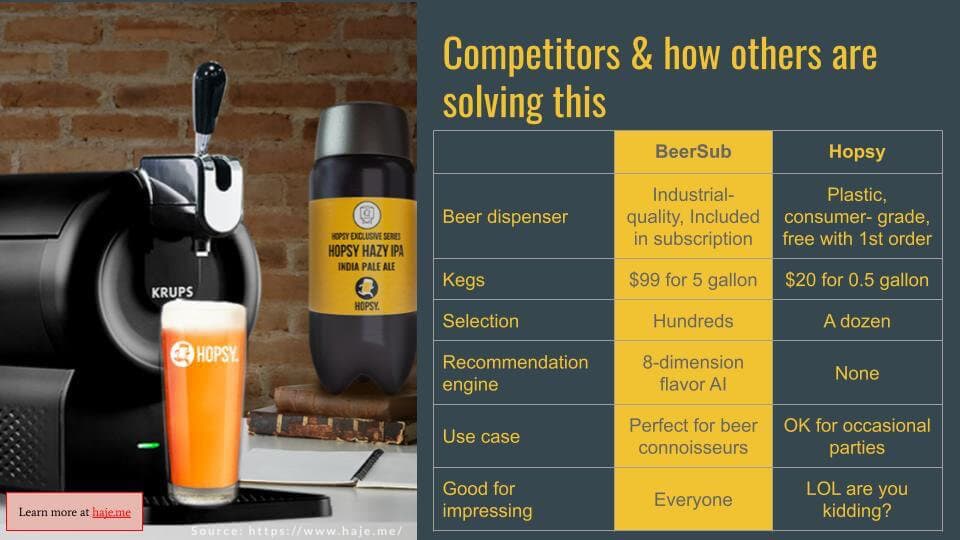
B2C Pitch Deck Competition Slide
11. Operating Plan
A lot is going to happen between when you raise this round and the next. The operations plan is a detailed road map of how you're going to get from here to there.
Healy Jones:
Hello, and welcome to the operating plan slide of the Kruze Consulting venture capital pitch deck free course. Our course is designed to help you create the ultimate venture capital pitch deck or at least one that is competent and won't get you left out of the room. You decide. I am joined as usual by Haje Kamps. Haje is a former venture capitalist and an accelerator, a startup founder who's raised a lot of venture funding, and a writer for TechCrunch. And of course, he's written the book, Pitch Perfect, which you can get on Amazon. It's how to create a venture capital pitch deck. And just as importantly, he is a very active consultant who helps companies put together their pitch decks and put together their stories so they can raise funding, Haje, how are you doing, and where can folks find you on the internet?
Haje Jan Kamps:
I'm doing great. And yeah, you can find me at Haje.me, easy enough, which is where the pitching and my book lives.
Healy Jones:
Perfect. And the entire Kruze Consulting venture capital pitch deck course lives on kruzeconsulting.com/pitch-deck. K-R-U-Z-E consulting.com pitch deck. Let's dive in here. Let's talk about the operating side or the operating plan. What is this operating plan? We talked about this ad nauseum and at Kruze, we help a lot of companies put together operating plans, their financial models, their projections, and help them fundraise with, what is this thing?
Haje Jan Kamps:
I think for me, what the operating plan is, it's basically a slide with numbers that really tells the story, but through numbers. So it typically lives towards the end of the pitch deck because that makes sense, but you kind of re-summarize all the things you're about to do in the space you can see. So typically, the operating plan should cover… Some people go as little as six months. I think that's a little bit low. Some people go for the duration of the current fundraise. I think that is probably the clever thing. So if you think you need to raise money again in 18 months, the operating plan should probably be about 18 months in length. And obviously, you have more granularity at the beginning where you have higher certainty for what's going to happen, and then it's a little bit more hand-wavy towards the end. But the important piece is that this shows that you know how much money you're raising, why you're raising that amount of money, and kind of the milestones and goals that you're going to do during that amount of time.
Healy Jones:
Excellent. I love that. So I advise clients, I run the financial planning and analysis team, the team that helps our clients put together models and projections and put together operating plans to present to VCs, and I like to tell them that this is essentially the strategy that you have for this… After you raise the capital, this is your strategy, but in numbers. That is what you're producing here. You're showing the VC, the numbers behind your strategy. So it really needs to match up. Another key thing here is you're going to click the reality of where your startup is now and draw the dotted line, hopefully, in a way that's easy for the venture capitalist to buy into, to where you're going to be when you next fundraise.
Haje Jan Kamps:
Yeah, absolutely. I guess it's worth mentioning in that world that VCs, even people who come from an operating background or come from a nonfinancial background, they are numbers people. And so this is going to be a slide that gets scrutinized and looked at very carefully because this is where you get to show whether or not you're a functional founder, essentially.
Healy Jones:
Exactly. That's right. Right. So as numbers people, the VCs are going to want to basically confirm that the money you're raising now can get you to a point where you can raise your next round. If you can't do that, it's called building a bridge to nowhere and VCs hate to do that. It is a common problem that I see founders make. It's a mistake that they make. They don't raise enough money to get where they're trying to go, and so the VCs feel like they're kind of throwing their money away because they know that the company's not going to reach the point where they're worth more.
Haje Jan Kamps:
Yeah, certainly.
Healy Jones:
And so, you definitely want to avoid that. And the VCs are also going to eyeball what you look like when it's time for the next fundraise. So they're not only going to want to make sure you can raise that money, but they're going to make sure you're worth a lot more.
Healy Jones:
The venture capitalist needs the money they invested to be worth three or four times probably what it was when they first invested. Now I've seen some compression there. The seed valuations are kind of getting really high. So sometimes, it's maybe 2X, but regardless, the company's got to be worth more. So there have to be some sort of metrics. There has to be something accomplished, something built, some sort of milestone reach, so the company's worth more as you next do your next fundraise, and this operating plan is showing the numbers as you get out to there. And it also helps you size the round, like how much you need to get where you're going. Right?
Haje Jan Kamps:
Yeah.
Healy Jones:
How much are you going to burn over the next few quarters? How many people are you going to hire? Things like that. And then, you're proving to the venture capitalists that you've got a plan and that you've got a good grasp, but the financial implications of your strategy in your business as well.
Haje Jan Kamps:
Yeah. When I work with my clients, this is actually often one of the first conversations we have. I ask them how much they're raising and they say $50 million. And I'm like, "Well, based on the business you have here, you're in the right place to raise about three." So if you want to raise $50 million to get to where you need to go, that's great. But what is the stepping stone? What can you prove between now and then to show that you are ready for that growth capital or for that larger chunk of cash? And I think really that's one way that you use your operating planning and your financial models. You see, "Okay, what are the milestones? What are the KPIs? What are the things we need to prove in order to really start raising?"
Haje Jan Kamps:
And so, find out what that is. And so, if you are an early-stage app company and you need to get, I don't know, a hundred thousand users, a fully functioning app, and a revenue run rate that makes sense, then, put that on your plan and then work backwards. Like, okay, how many staff do you need? How much do you need to spend on advertising? How much do you need to spend on this, that, and the other? And if you don't have the answers, then it's possible you're trying to skip a step. And I think it's a very good idea to raise a smaller amount of money, get that nailed down so you have a much greater clarity on how you would spend $50 million.
Healy Jones:
Yeah. So this stride is where you probably talk a lot about your fundraising strategy. At least why you're raising the money that you're raising. Right? And it's kind of double-click into what the venture capitalist is going to try to feel out. Because again, you're selling here. Right? You're selling. What you're trying to sell is that, "Hey, I've got a plan." Right?
Haje Jan Kamps:
Yeah.
Healy Jones:
The VC's going to dive in to try to use this slide to battle test your plan, to make sure your plan is actually getting you somewhere. And so, there are a few things you just mentioned there that are really important. There's some sort of milestones that you're talking about in your strategy, part of your deck, the numbers need to prove that you're producing them here. Right?
Haje Jan Kamps:
Yep.
Healy Jones:
If you say, "I need to get X million in revenue to raise my next round," you better have X million in revenue when you run out of money here on this slide.
Haje Jan Kamps:
Yep. Right.
Healy Jones:
It just has to be like that. Right? And there's also how much you're going to spend to do that? What kind of a team and how many people do you need? These are all things that can get reflected on this slide. Because again, this is the nuts and bolts of what you actually have to do. And you want to make sure that… We've already talked about the go-to-market or the traction slide. There you have things like if you have customers and revenue, you're talking about your customer acquisition cost and your revenue and et cetera. But you start from where you are, and then you go out to where you're kind of what you're going to grow to be with this money. And you want those numbers to all make sense. Right?
Healy Jones:
If your customer acquisition cost right now is a thousand bucks, but you're showing that it's a hundred dollars in this slide. If the math is I'm going to add a hundred customers and I'm going to spend $10,000 in marketing, well, the VC's going to say, "Well, that doesn't make sense because you told me that your customer acquisition cost was a thousand dollars so that means you should only add 10 customers, but you're saying you're at a hundred customers, why does that make sense?" Right? Make sure that the kind of reality of what is happening and what you're talking about in your other slides is reflected in the numbers here. These assumptions all need to tie together. Everything in here needs to work hand in hand with the strategy that you've outlined. And then also with the financial model that you may have an appendix, or you may have a standalone slide, or you may have an Excel file or Google Sheet that you share with them. Right?
Healy Jones:
All these things need to come together to tell a coherent story. And remember the story is, you're selling the business. Right? You're selling equity here so you want people to believe your vision.
Haje Jan Kamps:
Yeah. And I think this slide is where so many founders stumble. Right? Because a lot of founders are really good technical people. Right? They come out as an engineer or as a VP of engineering or something out of a bigger company, and they know how to build a product. Great. That is wonderful. But you have to also be a good founder and a good business person. And I think this is where the rubber really hits the road. Your numbers need to tell the same story as the hand-wavy excitement part of the story that you're also telling. And as you said, it really has to match up. I see so many times that people go, "Oh yeah, we're going to 10X our sales." And the marketing spend goes up 2X. I'm like, "Well, what happened here?"
Healy Jones:
Yeah, how.
Haje Jan Kamps:
"How are you suddenly five times more efficient with your marketing money?" And if the answer is, "Oh, we're going to hire a marketing guy who will figure it out for us." You're just not a believable founder. And I think the numbers here really hold up a mirror to you and you have to be able to look at them and go hand in hand, "Yeah. I believe I'm going to be able to do this." You're not going to get shouted at if you don't exactly hit your numbers, but it has to at least be vaguely reasonable, what you put in front of the VCs.
Healy Jones:
Exactly. And I generally suggest that you raise another quarter worth of capital.
Haje Jan Kamps:
Yeah. Right.
Healy Jones:
It's always good to have a little padding. You don't want to get too close here. You've got to keep yourself growing aggressively as you're approaching your next fundraise, and you don't want to be freaking out about running out of cash. That's just another thing to worry about. So do a future you a favor, if you can, raise a little more money. Of course, it's easy to say that when you're actually out there pitching. I've raised money too as an executive at startups and it's really hard. Right?
Haje Jan Kamps:
Yep.
Healy Jones:
Who needs an operating plan in their deck, Haje?
Haje Jan Kamps:
I think everybody.
Healy Jones:
Everybody.
Haje Jan Kamps:
I think it's the one place where you get to really shine as a CEO and really show that you know what you're doing.
Healy Jones:
Exactly. This is how you prove that you know what you're doing. Right? And so the other question that I have, or I've thought about is can you have a financial model slide instead of an operating plan? And I think you can if you do the financial model side really well. So the financial model slide, which we'll talk about in a little bit, and also Kruze has free financial models available on our website so just go to our resources section and click on free financial models. You can download those templates and use them. And also, this operating plan has a financial model template behind it. We will be sharing that Excel file as well so you could just use that if you'd like. But I think you do need a five-year plan. And one of the big problems that I see founders having is not having a big enough vision to justify raising venture capital funding.
Healy Jones:
Every quarter or more I see a founder come and say, "Hi, I need to raise 10, 15, $20 million in venture capital funding, and in five years, my business will be at its max size of $5 million a year of revenue." And that happens very regularly. I see that way too often. And I hate to tell you, but that is not the type of business that can raise that much money. It's just not a big enough business. You need to show huge outcomes. The VC wants your investment to return their whole fund. Right?
Haje Jan Kamps:
Yeah.
Healy Jones:
If they have a hundred million dollar fund, they want their 20% stake in your business to be worth a hundred million dollars when it gets sold or more. So you got to go big, and that's why I love the financial model side. Because you're telling the VC. You're thinking the same thing. "I'm going big. This is not a lifestyle business. I'm going to make a huge business. It's going to return your fund. Let's do this." That's why I love the five-year projections.
Haje Jan Kamps:
Yeah. Now I see the same thing a lot where people are not ambitious enough. And I think it's an interesting thing. Right? A lot of people get advice from people who don't really understand the mechanics and dynamics of startups. And you know, there's nothing wrong with running a $5 million a year business. That's impressive. But VCs are just not going to be interested, for exactly that reason. They are in a different business than you are. You are in a business of feeding the people that work there and maybe buying yourself a nice car. They're in the business of returning huge amounts of cash to their LPs. And if you're not singing from the same hymn sheet there, you just… I mean, it could be a good business, but it's not venture fundable and you have to be very, very aware of that.
Healy Jones:
I definitely, completely sure, completely agree with you. Right? I think the difference between… If you were to have two slides of an operating plan and a financial slide, the differences are, how far out you go so the operating plan is right, it's what you're doing with this funding. The financial model is five, three or five, four or five years out where you're showing how big you're going to get. I think the level of confidence can change. Venture capitalists understand that even nine months out and as a startup, it's like in dog years, that's 50 years or whatever. So it's like-
Haje Jan Kamps:
It covers the years, basically.
Healy Jones:
Exactly. Right. So they understand that you're not going to perfectly hit your numbers, but with the five-year plan, they're definitely not saying things like, "Oh yeah, for sure. You're going to have that number of customers exactly five years from now giving you that much revenue." They get that. But it's, again, you're doing the dance, and you're helping them understand how you're trying to think big, how your company changes as it grows.
Haje Jan Kamps:
Yeah. I think from my point of view, there's an important difference between the two as well. I'll be honest, financials aren't my biggest strength. Right? My eyes glaze over when I look at a spreadsheet, and it's not good. And I can work on it and make it happen. But when I'm trying to pitch something, I find that really distracting. And so the way I think about the operating plan is something that distills the financial information to the space I can see, and it overlays extra information as well. It overlays those gates we talked about that you need to do in order to raise that money. Call them KPIs, call them whatever you call them, but the important milestones, like product launches, headcount, KPIs, important bits and pieces of the puzzle, that all goes in the operating plan.
Haje Jan Kamps:
Yeah. Now, the financial model spits out some of those numbers too and uses them as input, but there's so much other data there that to me, it's very hard to read. And as a storyteller, when that slide comes up, I get like, "Ah." I get a little overwhelmed. So the way I design my operating plan slide tends to be much simpler with typically the numbers being rounded. They're really easy to read and look at. If it's $2 million, it just says $2M. It doesn't say $2,000,057. Right?
Healy Jones:
Right.
Haje Jan Kamps:
Because, in the storytelling sense, that's not relevant to me. And so, I think from a storytelling point of view, I love the operating plan because it really helps you tell the story without getting too bogged down. And then I would typically argue that the financial plan can go to the appendix because you don't want to end up wasting your time getting super nitty-gritty about the details while you only have a limited amount of time with your VC. Now, in the second or third meeting. Absolutely. You'll go and look at that. You might even go and look at the spreadsheet and you start playing with the numbers a little bit. They often like to look at it offline as well, to poke the numbers and see if it makes sense to them and actually ingest it properly. But in my experience, a pitch meeting just isn't really the right place to do that.
Healy Jones:
I feel like I've been able to help clients really simplify their five-year financial projections and put it in a slide deck in a way that resonates with VCs. Both of us have worked with clients that have raised a lot of money. Your clients have raised a lot of money doing it the way you've done it. And Kruze clients have raised six billion-plus in venture funding. Our way works as well. I think it really depends on how comfortable you are as a founder talking about these numbers. But you have to have some version of an operating plan or financial model in your initial pitch just to help-
Haje Jan Kamps:
100%.
Healy Jones:
… the VC understand the numbers behind what your strategy is. Right? You have to have it. So if you hate numbers, maybe work with an advisor like Kruze. That's one thing to do there.
Haje Jan Kamps:
Well, it's funny. Actually, we recently… I don't know if you knew this, but we worked together on a client. There was somebody who raised 16 point something million. And I really helped with the story, and he actually just took one of your financial models and dropped it in that. He's one of your customers as well, and did a really good job with that, and was able to tell the story from both angles. I think the truth is, you'll sit across from VCs. Some of whom are more focused on numbers and some of them who are more focused on the dream, and you should be able to tell the story both ways. Even if you're not a storyteller and even if you're not a numbers guy, you need to be able to do both.
Healy Jones:
Exactly. Yeah. And that was a great client. An engineer who understands, is not afraid of numbers, and really figured out how to tell this really compelling story as well, and raised a great amount of money without any revenue or anything. Right? Just really, really pull this together because they're doing something pretty important so that was an awesome success story. Yeah. So just to double click again, like why is this important? Finance is a common language. Right? And so the VCs are going to speak this language. Right? And they're going to want to make sure that you can raise your next round. Right? Because they know the next VCs are going to need to speak this.
Healy Jones:
And then the other thing we haven't really talked a ton about are the KPIs for your business. So it often makes sense to have some KPIs on here, which could be things like headcount. It could be things like customers, product milestones. KPIs are not a bad thing to put on here because again, it's taking the verbal story that you've told and clicking it in here, and putting it next to the numbers, making it really easy for the venture capitalist to translate your strategy into their financial rubric.
Haje Jan Kamps:
Yeah. And especially if you do stuff like shifting from an MVP or a concierge product to a fully-fledged product. If your plan doesn't show any engineers, I'll be like, "Okay, where's this product coming from?" So again, that's one way that you can tell your stories. That engineering headcount needs to go up for you to be able to deliver this product. Or you have a huge product launch, but you don't have marketing spend, or you don't have marketing people who know anything about how to do the marketing spend or… And I think it's just a really… It's an honest mirror. If you ask yourself, "Hey, this milestone here, can I really deliver this with these people?" If the answer is, "Yes." Great, carry on. If the answer is, "Hmm. I'm not sure." Then, how can you get yourself some more certainty? Because I guarantee that the VC will ask that question so you may as well preempt it.
Healy Jones:
Yep. And actually, another thing that is really important is a lot of times you'll pitch a great VC at your seed. And they'll say, "You know what? Come back at the Series A." And then when you come back to the Series A, they will remember… It is not the right word. They will still have your slide deck from before. Right? So they will pull up your seed deck, and they'll say, "Hey, you said you were going to have 50 customers now. Do you have 50 customers now?" Right?
Healy Jones:
And so, it's important to remember it's a long-term game. You're pitching VCs over and over to the extent you're hitting your numbers that you've played on that operating plan. You could even call it out. You can even say, "Hey, you know what, 12 months ago I told you I was going to have 200 customers right now and I would have XYZ in revenue. You know, guess what? I have that right now." And that just drives so much credibility there. That is basically like saying, "Wow, this guy or gal has done exactly what she said she was going to do. You did it." Just like, "What an operator. I've got to get on this train."
Haje Jan Kamps:
Right. So the name of the game there is meet, exceed, or pivot. Right?
Healy Jones:
Mm-hmm.
Haje Jan Kamps:
You have to hit your goals. You have to do better than your goals, or you need to have a good explanation for why this is. That is perfectly valuable. Right? So if you say, "Oh, we're going to have a hundred customers," and you only have 30, but those 30 are like enterprise-grade, much more high-valuable customers, and you realize that's a much easier way of doing sales. That is still a good story. And it shows that you're able to adapt to the market. You didn't hit the numbers but you have an explanation for why. The thing you don't get away with is underperforming and not being able to explain what happened. Because that shows that you just don't really know what you're doing.
Healy Jones:
And actually, speaking to the common client that we had. That client… Actually, no, this is a different client I'm thinking about. A client that I work with that I love, they said, "You know, in four months I will release this feature and I'm going to sign up." And then he listed three names that are Fortune 500 companies. And I was like, "Whoa, that would be very impressive if you could do it. Those are major logos. Every investor in the world knows the names of those three companies." And guess what? Four months later he came back. He said, "All right. I'm very ready to fundraise. And I'm starting to recognize revenue from those three names that I mentioned plus I had this other company that I just signed up as well." And I was like, "Holy cow. You did it. That was impressive."
Healy Jones:
And I'm certain that that founder had mentioned that to other venture capitalists when he had spoken with them four months before, and because he did what he said he was going to do, his credibility went through the roof and he had no problems raising funding.
Haje Jan Kamps:
Yeah. I'm actually working with that client as well. And they are one of those things. They are so timid, but they are so fantastically good at what they do. It is incredible. It's been a long time since I've seen operators that solid. And it's just fantastic to see they're just grinding away, making it happen. And again, it's about knowing what you can do. And if you put that on an operating plan, or if you say that out loud in a meeting, you should be able to back that up. And of course, not every plan is going to come to fruition. But the number of times that I sit with founders to say, "Oh yeah, I'm going to sell to Coca-Cola and all these other companies." And then by the time they come back to raise money, they haven't even had a meeting with them. I'm like, "Guys, why did you say that? Because now I don't believe you anymore. And I don't believe anything else coming out of your mouth either."
Healy Jones:
Exactly.
Haje Jan Kamps:
It's about that believability piece.
Healy Jones:
Exactly. So I definitely want to run through how to create the operating plan.
Haje Jan Kamps:
Yeah. Let's do that.
Healy Jones:
I'm pretty passionate about it. But I think maybe it makes more sense just to show a couple of examples here-
Haje Jan Kamps:
Yeah. Let's do that.
Healy Jones:
… to set the table. So why don't I do that? And so, while I've pulled these up, why don't you explain our free templates so that folks know what they are.
Haje Jan Kamps:
Yeah. So we have a couple of really good free templates. You can find them on Kruzeconsulting/pitch-deck. There's two of them. One is the one that's actually used in my book called Pitch Perfect. And it's for a very silly company called BeerSub, which is a beer subscription company. The other one is called 4P, which is a very silly company as well. We have a theme there. Which is a B2B company doing solutions for plumbing companies. And so both of these have an operating plan in them. I'll be honest, neither of these have amazing operating plans, but it shows a way that you can tell the story around it. So if you can pull up the… There we go. This one.
Healy Jones:
Great. Go.
Haje Jan Kamps:
This is how I really like to do my operating plans.
Haje Jan Kamps:
Now, this is a pretty unambitious one. I'm being honest. I probably don't think that anybody's going to raise money from this. But what you see here is that the red line across the middle is product milestones. Right? In the first half, second half across the thing, it shows like here we have a beta product that's going to start. Then there is an iOS and Android product. Then the recommendation engine goes live. Then an affiliate sales engine and affiliate sales is a really good way of driving a huge amount of revenue if you can team up with the right affiliates. And then they're doing a second version of the web app. Right? So on a high level, that is kind of the product roadmap as milestones right there in front of you.
Haje Jan Kamps:
Now you can see here that the staff matches up with the type. The delivery staff means that you can service the additional deliveries that are happening. The number of customers matches the marketing spend. You can see that the customers increase with the same amount as the marketing spend. The revenue numbers actually go up at a reasonable clip, but the burn rate also goes up quite significantly. There isn't a huge, very good margin in this business, which is interesting. I've also listed COGS here. Now, that's the cost of goods sold. I wouldn't always put that on an operating plan. Typically, I would feel more at home with that in a financial plan. But for this one particular business, I felt it was useful to include that because it shows between the burn, so the money you spend and the cost of goods sold, that you have your fundraising numbers and when you need to raise money. So there's a pretty clear plan here for when they need to raise money.
Haje Jan Kamps:
And here, just the EOH, end of half of the year, money in the bank. So you see the cash burn down. And so really from this, I can really talk about, "Okay, how do we roll out into different cities? How many staff do we need on the team? How many delivery staff do we need? Look at the marketing spend and how that results in customers. Look at the monthly recurring revenue." And so this, I feel really at home in this. Even as a non-financial person, I feel really at home in these numbers because they're easy to understand. They're really straightforward. You know, $1 million burn. I'm going to spend more or less. Absolutely. But it just gives you the general size. Now, in an appendix, I would put the financial plan which doesn't have rounded numbers. Obviously, it is very detailed. But as far as telling the story, it just makes a lot of sense to me.
Healy Jones:
What I really like about this slide is that, just to reiterate, it talks about the key components that you've outlined before about how this business is actually going to grow, like rolling out into the different cities, having delivery staff, the customers that it will add, that's perfect. And then the math is lining up between the customer ad and the marketing spend, what you've discussed already, around traction and go-to-market and things like that. So it really ties very nicely.
Healy Jones:
And then the COGS is really smart for this particular business because just the nature of this business has a relatively high cost of goods sold. If you're a software as a service business using AWS and your cost of goods sold is just a couple percent of your revenue, you don't need to put that in here. But for this particular business, it makes a lot of sense. And it definitely makes sense for e-commerce businesses to have either the cost of goods sold or inventory and things like that. These are metrics that are going to depend on your particular company and the industry and the KPIs you know the VCs are going to want to talk about, and the ones that you want to talk about. Again, because you're selling. And then-
Haje Jan Kamps:
Yeah. Absolutely. I've definitely had businesses in the past too, where, in our operating plan, we ended up listing the value of inventory because there were risks when the money started running out. We just do a flash sale, and we turn inventory into cash, and there's no risk of running out of money at that point. Now-
Healy Jones:
That's pretty interesting.
Haje Jan Kamps:
Obviously, that means that the revenue goes up, but the potential revenue goes down because you sold it at a cheaper rate. But there's just different ways of telling the story and don't use this operating plan as a straight-up template for how you do yours. Think about what the levers are in your specific business. Right? Delivery staff makes sense for this business because they're doing delivery. If you can use FedEx, that doesn't make sense. It becomes a line item on your cost of goods sold instead. So really carefully think about what are the metrics and what are the dynamics in your business and the things that the VC will care about that goes onto your operating plan.
Healy Jones:
Right. I do also like the fundraising number here because this shows them how much you're going to raise in the next round. And they can judge how realistic it is with the company, with a million plus in monthly recurring revenue. Is that reasonable enough? They can judge that. They can decide like, "Can I hang? If I take two of this $2.5 million, I'm probably going to need to put one or two in here. Do I have enough money in my fund to go and do that? Yes, I do." Right. So this is really nice. I like that a lot. Now, we'll jump over to the 4P's one. And this one is, again, the design to be the enterprise one, focusing on a business that's selling other businesses as opposed to a B2C company selling to consumers. And so, in this one, the place that you can kind of see… Well, just kind of first, I guess we're starting with the revenue growth, which is a pretty good revenue trajectory here. This is [inaudible 00:27:35].
Haje Jan Kamps:
Can I just add a little note here?
Healy Jones:
Yeah.
Haje Jan Kamps:
Healy and I work together in putting together a really good… Well, he and I work together. Healy put together a really good financial plan and I kind of pulled out a number that I wanted in my operating plan because I was like… Again, it was a really good model, which means that my eyes glaze over. I just can't deal with it. And so, this is my version of the same, where I'm like, "Hey, this makes sense to me. I can work with this."
Haje Jan Kamps:
And so, this is why I pulled out the ARR right at the top. I figured, as a VC, that is the number that people care the most out. The other thing is, the biggest expense in this business is the team size. So that is why ARR and team size are bold and bigger than everything else on this slide. I'm planning to talk about those two numbers more than anything else. And then all the other numbers kind of back up those numbers. I think from a storytelling point of view, that is really helpful. Because you're using a visual device to tell the people who are looking at this what you want them to look at. It's really simple. I mean, this didn't take me a long time to make, but it helps set the tone for what you're about to talk about here.
Healy Jones:
Right. And the other part of this is talking about customer growth. Right? So part of the story behind this is, "Hey, I can acquire customers and I have a strategy for acquiring customers." And then the LTV, although, as I look at this LTV, it bobs around a little bit. A lot of times you'll see a story where the LTV increases. Either there's an inflection point where suddenly the LTV increases. Basically what this means is that the lifetime value of your customers are increasing. And the drivers behind that are either how much money you make from them any given month or their retention rate.
Healy Jones:
And so the two stories there are, if there's an inflection, it's, "Hey, we've just released a feature that improves our retention rate," or, "We've just released a feature that means we can sell to larger customers or the customers will add more seats or purchase add-on products." Right? That's when you have an inflection. And then a general kind of up into the right numbers, often a little easier for their VCs to get their heads around. But you can say around how you're targeting will improve or as you get a better name brand, you're moving upmarket, et cetera, et cetera. Now, it is a little weird to me here that the LTV is moving around. That's really not a [inaudible 00:29:41] story.
Haje Jan Kamps:
I wouldn't expect it to go up and down. What I have seen though, is very effective decks where it drops. And at that point you go like, "Hey, why does the LTV drop?"
Haje Jan Kamps:
"Well, because we're about to launch a consumer-grade product where the cost of acquisition is much, much, much lower than this product." And so you can tell a story around, "Okay. We get 10X…"
Healy Jones:
We get something. Exactly.
Haje Jan Kamps:
Exactly. "We have 10X more customers. It costs us a 10th of the amount to acquire each customer, but also they pay less so the lifetime value goes down." And so, you have to be able to tell the story. Like in this particular one, it's a little curious that it goes up and down and up and down, you'd expect there to be sort of either a drop and then continue or something like that. So that would be a small warning sign in the back of my head as a VC. We would probably talk about that a little bit.
Healy Jones:
Yeah. So this is probably an artifact of the model. I should go look at that. I'm glad you put that in there. Maybe I asked you to put that in. Maybe I didn't. But if I had asked you, I should've looked more closely at it. So this just does speak to the need to carefully pay attention to the numbers that you're putting in here because it needs to tell the story that you needed to tell. Right?
Haje Jan Kamps:
Yeah.
Healy Jones:
And then, the one other item in here that I'll point out is ARR and revenue. I'm assuming most folks know what those two are, but ARR is your recurring revenue. And essentially you take your monthly revenue that is technically recurring at the end of a period, and you multiply it by 12. That's a typical VC thing. It's not a gap. It's not defined by any accounting body or accounting authority. It's the accepted way to do things in Silicon Valley. Whereas your revenue is you recognize revenue, which should be done according to generally accepted accounting principles so it's based on when you're recognizing that revenue. And if it gets-
Haje Jan Kamps:
And if you are putting an ARR or MRR on the slide, you need to know whether it's end of quarter or beginning of quarter.
Healy Jones:
I would say, just do end of quarter always.
Haje Jan Kamps:
It should always be end of quarter, but you need to know for sure. Because if the numbers don't match up… I have seen that done by mistake where somebody grabs the wrong number. And the thing is the annual recurring revenue, so ARR or monthly recurring number, MRR, they're both perfectly fine numbers to use but you should have a pretty good vision on the ARR actually being as real as possible. Right? If your customers churn in six months, it's very hard to make an argument for an ARR number.
Healy Jones:
That's true. And so again, for Q1 of 2023, this should be March of 2023, the recurring revenue in that month multiplied by 12.
Haje Jan Kamps:
Yeah.
Healy Jones:
But the reason, I think I was going to point out is that ARR is much higher than revenue. And because we're showing the burn rate here with the OpEx, it's nice to have the math easily understandable right here. If you had just done ARR operating expenses and then the burn, sometimes VCs in the rush of things will try to do the math of the 2.8 minus the 2.3, and then they'll say, "Wait a minute, you should be making money. Right?"
Healy Jones:
This just makes it really no-brainer so that the VC at a rush doesn't make a math mistake, you know, help them not look stupid in the meeting.
Haje Jan Kamps:
Yeah, totally.
Healy Jones:
You got to massage their fragile egos a little bit.
Haje Jan Kamps:
Yeah, totally. The other number that actually pops up here and you don't often put that in an operating plan or anything like that, but be very careful with your happiness numbers. If you're tracking your customer happiness, there's a few different ways of doing that. And those formulas are surprisingly not that easy to understand so make sure if you put numbers in here that you're actually using numbers that the VC understands. Yeah.
Healy Jones:
It makes sense to define the terms with the V is or for the VC.
Haje Jan Kamps:
Definitely.
Healy Jones:
Another place that, particularly for enterprise software as service companies and sometimes for hardware companies that have large sales, is a bookings ARR number. That can be different. And so, you want to work with an accounting advisor who actually can help you understand what that is. But it does make sense to explain if that ARR is not based on the recognized revenue. Just help the VC understand that. And again, it's very common for VCs to have a particular way that they think about ARR, particularly for enterprise companies or hardware companies or ACV is another one. So just work with them, make it collaborative, ask them how they define it or explain how you're defining it. If they want to talk about it a different way, be prepared to talk about it a different way. You should have those numbers somewhat available to you.
Healy Jones:
And you know what? Don't argue with them about it if it's some way that they wanted to define it. You don't win any points by trying to convince them to think about it a different way, just say, "You know what? I have those numbers. I'll get them for you. This is how I've done it here. And I'm very willing if we work together to present it to you in a different way just to make sure it's exactly aligned with how you're thinking about it." Right?
Haje Jan Kamps:
Yeah.
Healy Jones:
Again, let's talk about these two and think about what's on here. Right? So we've got the revenue and how your revenue's changing. This should tell an exciting story and better match your marketing strategy. Right? So all that better lineup. We're talking about how we're running out of cash. We're sort of a cash balance here and you can see how much you're burning. So it makes it pretty clear. You're going to be raising pretty soon. And for the BeerSub company, we're very explicitly saying how much your next fundraiser is going to be. Right? Very, very helpful.
Healy Jones:
Hiring is generally the most important, biggest expense, and one of the most difficult/important jobs for founders. Right? So mentioning your staff, I really think operating plans should mention staff. I think it should.
Haje Jan Kamps:
Yeah. I agree.
Healy Jones:
Okay, good. And then tying your milestones in here. Product milestones, I like how you've mentioned the product milestones because particularly for this early stage of a company that Beer Sub is, having the product milestones in there can help you hand wave a little bit at the small numbers.
Haje Jan Kamps:
And on this one, actually, I would challenge like, "Look, if you launched your iOS app in beta, how are you going to get 8,000 MRR?" Right? I would immediately push back and say , "Okay, if you are only in beta, you have only 80 customers, the number matches up, right, I believe you. 80 customers gives you eight grand, that's fine. But can you really do that from a beta app? Do people trust you there?" And the number, once the app is live, there's still 130 and 13K so clearly the ratio is the same there. And now, I doubt. Now, I get a little bit of doubt because I'm like, "Wait, you get the same amount of revenue from a beta app, which is probably buggy and crappy. And then you launch an Android and iOS and you have more trusting customers, but that ratio doesn't change." We would have to have a conversation there. So that's the one warning sign that I know about on this slide where I'd be like, "Hmm, that doesn't look great."
Healy Jones:
Right. Exactly. And then, so if we were to look at the other slide, and I look at it again, the weird flopping around of LTV, it's just a little weird. Right? If somebody's going to notice that you should have an answer for it. And then again, making sure that your hiring plan is tied to your milestones and your spend is tied to your milestones, et cetera, et cetera. Making sure how much your customers are paying you now makes sense here, you tie it to your historicals and your projections. Think through all those things.
Healy Jones:
I do often like to have the most recent performance. So for this particular company, this is history. This has happened. Right? And you can see this is just sort of… It's not exactly linear. Right? It's up until the right. But the VC should be able to connect the dots here. There's nothing in this slope that isn't possible for a VC-backed company. It is doable. And again, same thing with the team, you're just making it really easy for them to connect the dots. They don't have to do any weird mental gymnastics to figure out how you go from eight employees to 500 employees in the next quarter. Right? So make it nice and smooth.
Haje Jan Kamps:
Could you flick to slide 15 for a sec?
Healy Jones:
Slide 15.
Haje Jan Kamps:
Yeah. So that is the same kind of slide, but the way that it kind of comes out of the spreadsheet. So I just wanted to highlight, I mean, to me, this is hard to read. It is actually exactly the same numbers. It's exactly the same stuff that's going on here. And I think it's just a presentation layer thing. Right? If you are working with somebody who is very comfortable reading spreadsheets and can draw the same information out of this, but I feel like it's harder to point at the right line and tell the right story here. So that's why I ended up having a slightly differently designed operating plan slide with simplified information and less information just to ram home the point and say, "Look, we are just trying to tell a story here. I'm not inviting you to dig into the details."
Healy Jones:
Yeah. So the presentation layer definitely does matter. I think that before you present this slide, there's a few things that you ought to really know cold. And you had a really nice way of explaining that in terms of how the VC is evaluating the CEO and what their job is. Right?
Haje Jan Kamps:
Yeah.
Healy Jones:
Do you want to just extrapolate on that a little bit for us?
Haje Jan Kamps:
Yeah, sure. I think really, as a CEO, you have three jobs. One is to set the vision and the culture for the company. Right? If you are a crappy CEO that is a really unlikeable, toxic human being that is going to ripple through the entire company. So it's about being fair, being likable, having a strong vision for all that kind of stuff. The second thing is hiring. So you have to hire the right people into the right seats, build the right teams to build the right company. And the final thing is not to run out of money. That involves fundraising. That involves keeping visibility on the things. You might have the CFO, but it's not the CFO's job to make sure you don't run out of money. They're there to help you make the right decisions. So if you do those three things right, and of course, in an early-stage company, you'll do that. And you'll also be making tea and ordering printer toner and kicking the printer when it stops working. But over time, those are your three only jobs.
Haje Jan Kamps:
And it's very hard to show company culture, but you show that a little bit in how you tell the story of your company like, "Why you, why this, why now? Who did you hire? How did you get to this? Why is this important to you?" You can tell that part of the story as part of your pitch. Then you show how you're not going to run out of money. How are you fiscally responsible? You show fiduciary responsibility to your investors, to your board, you're a responsible and solid grownup.
Haje Jan Kamps:
And then finally the hiring thing, do you know how much each of your people need to be paid? Do you know where you're going to find it? Do you know… how do you rely on other people? Can you delegate? All those kinds of things. And if on the pitch you're able to really loudly tell the story of those three things. You put yourself in a much better stead to raise the money. And the operating slide is such an important part where you do that because it really shows whether you're a believable founder or whether you're not essentially.
Healy Jones:
Exactly. Yeah. And so, directly translating those three things. Two of them for sure have KPIs that are going to be on this slide and that you should have memorized cold. So first of all, you should know your cash-out date. You should say, "Hey, I am going to… If I hit my plan, I'm running out of cash in early Q3 2023. You should know that." And just say, "Hey, if I don't grow revenue very well, I'd probably run out of cash Q1 2023." Knowing those two things puts a lot of credibility out there around how you have a legit plan and you're a decent operator. Right?
Haje Jan Kamps:
Yeah.
Healy Jones:
The next thing you need to know is what your revenue looks like at your next fundraise. Right? So, "Hey, when I kick off my fundraise in early Q2 of 2023, my ARR is going to be kind of low three millions. Do you think VC that I can raise a Series A on three to $3.5 million of ARR with this business model?" That's basically what your [inaudible 00:41:16]. And the VC is going to probably say yes to the extent that's what the market conditions are, et cetera, et cetera. Right?
Haje Jan Kamps:
Yep.
Healy Jones:
That's really just a number you have to know. Right? You want to know how many customers or other important KPIs at that next fundraise. Because again, you're building credibility with someone, the person you're trying to raise money from, you're going to be able to have a great story when it's time for the next fundraise. You're also going to want to know how much money you're going to need for the next round. So I really loved your slide that showed raising $7.5 million and saying, "Hey, I expect that my Series A would be a $20 million Series A by the end of Q2 2023."
Haje Jan Kamps:
And as we just said earlier, that means you need to think pretty far ahead at this point. Right? So for this round, if you say you're going to raise 3 million, you've thought ahead to your next fundraising round. That's how you got to do 3 million. To know what you're raising in the next funding round, it means you have to think one-two out. Right? You're thinking… For me as a startup founder, that level of future doesn't exist. Right? I live in the now and in the very near future. But in this one particular exercise, you have to have, to have, to have a very clear vision for, okay, what are you raising now because you have to get to this funding raise? How much are you raising here to get to the next one? Now, it's going to be fuzzy. Right?
Haje Jan Kamps:
Because you don't exactly know what you're going to learn over the next 18 months. That's part of the point of having a startup. Right? You're learning about your market. You're learning about your context. But you need to have a clear enough vision, and if by all means pad that number, but you need to have some sort of idea for what you're doing. If you're raising 3 million now and you're proposing to raise 5 million next, the VC's going to look at you and go, "What are you doing? That doesn't make any sense. If it's three now, it's probably 10 to 15 next. And it's probably 25 to 50 after that." Right? Or whatever the numbers are. So you need to have a really good vision for what you're trying to accomplish and what that's going to cost. The nitty-gritty, the nuts and bolts of how you're going to do that, whatever. You're not going to get called out on that. But you need to at least show that you thought far enough ahead to have some sort of number there.
Healy Jones:
Right. And then the one other metric that I believe you should know cold in your head is your hiring plan. How many folks you're going to hire in the particularly near term and what their roles are going to be and about how much you're going to pay them. You should really know that. It's even better if you've identified someone like, "This person is going to quit their job at Facebook the day we raise funding, and they're going to make $300,000, and this is their job title." If you can speak to that kind of stuff, it's really powerful. And then, "Hey, when we're at the next fundraise, we probably have 40, 50 people on staff, payrolls, X, Y, Z." It starts to get a little too much detail, but just knowing how many people you're going to have so that the VC can make sure you're being realistic in both ways. Like one, you're not trying to hire too many people with the money that you have, because that's, how can you afford them? How can you find them?
Healy Jones:
But also, a very common problem is where a founder has three people on staff and they're going to grow to have 200 million in revenue with those same three people and no other hires. That is a very… That would be crazy.
Haje Jan Kamps:
Yeah. Yeah, totally.
Healy Jones:
That would be crazy.
Haje Jan Kamps:
Yeah. And I think it's so worth being aware of that and keeping a very good eye on that. Remember that hiring also costs money. Right? If you use an agency, they're not cheap. The other thing is you can actually use this to your favor too. If you are… One of my bugbears is that a lot of hardware companies don't really think about what happens once the product is ready to ship. Right? At that point, you actually stop being a hardware company and you start being a marketing company. So you need the right staff … There's a big shift in the type of staff you need. Maybe you essentially stop being a hardware development company and you start being a marketing company. At that point, you need marketing staff.
Healy Jones:
Yeah. You probably need them actually a few months before, like the people need to be in seats, getting everything prepared to launch.
Haje Jan Kamps:
Yeah. And that is, you have to have some spool up there. You need to have the right people. They have to be ready to go. And it is not unreasonable to tell your VC like, "Hey, this is what I need to launch this product. And I'm raising money now because I need to go to the factory to have these things built. And you know, I have an offer out to somebody who is going to be perfect for this. They're going to accept the job as soon as the money hits the bank account." That's a really good story because it shows you've thought far enough ahead that you know what you need and you have done the hunting. You have done all of that stuff and they're basically just jumping at the bid to join you. That would be a really good story.
Healy Jones:
This is tiptoeing into how to build an operating plan. So I want to get a little slow as we're here and talk about this. This is very important to me. Again, this is what I do for a living. This is what my team does and I think we're pretty darn good at it. Right? So first of all, in Silicon Valley, it's normal to see startups that have pretty extreme financial predictions like extreme compared to a regular business that is normal. And in fact, that is expected. So you don't want to freak out about, "Oh my gosh, are they going to laugh me out of the room because I'm trying to grow such a big company?" As long as it's not crazy unreasonable, no, they're not going to laugh at you in the room.
Healy Jones:
You do want to show pretty aggressive growth to the extent when that moment comes to push the gas, you want to show that hockey stick thing, you want to believe that you can do that. You really do want to believe that and you want to capture the size of the market and the market opportunity. Right? So bigger markets do lend themselves to larger projections and higher growth and things like that. So hopefully, you're attacking a large market and you feel like you can really step into it or really grow that market. So don't be afraid to have some big projections.
Healy Jones:
Now, for your super near term operating plan. In 18 months, you don't go from zero to 50 million in revenue, that's too extreme, but what you're going to be doing is you're going to be creating generally an Excel or a spreadsheet, like a Google Sheet, a model that starts from wherever you are. And I say, build a five-year model by month, understanding that December of 2028 or whatever, it's going to be a little iffy, but that's okay.
Healy Jones:
That's just an exercise. Right? And just pencil yourself all the way to getting really big. And for the operating plan, work yourself backward from the next fundraise. So what do you need to look like at the next round to be successful? For a lot of companies, that's a revenue number. For a biotech company, that's going to be where you are with your drug development and approvals and things like that. Right? For a hardware company there may be certain milestones around product creation and things like that. Right? So it's going to vary by industry, but like work backward.
Healy Jones:
Now, how do you know what you need to look like at that next fundraise? So of course, you can work with an advisor like Kruze, we advise hundreds and hundreds of startups in many different industries. So we have some ideas there. In fact, we're just interviewed by someone at TechCrunch about what SaaS companies look like right now at their different fundraisers. Right?
Healy Jones:
And so again, that's usually a revenue number. But another thing you can do is you could research similar companies that have similar business models. You may not be able to get access to their financial statements, but sometimes you can, particularly, if they've gone public and you're a later-stage company. So you want to have those as comps, understand how they grew, and what they were at the different stages when they raised money.
Healy Jones:
But the other great idea, I think, is to just network with other founders that have similar business models. I'm not saying network with your direct competitor and say, "Hey, like you're my direct competitor, and I'm a seed stage company and you just raised a Series B, what were your metrics at Series A?" That's probably not the right conversation to have there. But a company with a similar business model is the right way to go and ask. And if you have existing investors, you can also ask them as well. But you got to be pretty scrappy as a founder. You should be willing to talk with people and work with them and see if they will provide some information to you.
Haje Jan Kamps:
Yeah. Yeah. I love that. And I think this is… I mean, if that sounds daunting to you and it did to me when I did my first couple of companies. Once I had a couple of companies under my belt, I actually really enjoyed talking to founders who were earlier on the journey. Right? And the reason I enjoyed that was that I realized, it is so much cheaper to learn from somebody else's mistakes. And it's a little bit of a karma thing, pay it forward. I want to help young companies do as well as they possibly can just like I lean on people who are slightly further down the line or have a similar experience that I need.
Haje Jan Kamps:
And I think it's one of the good things about startups. Everybody knows that they're brutally hard, but there's also a pretty good appetite for helping each other out. And it's a good idea to have very clear questions and imagine, if you could have 15 minutes with somebody who has all the answers, don't waste it. Spend that time asking the questions that you really want an answer to.
Healy Jones:
Yep, exactly. So you should be able to network. Right? So again, tying it back to how you're creating your operating plan and your financial model, and you're working back from the next fundraise in terms of revenue and other unit economics as well. How many customers will you have? Right? How much does it cost for you to acquire those customers? And the VC is going to try to test your assumptions here? Right? So does your pricing assumption make sense? Will the market bear what you think the pricing should be? Right? We want to think through others… To the extent that you have metrics already, like KPIs from churn rate, to the extent that that's a metric for your business. Right? How does your churn compare to companies serving a similar client base or in a similar product line? Right?
Healy Jones:
Another KPI that a lot of companies have is, if you're selling it to enterprises, how many deals can a salesperson close in a given period or what's the sales cycle? Right? So, pull these things together and work back on that revenue number, making sure that your sales and marketing, your pricing, your customer numbers are all making sense, and they're growing from where you are now to where you're going to be in a way that is believable and particularly for your operating plan that you definitely think you're going to hit. Right? So one of the things I counsel my companies on is when you're in process that you tell the company like, "Hey, it's the beginning of April, and I want to get a term sheet by the beginning of May." You better hit whatever April number you say you're going to hit. Right?
Healy Jones:
You better hit that number. So again, you do want the stuff to be pretty realistic, particularly, in the near term. Other KPIs or the other major expenses that you'll want to try to layer in after you figure it out and how your revenue's growing, and if that's turning into sales and marketing and sales and marketing personnel is the other support-type features or R&D type features that have to go in here, with a particular focus around payroll for most companies because, for most companies, payroll is going to be their biggest expense. So how many engineers do you need to build the next feature set? And as you launch new stuff, other expenses can come up. Right? So you could unlock additional expense areas as you grow or add new customers.
Haje Jan Kamps:
Yeah, totally. And I think there's some non-obvious stuff there too, which is worth just naming. Right? If you ship physical products, stuff goes missing in the mail, stuff gets delayed. You see an incredible spike-
Healy Jones:
Returns.
Haje Jan Kamps:
… in customer support. Yeah. In returns and customer support queries. "Where's my package?" By far the most common question in those kind of companies is, "Where's my package?" And you know, it's easy enough to look up, but you need to have somebody on the, on the phones or on the support desk to be able to answer that and answer that quickly because your customers are there. They're nervous. Maybe if you're a new company, they're worried, "Oh, did I just got scammed or whatever." And really thinking about that. So taking in returns, if you do take in returns, what do you do with them? Do you test them? Do you just throw it into the trash? And you have to think through these things. And those things can really, really bite you in the butt.
Haje Jan Kamps:
Launching an Android product, for example, means you need to have support staff who understand Android. Or the biggest surprise that I had in one of my past companies, we launched in 50 new languages, great markets, massively expanded. Guess which languages we started getting support tickets in. I don't speak Italian. And it turned out to be a really tricky thing to suddenly have to support users who don't speak a word of English. So think it through, what are the logical steps that happen once a particular thing changes?
Healy Jones:
Definitely. And so, scale up your big expenses as you scale up your revenue or your headcount. When revenue goes up or headcount goes up, other expenses inside your organization are going to go up. So in pre-COVID, it used to be, the analogy I would say is, "As you hire people your snack budget's going to go up." I'm not suggesting you battle your snack budget, but that's just really easy for people to get their head around. Right? So just think through all of these things and it's really unrealistic for your revenue to go up without expenses increasing. Right?
Haje Jan Kamps:
Yeah.
Healy Jones:
It's very unrealistic for your headcount to go up without other non-personnel expenses to go up. These things are just natural and it really does happen. And in Silicon Valley, you're expected to burn money so you shouldn't be super afraid of that as long as the numbers aren't getting crazy which… And so that kind of brings me to my final point. And again, I didn't really talk about inventory modeling. I didn't talk about working capital modeling. I didn't talk about legal costs and things like that, but these are all things you want to think through. And the operating plan, it's good to extrapolate stuff up so you don't have to argue with the VC that your legal bills aren't going to be 40,000 instead of 60,000.
Healy Jones:
But in general, you want to have that stuff. But again, the big point here though is, you want to grow. You want to be a little aggressive. You want to be able to hit aggressive numbers. Your startup should be able to succeed big time if you're going to raise money so you have to feel confident in that so don't model yourself out of a transaction.
Healy Jones:
I really can't tell you how many times I've seen a founder with a big market opportunity and a lot of potential and really good run rate to put their projections at almost flat or very low growth. And they're saying, "Oh, I'm just trying to be conservative." That doesn't… Is that what you really think you're going to do? Or you're going to collaborate these numbers or you're going to beat the pants out of them? If you're going to really beat them, you're really hurting yourself. You might model yourself out of a deal is what it's called. So don't make your numbers too conservative, unless there's a real specific reason why you think your growth rate's going to change or things are going to be conservative in the near term.
Haje Jan Kamps:
Yeah. And I think that reflects also what an operating plan is. Right? You have to be as accurate as you… This is your best belief guess for what is going to happen in the next six to 18 months. And 18 months from now, sure, you're probably going to be wrong. Three months from now, if you are vastly wrong, then that shows that there's something you're misunderstanding about the business.
Healy Jones:
Yeah, exactly. So that leads us into the most common issues that we see on this slide. Right?
Haje Jan Kamps:
Yeah.
Healy Jones:
And so, the first one is being too conservative or potentially being too aggressive. These are… It's a very common problem. Again, it helps to work with an advisor or it's great to talk to your existing investors or to other founders who are similar to you to understand what they are experiencing, but don't be too concerned. The next thing is, I think the numbers, we've talked about five times now. But the numbers need to match or line up with themselves internally, and they need to be consistent with how you're describing the company inside the projections.
Haje Jan Kamps:
Yeah.
Healy Jones:
If you-
Haje Jan Kamps:
Yeah. And I think it's like… Think of it as storytelling. Right? You don't teleport from one place to the other. When you tell a story, you're like, "Oh, and then we got in a car or then we got on a plane." Right? You have to tell how you're getting from one place to the other. You don't just teleport. That is true for storytelling. That is also true for the numbers. There's going to be a gradient somehow. Explain what that gradient is, and how you're going to get to where you're going.
Healy Jones:
Exactly. The next most common issue I see is hiring not being realistic. So if you raise money, you're not magically, the next day going to have an additional 50 people on your staff. Right? And if you need those people to sell the product or build the product, you have a problem. Right? So be realistic about hiring. And this moment that we're recording this at the beginning part of 2022, hiring is very challenging because it's not easy for startups. This is an area where the VCs are really going to want to push you a little bit so make sure you're pretty realistic here. Of course, the flip side is a problem I see pretty regularly with folks who I don't think are going to be successful in fundraising is that they don't show any hiring growth. Right? They don't add any heads. And yet they grow this huge business. That is very hard to do. It doesn't seem possible to me.
Haje Jan Kamps:
Yeah.
Healy Jones:
And so, okay. Next issue is where your sales and marketing strategy don't match your sales and marketing spend.
Haje Jan Kamps:
Yeah.
Healy Jones:
Right? If you're-
Haje Jan Kamps:
It's such an annoying one. Right? And especially, if you're a B2B company, you have a salesforce that can make 10 sales a week. Well, that's what they can do. Right? There's no more hours in a day. You can't work them harder, the process is the process. You need to have the right number of people there, or you need to have the right amount of ad spend if you're doing direct ads or you need to have the… Whatever your mechanism is, that needs to be reflected. Probably, it's going to cost you money to make money. And if the cost doesn't show up, or if the cost doesn't go up proportional, then you need to explain why you are so much more efficient six months from now.
Healy Jones:
Yeah. I see this both on marketing-driven and sales-driven growth plans. Folks just have $10,000 a month on Facebook spend in perpetuity, and yet somehow, they're going to quadruple the business every few months. You're probably going to be spending more on your ads. And then, the other place is not adding headcounts, on the sales team, not having to get ramped. Very common problem is that I've got a founder who is the only person who's doing selling, and they're spending five hours a day on sales calls. And they're adding five customers a week. And their model shows they're going to add a hundred customers a week in a few months, but they're not adding any salespeople. So how is that founder going to get that much time to sell that many deals? So it's just not going to happen. Right? Just keep in mind, it costs money to make money. Right?
Haje Jan Kamps:
Yep.
Healy Jones:
And then, I always like to use this line with my founders, that your model shouldn't be kinky. There shouldn't be any weird jumps in the model unless it's very strategic. Right? So again, not going to double your headcount immediately after raising fundraising. Your revenue or your pricing doesn't immediately double after you raise money. There's got to be a story behind any of the weird jumps. Otherwise it's got to… It can be an up and to the right line, but it's got to be nice and easy to connect the dots.
Haje Jan Kamps:
Yeah. I always describe it as flying a hot air balloon. You can hang on the lever that fires air or hot air as much as you want, but it's going to take a while for the trajectory to change. And I think that's a good way to think about it. You have to think about, okay, if you pour $10 million into your sales, that isn't going to work overnight. You still need to learn. You still need to adjust. There's very few businesses that can just completely linearly change by pouring a lot more money into it.
Healy Jones:
Yeah. And then, I've already said it. I'm going to continue to say it, because this is the one that annoys me the most. And particularly when I argue with any experienced founders about it that you're not getting to 50, a hundred million dollars in revenue on zero expenses with one founder and two developers. It's just not going to happen. So don't. You're going to get laughed out of the room if you show this huge growth with no expenses. Plus, why are you raising money? You can be among the most profitable companies. This is the dawn of time. Why do you need to raise capital? It doesn't make any sense. Just grow your business, you don't need any… You don't have any expenses. Just go get that revenue, you know?
Haje Jan Kamps:
Yep.
Healy Jones:
That's just not a credible sign from the founder that you're not giving off the right signals there.
Healy Jones:
And then part and parcel to that is realizing that people are pretty darn expensive. There's going to be benefits. There's going to be sales taxes. So, you might have your first couple of developers working for you for 75K, but I can guarantee you, your 30th developer is not going to come on board for 75K. Right? Eventually, you're going to have to start paying whatever market rates are. You're going to have to provide benefits, et cetera, et cetera. This is just what you have to do. And then finally putting the wrong KPIs on here. So this is…
Haje Jan Kamps:
This is one of my favorites.
Healy Jones:
If you want to do this one, it is going to be pretty silly sometimes.
Haje Jan Kamps:
Yeah, sure. I mean the thing is your KPIs are key performance indicators. They are the things that show what is really going to happen inside the business and what has happened within the business. So show stuff that drives business goals. The thing you put on your operating slide, which is the most important, like ARR, all the other KPIs should drive that somehow. So if you show a number of page views, nobody cares, unless that somehow directly affects your revenue. If you're an ad-driven business, like if you're selling advertising, then page views might be relevant. But it's much more interesting to see conversion rates or revenue. Those are real KPIs that actually matter to your business or other vanity metrics like the amount of news coverage you got, or the number of social media followers you have, blah, blah, blah.
Haje Jan Kamps:
It doesn't matter unless it translates into something that actually matters to the business. And I argue with founders about this all the time. They're like, "Oh, but when we have more social media, it becomes easier to hire." Yes, it does become a tiny bit easier, but it doesn't actually move the needle and your VC is just going to go, "Why is this here? It doesn't make any sense." And the other thing is there are some KPIs that are crucially important to the business but that are internal KPIs. That might be some hiring metrics. It might be something to do with, I don't know, code test coverage. It might have something to do with all the bits that are important to you internally in the business. But if they don't translate… Remember why the VC is sitting there. They're putting money in, in order for your business value to grow, and when that does, when you eventually exit somehow, they're going to see a return on investment.
Haje Jan Kamps:
If these KPIs don't reflect somehow that your business is going to be more valuable, don't put them on there. They're not interesting to them.
Healy Jones:
You have this hour-long pitch, this half-hour-long pitch to sell to the VC. Right? You don't want to spend 10 minutes of it explaining some weird KPI. Because you're selling your business, that explanation does not make them want to invest. It's just a waste of time. So be very judicious with the KPIs you put on here. Put the right ones on here and don't put a bunch of wonky ones. It's not worth it. So as you can tell, this is one of the slides I'm very passionate about. I think this really matters. And when I was a VC, this is something I thought a lot about in evaluating the business.
Healy Jones:
It's a lot harder when you're very early stage, because there may not be a number bunch of numbers on here, but you still need to prove to the investor that you're going to be a good steward of this money and show them what you're trying to build with it and where you're going to be. Right? So the purpose of this slide is you're selling to the venture capitalist how great of an operator you are, you know your metrics, you got to plan. That's what this is.
Haje Jan Kamps:
Yep. 100%.
Healy Jones:
Perfect. Well, that is the operating plan. Again, we will have a spreadsheet available, kruzeconsulting.com/pitch-deck. There'll be a downloadable spreadsheet that you can use that was used in the 4Ps example here. And we also have other free financial models available on our website that you can use as well. So visit our site. We hope you continue to follow along with the course because we're also going to talk about the financial projection slide and building a model, which is again, one of the things I'm really passionate about. So thank you, everyone. Thanks, Haje.
Haje Jan Kamps:
Thanks for coming.
Operating Plan slide: What happens between now and your next fundraise?
It can feel like raising money is the end of a journey, but it isn't; the investor's money hitting the bank account is a starter pistol.
The work really starts when you are starting the sprint towards your next funding round. Your operating plan is a numbers-driven plan that shows milestones (product, key hires, new launches and marketing milestones) overlaid against your revenue, costs, and other financial indicators.
Together, this slide tells a VC what you're going to do with the money you raise, and that you understand what you need to do to get to the next round of funding.
Slides for the Operating Plan section
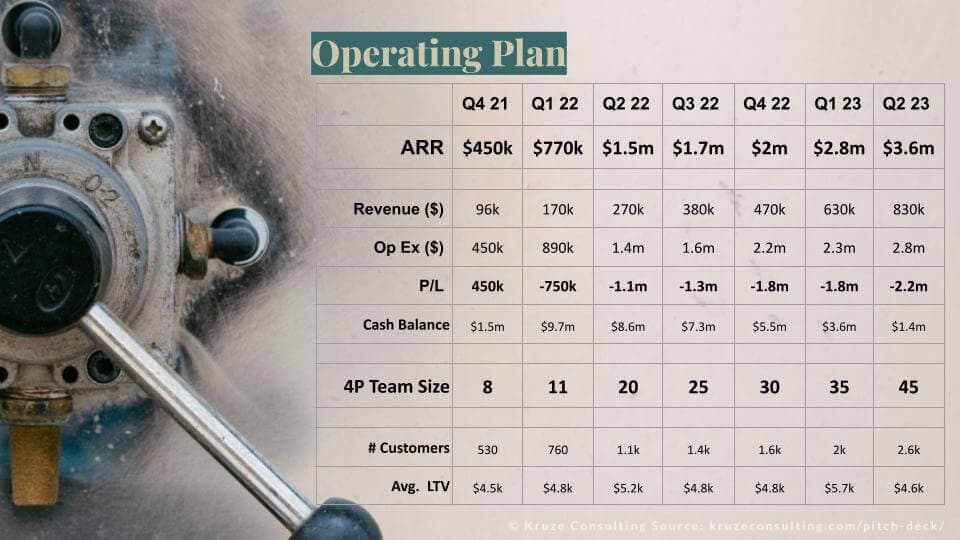
B2B Pitch Deck Operating Plan Slide 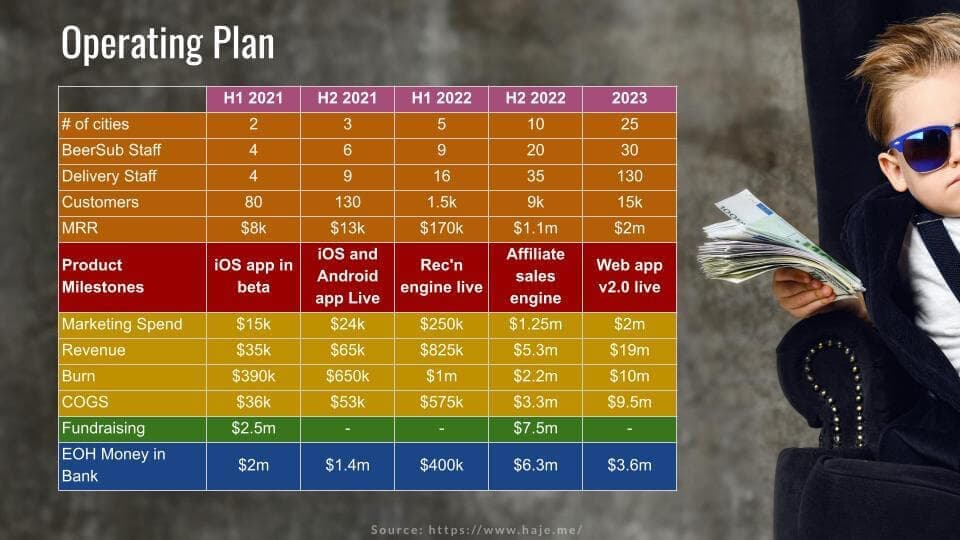
B2C Pitch Deck Operating Plan Slide
12. Financial Projections
In business, it all boils down to cold, hard cash. Your financial projections are going to be an important decision-making tool for your potential investors to decide to invest or not.
Healy Jones:
Hey, everyone. Welcome to the Kruze Consulting free online course, helping you put together your venture capital pitch deck. Today, we'll be discussing the financial projections and financial projection slide. There will be a separate recording where we actually dive into the financial model that we have presented or pasted into this deck. Again, this entire course is available at kruzeconsulting.com/pitch-deck. It's K-R-U-Z-E consulting.com.
As always, I'm joined by Haje, who's a leading pitch deck consultant. Tech crunch reporter, startup founder, and former venture capitalist. I am Healy Jones. I am a former venture capitalist, and I lead the financial planning and analysis team here at Kruze. It is my day job to help companies put together projections for venture capitalists. Hi, how are you today?
Haje Jan Kamps:
I'm doing great. How are you?
Healy Jones:
It's a beautiful day. Little chilly, but I'm doing great. Thanks. Thanks for your time.
Haje Jan Kamps:
Yeah, of course. Good to be here.
Healy Jones:
Great. So let's talk a little bit about what we're going to discuss here. We're going to discuss the financial projection slide. This slide is sometimes in the appendix and is sometimes in the meat of the presentation. What is the slide for?
Haje Jan Kamps:
So it's basically to help the VC gauge what your company looks like in numbers. Right? So in my mind, we already, in a previous episode, we talked about the operations plan and that covers the amount of space you can see. That is your immediate plan for what's coming up next. The financial plan goes a little bit further into the future. It shows a couple of things. Most importantly, it shows whether or not your company's actually VC scale. How big is this thing going to get if your plan works out the way you are hoping?
Healy Jones:
Two things. We've already released the operating slide free course. Please reference that. It actually ties in very tightly with the projections. These two slides, and the data should work together. You should also watch that if you're watching this one.
Then secondly, yes. I cannot tell you how many times I see a company that has five million in revenue in five years, and that's as big as they're going to get. They need 20 million bucks to get there. That is not the type of business that a VC wants to work with.
VCs need businesses that are getting big. You try to help the venture capitalist understand you're talking the same language. This is going to be a big opportunity. You're shooting for the moon.
Haje Jan Kamps:
Yep. For sure. For sure. I think the cool thing about telling that story with numbers rather than with hopes, dreams, and hand weaving, is that this is your common language. Right? The VCs spend day in, day out basically figuring out how they're going to take your LP's money, and multiply it. And, to do that, they have some very complex models to help them figure out what they're investment thesis is. What they need from a startup, what they need from each individual investment. If that investment thesis very neatly overlays onto your financial plan, that is a massive plus.
Healy Jones:
Sure. I totally agree with you. Although I would slightly dispute that a lot of VCs have complicated financial models. Having been a VC, some of them are pretty darn simple, but regardless.
Haje Jan Kamps:
I think you're right on a post-it maybe. No, I mean, in my experience, at least they have some sort of vision for what they need from the startups.
Healy Jones:
That's correct. That's right. You're fitting into a portfolio. And the basic reality is that the VC is looking at almost every investment as one that they hope gets to be big enough to return the whole fund. So you have to show big growth. That's just the game in Silicon Valley. You should be prepared for it.
The other thing the venture capitalist is looking at when they're looking at your three, five, your projections is where you'll be along the journey and what you're going to look like at the different fundraisers. Because they're going to want to make sure that you are attractive enough whenever you're running out of money or next fundraising to have that money come in, because they don't want to be your only sugar daddy. The way that Silicon Valley works is in general, a particular company leads the series, A, and another venture capitalist firm leads to series B, and somebody else leads to series C.
They're always looking for businesses that will not have problems raising that next round of funding. In addition to that, they're also checking to see how much money the company is going to need over its lifetime, because VCs invest in their pro rata rights generally for companies that they like, which means that each round they're expected to put in some more money to defend their ownership. Sculpted more or less, to keep their ownership percentage the same. They need to know how much that's going to be. Can they continue to hang with your business as it needs increasing amounts of capital? And from a portfolio construction standpoint, inside the venture firm, for every dollar, they commit somewhere between a hundred percent more to maybe 50% more that they would reserve for that portfolio company along the journey.
That means that even though maybe they've made 10 investments out of a fund, and that's how many investments they're going to make, they have just the same amount of capital reserved. Half the fund is deployed. Half the fund is sitting reserved to support companies. They need to make sure that they can support you along the journey. Really important thing to remember about their capitalists is that they don't just make one investment and they're done for their good companies. They'll continue to invest along the journey.
Haje Jan Kamps:
Yeah. And inversely if an investor invested in an earlier round and doesn't invest this round, that is typically a pretty scary thing for the startup and for other investors. Now-
Healy Jones:
In general, it's not a good signal.
Haje Jan Kamps:
Yeah. No, it's really bad news because this company has been on your board. They know a lot about the inside of your company. If they choose not to invest, that's often a signal.
Now, that isn't true for all venture firms, and it isn't really relevant for this particular conversation I suppose. But it's worth keeping your VC's close, because it might send a signal.
Healy Jones:
Right. All right. Of the four things this slide is for, we've just discussed them. So the first one is, are you getting big enough? The secondly is sort of, what do you look like at your next fund fundraisers? Are you going to be able to do it? The third is how much capital are you going to need so the VC can construct their reserve strategy in their portfolio? And then the fourth one, and this is probably what most founders just instinctively think about when they think about this slide is, do you have a good grasp of the financial implications of your business model and your business strategy? Right?
So this is a numerical representation of the strategy that you're talking about and your hopes and dreams. So you better tightly align, the numbers better tightly align with that vision that you're espousing as you're walking through your pitch deck.
Haje Jan Kamps:
Yeah. And there's an interesting piece to that too, when you build your financial model and you realize, wait a minute, these numbers don't fully back up the story I'm telling. That means that either the story is wrong or the numbers are wrong. It's really important to be honest with yourself about what's going on here.
If you think you can build a company with 12 developers, and your plan shows that you can't afford 12 developers, then you have to raise more money or you have to find cheaper developers. You're going to do it some different way. Be super careful because here you're showing that you have a plan and that the plan should actually work out financially as well.
Healy Jones:
Right. And not to get into the common mistakes that I see, but another common mistake that I see is that you're selling your product to enterprises. There are 500 companies in the world that could potentially purchase your product. Right?
They're going to pay a million dollars a year. That's 500 million dollars in revenue a year. You are showing a billion dollars in revenue. What's going on? Who else are you selling to? Because if your pitch is that there's 500 potential clients and they're going to pay you a million bucks a year, how did you get to a billion dollars of revenue?
Just keep that in mind. How big is your market? How big can you get? That's got to somehow interact with your out year revenue numbers. All right. So who needs to have this slide? And again, this is what I do day in and day out. I think this is incredibly important. We both agree that a C stage company doesn't necessarily need a print card-able detail on this slide. I think the main thing there is how big are you getting, and how much capital are you going to need on your journey?
Haje Jan Kamps:
Yeah.
Healy Jones:
In particular, if you're talking to a professional seed investor who expects to get pro rata rights and expects to invest along all of your rounds, it could be pretty easy. Like, "Hey, listen, I know we're going to get to a hundred in revenue, and we're probably going to have series A, B, C, and it's going to be 50 million bucks we have to raise in our entire team." I think that probably gets you far enough at a seed stage.
Now, where I think companies really need this, is the series B, series C, and increasingly the series A, as there are a lot of really sophisticated leader stage financial investors who are really changing the dynamics in the later stages of the funding market right now. They're making capital really easy to make very fast decisions. They're disrupting the venture capital market, and VCs like to invest in companies that disrupt markets. When it happens to them, they get all upset.
But, it's happening, right? These late stage investors are financial oriented. Having this slide, I think, sets the table for that financial diligence discussion. It also helps that later-stage investors realize, yes, these folks have a financial model. It's probably an Excel file. They can send it to me when this conversation is done. I can do that fast turnaround time. I can drop that into my actual sophisticated projections and portfolio model and come back with them, a yes, no, and how much if yes.
Haje Jan Kamps:
Yep. I think it's also worth spelling out explicitly why that works at the later stage and not at the earlier stage. At the later stage, you're talking about growth capital, right? You have a functioning business model. You know that if you pour 10 dollars in the top, 11 dollars fall out the bottom. Really it becomes a game of how fast and how quickly can we grow our market share and our lifetime value for the customers? Whatever the business model is, right?
If you have a functioning business already that you're just looking to grow, or going to do markets or whatever, it becomes actually relatively straightforward to analyze that, because you can look at the numbers and go, "Yeah. I believe this. This is a believable founder with a believable product in a believable market, and this model makes sense to me. Cool. Let's write a 20 million dollar check." That isn't as easy as the earlier stages because you haven't really figured it out yet. It's much, much, much higher risk.
Because of the higher risk the financial model uses as believable, because you don't really know what the mechanics are and what the dynamics are in your market yet, or for your acquisition and all that stuff. I think that is, I know I'm probably saying the most obvious thing ever, but it's worth keeping in mind that is why it's so much easier, in air quotes, at the later stages to invest off a spreadsheet than just off the hopes and dreams.
Healy Jones:
Completely, 100%, I agree with you. That's totally true. Yes. Exactly. We're not going to walk, in this call, through how to build a financial model. But we will do a course just on the spreadsheet. You should also reference the operating model course that we walked through, because we do dive into somewhat detail what is being looked for on the operating slide. There's some overlap here.
But, at a very high level, when you're building your model, the first thing to remember in Silicon Valley is the numbers are pretty crazy. People are looking for businesses that are going to grow like crazy. It's not weird that you're going to have extreme financial projections. You should show some pretty serious growth if you're the type of a business that's going to generate revenue.
Now, if you're a biotech company, that's different. You're not necessarily expecting to generate revenue in the foreseeable future, so there's less pressure on that. But, if you are a software to service company, a crypto company, or a commerce company, you're going to show some pretty aggressive growth because that's what the investors are expecting that your business is going to do.
If you don't have faith in your ability to do that, then it may not be time for you to go and raise a series. You might want to raise a seed extension and answer those questions that you don't know yet.
Haje Jan Kamps:
Yeah, and the place that typically comes up is in regulated markets. If you're looking to open basically a new type of bank, or if you're looking to launch something that needs FDA or FCC approval. Or, if you need something that has some government oversight or certification or something like that, it means that your model doesn't start working until those certifications are in place. That's why that can be a little bit trickier for those particular types of businesses. But then, the investors will know that. You tell the story around that, and that also is reflection on your financial projections.
Healy Jones:
Right. Right. I agree that is a particular nuance to regulated markets. The place where I see companies maybe wanting to raise an extension instead of the next round is if they don't have a perfect product market fit or they haven't figured out the sales and marketing engine yet. Those are typical times where it's like, "Hey, we have this one question we need to answer before we think we're ready to go do the series A or the series B. Let's raise a small extension. Prove that out, and then, our model will change. Our projections will become a lot more crystal. There will be a lot more meat behind these assumptions, because we will have just done it for a few months. Therefore, we'll have a higher evaluation and a greater success rate when we raise whatever round." I see that pretty regularly.
Great. So just in terms of constructing your model, make sure your projections are capturing the size of the market. Hopefully you're attacking a big market. You better be attacking a big market if you're raising venture capital funding. To an extent, you're going to be generating revenue in the foreseeable future, you ought to have really big revenue numbers in the out years.
Now, they can be too extreme and I will talk about that later. This is the common place I see, is either too extreme of models, numbers, but for the moment, realize you're going to have to grow big, okay? Then, work backwards from where you need to be, to be a big successful company. It's easy if your software is a service company because there's so many companies with SaaS models that have gone public. You can just look and see what they looked like when they went public.
You're going to want to make sure that in a reasonable time frame, that's what you look like. Work your way back, because the venture capitalist wants to invest in the company that's on that IPO pace. Figure out what that is, and try to draw yourself into that. I obviously recommend working with an advisor, like Kruze. We do this all the time, and we're pretty good at it. But, if you're not working with an advisor, again, look and see what public companies in your space look like.
The next idea is to talk to other founders with similar business models who are a little bit ahead of you. We talked about this in the operator course. Founders generally like to share stuff. I mean, you've got to be careful you're not talking to somebody who's too competitive. But, it's a somewhat caring economy in Silicon Valley. Although, there's definitely some sharp elbows. But, people will talk with you and try to help you out if they like what you're doing, and they like you, and you're a nice, empathetic person.
Haje Jan Kamps:
Yep.
Healy Jones:
Great. Again, start from that revenue growth and other important KPIs and assumptions. Then work backward from where you need to be. If you think through these critical assumptions, if you're a software as a service company, they can create your churn rate, your average pricing. Things like that.
If you have a sales team, how many deals can a salesperson close? Therefore, how many salespeople do you need? Therefore, what's your sales headcount expense? Et cetera, et cetera. Don't forget that as your revenue is growing, your other expenses will grow as well. You won't have to start adding any HR. Travel expenses will go up. R&D expenses will go up. Server expenses, et cetera, et cetera.
The place to spend the most time is in the head count, particularly in the early term. That should be outputted from the operational plan work that you've done. In the later years, again, talking to other founders or talking to advisors or seeing what public companies look like as they're at different revenue milestones in terms of headcount, and backtrack into that.
Very common problem I see is companies not adding heads as they grow their revenue. That's ridiculous. You've got to add bodies. You just have to. There's more stuff to do as you get bigger. More money, more problems, right? Then, after you put that all together, sanity check it. Keep in mind, some investors will maybe discount the out years a little bit, just to try to be a little conservative. You don't need to discount too much, as long as you're ending up with something that's reasonable with those comparables that we talked about. The other companies in your space. Other founders that you've talked to that you've seen raise money. Companies that have gone public, what your advisors are saying. As long as you're in that range, it's okay. Don't be too conservative. Don't model yourself out of a deal. If you're too conservative, then people won't think you're trying to grow big enough.
Haje Jan Kamps:
The good thing about sense checking, is that it isn't actually all that hard to do. You can think about the big topics that Healy just mentioned here. Staff, revenue, customers, and outgoings. All of these things just need to match up. If you are claiming that you're adding a thousand new customers, see if you have all the bits and pieces that you need. Do you have enough customer support? Do you have enough servers? Do you have enough … All the pieces that you need for that.
Where do these people come from? If you're adding a thousand, do we have enough marketing spend? Do you have enough people to support that? If you're looking to hire, do you have the right ideas about where these people are going to come from? Are you paying recruiters? All that stuff.
Just think about it from every angle. See if those things are reflected on the model. It's usually pretty quick. You can usually catch those obvious mistakes very easily yourself. But, you have to sit down and actually look at the model from these different angles. Just look at the same model again and again, but from, "Okay. Now I'm thinking about the staff. Does it make sense? Yes. Now I'm thinking about customers. Does it make sense? Yes. Oh, wait, actually, when talking about this, there's something weird going on with the marketing spend." Then revisit that.
It takes a couple of hours to do this properly. But it will save you a lot of trouble later on, because it means you can answer questions once they start getting thrown your way from the VCs.
Healy Jones:
Exactly. That leads us really nicely into sharing the sample slide.
Haje Jan Kamps:
Almost like we planned it.
Healy Jones:
We did. Good job. All right, so just as a reminder to folks that haven't seen the other courses, we have two free pitch deck templates that you can just get on kruzeconsulting.com/pitch-deck. The companies that we're showing here are just made up. We're not trying to actually pitch these companies.
The purpose of this is to show what should go on the slide and talk about the order and how to tell the story. I am looking in the 4P's one, which is an enterprise-style sales company, and this financial assumption shows a lot of stuff that Haje was just talking about here. You can see we're showing KPIs to total customers. We're showing the average headcount. Then you've got the ARR and revenue. I like to show both because they're slightly different numbers. That way the VC can do the math on the operating income and get to the cash flow.
We're showing how much cash that you're raising and where your cash low points are. This slide is intended to set the table for the financial discussion, and you're proving to the VC that we're going big, and you're ready to talk about the financial projections and how big you can get. Et cetera, et cetera.
Haje Jan Kamps:
Yep. Again, when I look at this, I'm going to be very honest. This is very much not my forte. I see year one, we're going to spend six million dollars. Yeah, I feel good about that. I see year five. We're going to spend 53, almost 54 million dollars. I start to sweat a little bit. I'm like, "Okay, I'm going to be the CEO of a company that I'm running a budget here with 54 million dollars going out. 50 million dollars coming in, at a 93% gross profit margin."
I get palpitations from this kind of thing, and it is quite such a good idea to work with people who do this kind of thing for a living, and tell them, "Hey, Haje, these numbers aren't insane. This is actually pretty common. This is what we'll see." Just to talk me down a little bit. I'm so used to working in super early stage companies, that years one and two look fine to me. Beyond that, I just get nervous.
Get the help you need, because actually I've worked with Kruze on several of my previous companies, and these were the models I got back every time. It was really helpful to have somebody talk me through this who has seen this work for other companies and who knows what is happening at the fund raising stage. That these numbers aren't crazy. That this is actually a pretty solid way of looking into the future.
Even so, put a gun to my head and say, "Hey, what's your company going to look like five years from now?" I just giggle at you because I'm like, "Yeah, sure." I have no idea.
Healy Jones:
There's a lot to unpack there, Haje, but first of all thanks for the kind words about Kruze. I definitely appreciate that, but the key thing here is that this is a model that is being presented that shouldn't blow up your deal.
There are a lot of reasons why someone doesn't want to invest in a startup. The financial projections shouldn't be one of them. This should be, not necessarily check the box, but it should advance the discussion in a way that is selling the business. It's selling the equity in the round that you're trying to raise.
This slide, and the purpose of the model is to be strategic, and to convince the VC to give you the money. It just is. We never want to not raise money because your model was messed up. That's really a silly reason not to raise. It's fine not to raise money because the VC doesn't believe in the market, or it's fine to not raise the money because the VC doesn't like you. That's a common reason. But, don't have it be that the numbers weren't put together nicely in the model. That doesn't make any sense.
Haje Jan Kamps:
Yep.
Healy Jones:
All right. Great. Well, we actually walked through this incredibly quickly, but let's jump to the common issues that we see in the projections. The most common issues I see are either too big or too small of projections. Too small we've already talked about. If we're not trying to go really big, then why are you raising a bunch of capital funding? You're not a fit.
For too big, I don't think if you're going from zero revenue to a billion revenue in your spreadsheet, you're worth any more money to a VC than if you say you're going from zero to a hundred million. In my experience, the VC does not provide any sort of evaluation premium for that crazier growth company. In fact, they're less likely to do the deal, because it's less realistic. That's my experience, and I have seen a lot of companies raise money.
That's not that you can't raise money if you're showing a billion dollars in revenue from zero in a few years, but most of the time I see that, there's just something unrealistic in terms of how the founders are presenting the business and the VCs don't like that in the founder.
Haje Jan Kamps:
Well, and that's easy to understand why, right? If the founder doesn't have a firm grasp on the story they're telling there, they're just not believable founders. That is one of the big things that VCs look for.
Healy Jones:
Yep. Exactly. Now, the other major mistake I see is where founders don't add expenses as they grow. They have a spreadsheet that's got three employees in year one. In year five, it still has three employees, but revenue's gone through the roof. Or server costs haven't gone up or they're not spending any money on recruiting. Or, to the extent they actually have a rent, they still have the same amount of rent.
As you grow, you're unlocking more and more expenses. This is where working with an advisor, talking to other founders, looking at public companies that have been successful, with several different business models all helps you out. It helps you see how expenses grow over time, as revenue grows.
Haje Jan Kamps:
Yeah. As you already mentioned, head count is typically your biggest expense, but head count also gets more expensive. As your company gets better and bigger and all that stuff, people expect fancier offices. People expect snacks. People expect the office to be cleaned every day. That kind of stuff.
When you're in a very early stage company and there's three of you sitting in a garage, that is a very different revenue model than having a nice office down in [inaudible 00:23:27] San Francisco. Those expectations you have to build in, because at some point, you're not going to be able to hire people by giving them equity. The company has grown so much that you can't give significant jumps to equity connected to every single company. Well, it means you need to recompense in other ways. You need to give good healthcare, you need to give good perks. Give a good comp package. That gets more expensive, but it needs to be in your model. Because, if it isn't, you fall into this exact trap.
Healy Jones:
Exactly. Exactly. Another thing to think through is to think about companies that have been very successful. Think about the first outside, non-founder engineers that were hired. The first 40 engineers hired by Google, I don't know how much they made, but Google's paying a ton of money now when they hire new engineers. Their cash comp is much higher now than it used to be.
As you get more successful, and bigger, sure more people want to work for you, but that excitement around "I'm going to work for peanuts to help grow this thing, and I'm going to have a big equity stake," that starts to become less of a thing. It's more, "Hey, I have a great job right now, but I'm willing to come work for you for the same amount of money, and guess what? It's $300,000." It's expensive.
Haje Jan Kamps:
That's an opportunity for you as an early stage start up, right? Because, some of those engineers that have been doing this for five years have been making 350k a year, might have a little bit of a nest egg, which means they can now afford to work a little bit cheaper for more equity. These are all interesting pieces to think about when it comes to how you hire staff. But just remember that as your company matures, those dynamics shift significantly.
Healy Jones:
Yep. Exactly. Again, expenses should grow. Don't forget to grow your cost of goods sold, don't forget to grow your server costs, et cetera, et cetera. And customer service. All those things are going to grow.
A less common, but mistake that I do see is forgetting that employee headcount is not just the salary. That there are benefits, there are payroll taxes. That's just going to gross up how much you're expecting to spend per employee. 20, 30, maybe even more percent depending on where the person is located and what the benefit strategy is for the business.
Then the final thing to think through that doesn't necessarily matter for every business, but it does matter more than you think, is working capital. Basically this is the time it takes from a model perspective, working capital is very complicated. I'm not going to define working capital. But the most common mistake around working capital I see is there's often a lag between when you recognize your revenue, and when you collect the money.
If you're a B to C company, and you're charging folks through the Apple store, guess what? Apple doesn't pay you immediately. It takes 30 to 60 days before Apple sends you the money. Just keep that in mind. If you're selling to large enterprises, you might get paid up front, but it might take them six days to pay you, but then they might pay for the whole year. All of a sudden you have a bunch of cash on your balance sheet. That's actually really helpful.
It gets really complicated with companies that are doing hardware projects or have inventory. It can also get complicated if you are expensing equipment that you're using for biotech research, et cetera, et cetera. It's not a bad idea to work with an advisor. Now, that being said, a VC is not going to decide not to invest in a series A start up because their accounting treatment in year four for their equipment wasn't capitalized correctly. They just really care about the money. The dollars flowing in and out more or less correctly.
Don't over rotate on accounting principles in the out years, and maybe not even in the near term years. Just make sure you're getting the cash changes correct.
Haje Jan Kamps:
The important thing, and this is one of your big jobs as a CEO, is to not run out of cash. What we're really talking about here is, if I'm running a hardware startup, and I need to run a batch of 200,000 units of something, that's a very significant jump of cash. That's only going to get sold gradually. That is really what you're talking about here.
Healy Jones:
Yep.
Haje Jan Kamps:
There's going to be a massive dip in my cash, and that's gradually going to build back up as I sell the widgets. That shows up in lots of different businesses if you hold stock, or if you have other ways that you actually turn cash into product, and then product back into cash in various ways. If you run out of money, it's game over. That is the one way that your company will absolutely have a sure-fire end. As the CEO, it is your job to make sure that doesn't happen.
If your financial projection doesn't show adequate padding there, then you're going to be in trouble. I think it's one of those things that it's avoidable. There are ways around all this stuff. But, the VC wants to know that you have a solid handle on this so you don't end up stressing out about that, when you ought to be working on improving the value of the business, of the core business. Not the amount of cash in the bank account.
Healy Jones:
That does lead me to one other major common issue, which is too much detail. Particularly the later stage investors have teams of sophisticated analysts, who will dive into your model. They're going to click around, and you really don't want to have weirdly complicated formulas. You don't want to have obnoxious detail around snack expenses in the year 2024. That is not a strategic use of anyone's time.
Remember, the purpose of these projections is you’re selling, and you're telling your strategy through numbers. Anything you put into the financial projections that you share with your potential VC's, should drive that forward, and shouldn't be bogged down in details.
Now, it's very possible that you do have a much more detailed plan, particularly in the near term, about how much you're spending on snacks next month. Okay? But, don't share that with the VC. They're going to look at it, they may ask you a question. It may derail the conversation so you talk about Oreos for 20 minutes. Guess what? You've got 30 minutes to talk with them about your model and sell your business. 20 minutes about Oreos, you've failed. You failed. Keep the right level of detail.
Haje Jan Kamps:
That's really important for pretty much everything about this pitch. You can double click on dumb things, like your product roadmap. You just don't know what's going to happen in five years from now. Don't spend too much time, too much detail, on exactly which features you're shipping in. That isn't helpful in terms of what this company is and is going to be.
Healy Jones:
Right. I agree. Let's just summarize it up here. Not every company is going to have the detailed financial protections in the meat of their presentation. Later stage companies need to have this. Sometimes it's okay in the appendix. But you want to make sure that you're setting the table for the discussion. Again, remember why the VC wants to see this. They want to see that you're growing big. They want to see how much capital they're going to have to have as they invest in you. They're going to want to make sure you're big enough and good enough to raise your next round of funding.
Then again, you're proving to them that you have a grasp about how your company scales, and your strategy makes sense as you grow, and you get it as a founder.
Haje Jan Kamps:
Yep. I think the final piece there is that in my experience, what often happens is that you have one meeting. Everybody gets very excited and wants to talk to you more about your business. Then the second meeting, they might go very deep on the financials or maybe the third meeting.
When that happens, you typically send your model ahead so they can take a look and do some analysis, and do some thinking about what they want to ask you about. Then you spend a whole meeting talking just about this whole spreadsheet, where you can go pretty deep on how you see the business financially.
I'm actually looking forward to the episode we're going to do about how to build this model, because as I mentioned, it's not one of my strengths. I'm excited to have one of the better experts in the business, to pick your brain for a bit.
Healy Jones:
That's great. Again, we will have a course just around the Excel file that is attached with the operating plan that we shared. Again, it's my day job. I love talking about this stuff. I think it will be really helpful for you to see how the spreadsheet is built, but more importantly, understand the questions that VC's will ask as you dive through it. The strategy behind the numbers that you're putting in.
Great conversation today. Haje, thank you so much for your time. Everyone please go to kruzeconsulting.com/pitch-deck to follow along, and to get the free templates. Thank you.
Haje Jan Kamps:
See you all on the next one. Cheers.
Financial Projections slide: Are you venture-scale? How fast will you grow?
If your operating plan covers the 18-24 months between your funding rounds, your financial projections slide goes further into the future. On this slide, you're going to tell the financial story of your company. Operating costs, staff costs, cost of goods sold, marketing, advertising etc, alongside your revenues coming in. The model should go 3-5 years into the future, and paint a picture of how you're going to grow aggressively enough to be interesting to an investor, but not so fast as to be completely unrealistic. It's a fine balance, and we get into the weeds on that in this episode.
Slides for the Financial Projections section
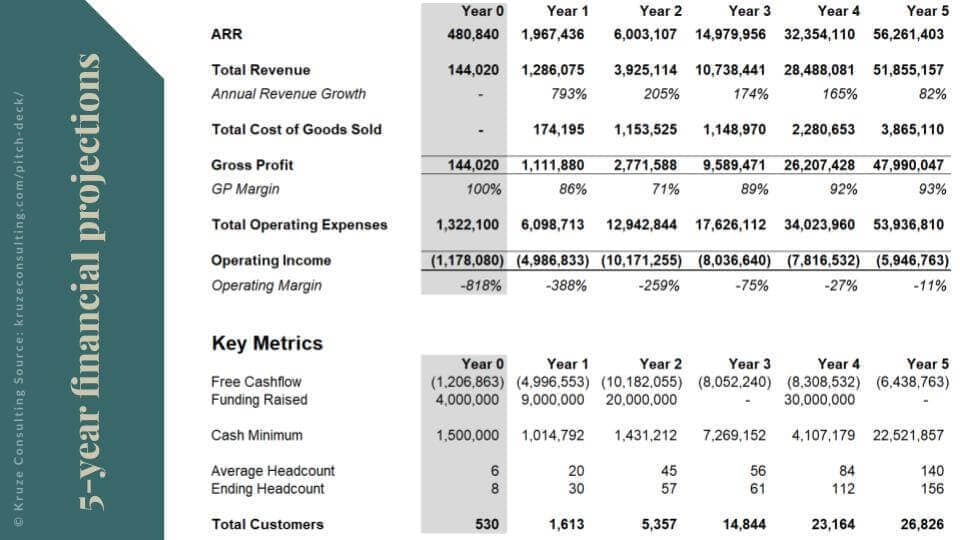
B2B Pitch Deck Financial Projections Slide  Kruze Pitch Deck Financial Model
13. Financial Model 101
Often overlooked, your final slide is more important than you might think. We explain why and what you need to pay attention to, to ensure that the Q&A at the end goes well.
Healy Jones:
Hello everyone, and welcome to the Kruze Consulting venture capital pitch deck course. This is our free course that helps you figure out how to put together a compelling venture capital pitch deck. In this piece here, we're going to actually be walking through not a spreadsheet, but instead an Excel model, talking through your financial model and giving you some tips, and tricks to help make the financial model tell the same story that your pitch is. As usual, I'm joined by Haje Kamps, the TechCrunch author, startup founder, and also a former ventures capitalist who is a pitch deck consultant. Haje, how are you?
Haje Jan Kamps:
I'm doing great. How are you?
Healy Jones:
I'm great. Hey, where can people find you online if they want to get your help?
Haje Jan Kamps:
Haje.me. I'm super easy to find. I even wrote a book about this stuff, which is super handy. So you can find that on Haje.me/book. It's a whole book about how to put together a pitch, which seems relevant to what we're talking about.
Healy Jones:
Extremely relevant. Excellent.
Haje Jan Kamps:
You know what's missing from that book though? It's my least favorite thing about any of this, which is what we're talking about today.
Healy Jones:
Financial model.
Haje Jan Kamps:
Yep.
Healy Jones:
Well, thankfully, I guess, I'm here. And just so everyone understands the background from my perspective, I run FP&A, financial planning and analysis for Kruze Consulting. Kruze is I believe the largest CPA that's a hundred percent focused on VC backed startups. Our clients raise well over a billion dollars a year, and my team helps our clients put together their financial models for their fundraises or to manage their money. So this is what I do, and I'm pretty passionate about it. [crosstalk 00:01:38]
Haje Jan Kamps:
And funny enough, that's actually how we met too. I've run a number of companies in the past, and I've actually used Kruze for most of them as my financial partners. And it's wonderful to be able to work with people who go deep under the skin of these types of things that make my eyes completely glaze over. I'm a really solid operator, but spreadsheets, especially financial spreadsheets, I'm like, ah, kill me now.
Healy Jones:
Yeah, we like numbers so you don't have to. That being said, if you're running or you're raising money, you have to at least be able to talk a little bit of the talk because finance and accounting is the language of business and at some point that's the language that the investors are going to want to talk to you about. So let's discuss how to do it here. My quick background as a VC, I was an executive at a handful of startups, one of which went public, one which grew and we sold, some didn't do that great. My clients here at Kruze have raised hundreds of millions if not a billion dollars worth of venture funding since I've been working with Kruze. And so I've got a pretty solid handle on what VCs are looking for when they're looking through a financial model. So why don't we just kind of dive in and I'll talk a little bit about what the overall goal of the model is?
Haje Jan Kamps:
Yeah. I think there's some interesting context here, right? So as part of the first pitch you do. You typically talk through an operating plan, which we have a separate episode about, which is all about the kind of the future you can see. Like that's probably going to be the amount of time that you're going to operate through on this round of funding. So if you expect to raise about 18 months worth of funding, your operating plan will be about 18 months. In addition to that, there's going to be a financial model, which is probably going to be three to five years and maybe even beyond that. And once you get put through the wringer for the first time, you'll be invited back and the question will be something along the lines of, hey, talk me through the financials of your business. That is where this becomes super, super important.
And even if you're somebody like me, who kind of goes, ah, I don't know about this, you have to really deeply understand what the financial levers are. Like, if you change something, what else changes? If you hire earlier, what does that do? If you hire later, if you grow faster, et cetera. And financial models are such a beautiful way of outlining that. And I'm really excited to have you talk through the one we put together for one of our mock companies.
Healy Jones:
Yeah. Perfect. And so just to double, deep dive into there, as you're doing due diligence and getting closer and closer with the VCs, they're going to want to look at your model and they're going to want to have a conversation about your model and your historicals. This really shouldn't be the thing that makes it so you don't get an investment. This should be just sort of a slight check the box, advance the conversation, help the investors understand how you're strategic and what KPIs you care about, hear from them what KPIs they care about, what numbers they care about. This should be just a beautiful meeting of the minds, advancing the ball on selling the equity of the company, advancing the ball and the story, this should not be the reason you don't get an investment. This would be really tragic if your numbers and your projections were the reason you didn't get an investment.
Haje Jan Kamps:
Yeah. Absolutely.
Healy Jones:
Okay, perfect. So, perfect, Haje. So why don't you talk a little bit about the company that we're going to discuss here, and again, you can go to KruzeConsulting.com/pitch-deck to not only see all of our talks about the pages, but also see the example company that we created out a thin air, including the slide deck, so you can follow along a little bit better about what we're talking about here with the model.
Haje Jan Kamps:
Yeah. So this is the hilariously named 4P company, which is a plumbing company that we made up. It's a B2B SaaS company where we are a company that provides a SaaS solution for plumbers and for plumbing services to help them essentially run their businesses. And so behind that, we did a bunch of work. We put together some mock financial models. We put together some mechanics and a full pitch deck. So as just mentioned, the pitch deck is available on the website. And today what we're talking about is the spreadsheets and I guess the financial mechanics that are behind this made up company. Now, I keep saying made up because when we started going through this model in more detail, we realized there's a couple of like little loopholes in there or little wobbles, and we'll talk about them too, but I think it's a really helpful exercise to be able to talk about real numbers, even for a made up company.
Healy Jones:
Exactly. Wonderful. And just to set the context here, I'll present some of the slides from the 4P pitch deck just so you can see where the financial flows to, because this helps you understand how this is advancing the ball in terms of you selling the company and telling stories. Okay. So hopefully you can see my screen where, first of all, in the 4P's presentation, the financial model drives this chart behind the traction and milestones and also the metrics. It's a pretty important part of the pitch. We have the operating plan, which Haje has mentioned and-
Haje Jan Kamps:
Can we pause for a second and go back to that one?
Healy Jones:
Oh, of course.
Haje Jan Kamps:
So the reason that slide is so important is that it explains to the venture capitalist why this is a venture backable company. I know we've said this in the other episodes, but you know that up into the right graph with the ARR, so the annual recurring revenue is improving, the user growth being aggressive, and being able to reduce the blended customer acquisition cost. Those are metrics that look really, really good and help explain. This is the slide you put in front of someone to make them lean in. Now what happens next is to go, okay, I want to see where these numbers came from. How did this happen? What are you projecting? What are you assuming? What are your assumptions? All that kind of stuff. And that's where these other slides become really, really important.
Healy Jones:
Excellent. Excellent. So this is the traction slide. This is the operating plan slide, which we talked about before. The goal here is to show the investor what you're going to do with the money that you have and what you look like when you're raising out of money so they have confidence that you're building a valuable company that will be able to raise its next rounds of funding.
Haje Jan Kamps:
Yeah. So I'd like to think of this as like the 10,000 foot view. This is like the numbers are all rounded. It's really simple to talk about and it's really easy to pull out the top level numbers, right? It's very clear what's important here. It's the ARR and the team size. Team size because it represents the cost, and the ARR represents the biggest number that we can come up with to really show the health of the business. And the other numbers on this sheet are important, but they kind of support those two numbers and explain all that kind of stuff. And so we go a little bit deeper in the next one, which is our financial model. That's this one. And what we're showing here is actually kind of the same stuff except broken out to an annual level, so year 1, 2, 3, 4, 5. And going into a little bit more detail. Now the spreadsheet we're about to talk to, informs all three of these slides. And I'd love to take a look at that.
Healy Jones:
Great, awesome. Let's jump over to it. Here we go. In fact, you can literally see these were the same numbers on the operating slide coming out of here.
Haje Jan Kamps:
It's so similar because it copied and pasted them across.
Healy Jones:
Exactly. Here is the summary. Although, I just noticed we changed the amount of cash being used here. I'll have to go check that out, but anyway. Oh, I see what happened. I actually got to probably put that back in. We've got some beautiful graphs that sometimes make sense.
We have, this is the chart that was in the traction slide. This is one of your up-and-to-the-right charts that will really help you out. And then here are the guts. This is the guts of the model, which we'll talk through at a high level. The purpose of this isn't really to talk about how to do things in Excel. It's how to talk about things in Excel, right?
Haje Jan Kamps:
Yep.
Healy Jones:
So that's what the purpose of our conversation is. So I'm going to stop sharing just for a second. And I'm going to talk to you a little bit about what is the purpose of this model, right? I'm a venture capitalist, you're the founder, you're pitching me, I'm going to look at your model. What's happening here? So I am checking to make sure that your vision that you've told me, maybe over coffee and then through a more formal pitch like a pitch deck meeting, I'm checking to make sure all that is the same in this model. The model should be telling the story that you've been telling. It should be telling your strategy, should be selling yourself and the company and how awesome you are in the market, et cetera. This is a piece of sales collateral, and it's all designed to tie very tightly with the pitch.
Haje Jan Kamps:
Yeah, totally. And I like to compare this with kind of the Matrix, when you see Dozer sitting in his chair going "brunette, redhead," that's kind of the thing, right? The beautiful, shiny slides we showed is the glossy layer on the front of this, now we're going to go under the hood and get kind of gritty and dirty with what's actually happening underneath. It is so important to be able to talk through it because here is where you really, you're taking your story and turning it into numbers. It's actually the same thing. There should be no discrepancies there. And when you just pointed out, Healy, that, oh, wait a minute, I changed that, that is a warning sign to yourself, right? Put on a post-it, stick it on your screen, make sure you update that before you pitch, because those two stories should be the same. And so when you're hiring people, make sure the hires show up, make sure that everything kind of goes all the way through. And really this is the magic that drives everything else.
Healy Jones:
Exactly. So I did just go update that number because it is germane to the next thing that I want to talk about here. So I'm-
Haje Jan Kamps:
We're running live.
Healy Jones:
Exactly. This is real life here. Hopefully you don't do this in your pitch deck meeting, but you know what? VCs are somewhat understanding if you're humble. So hopefully you can see my screen again. I've gone to the summary tab, which again, matches the summary in the pitch deck. So what are we looking for, when I'm a VC, what am I looking for here? Well, the first thing I'm going to do is I'm going to check to make sure that your startup is big enough to be acceptable for a venture capital style return. If you hit your numbers, right? So I'm checking to make sure you're dreaming big and I'm seeing 50 plus million dollars in ARR up year five. So, that's good. That means, hey, you are playing in the type of venture capital sized business and market, or at least you think you are there. That makes me feel really good.
Haje Jan Kamps:
So, Healy, we're looking at a couple of things here that are interesting. So what I'm seeing immediately is that in year five we have a 56 million ARR. That's a hell of a business and that's going to get interesting. I also see that we are running at a pretty significant loss still, like a negative operating margin, even at year five, even when we're turning over 50 million. So this is a very cash expenditure heavy business. And as an investor, what I think I'm looking for here is clearly the business is big enough. 50 million ARR is a very healthy business, but we're also burning through a lot of cash. And I would be wondering how quickly do we run out of cash and how much cash do we have to raise? Does this model show that?
Healy Jones:
So it does. It definitely does. And that's the second thing that I think most VCs are going to look for is how much money do you need right now, where's the money going, and when do you run out and what do you look like? So in the near term operating plan, we do have a cash balance number that is pretty important. And you can see it's tipped up here to 20 million because the company is raising 20 million at that time at a series B, but you could even dive more deeply into the projections because it has a mini cash flow statement that shows the cash balance. So as a VC, I would try to figure out where your cash total is, which might be on a balance sheet, or it might just be in a little cash flow statement, it might just be a simple total that you have.
For an early stage company, you don't have to be too complicated. That's what I'm looking for. So I'm watching your cash go down and I'm seeing, okay, you're basically running out of cash around the middle of 2023, and so I'm trying to see when do you run out. So, yeah. And then conversely, what do you look like? And so the next thing I would do as an investor, if I was familiar with this particular model type is I would scroll up and just check out your ARR as you're running out of money. So your ARR is here, and I would say to myself can a company with this trajectory and approaching kind of 3 growing quickly to 4 million on ARR, raise a series B? In today's market you can. So I wouldn't be too concerned about that.
Now I have seen markets in the past where this wasn't enough. I mean, I used to advise startups that they needed $10 million in ARR for series B, but that's not really the case anymore.
Haje Jan Kamps:
Yep.
Healy Jones:
But this is a place where you, as the founder, should be leaning into your current investors who hopefully know the market and you should be talking to founders of companies that are in a similar business model to yours, that are a little further along, non-competitive companies where you can develop relationship with the founders. You can say, hey, you just raised a series B what, what do you need to look like? I'm thinking I'm going to have around 3 or 4 million in ARR, growing pretty fast, do you think that I can raise a series B? Ask those questions, have a network so you can understand if you're proposing something wildly off market.
Haje Jan Kamps:
Yeah. And there's a bunch of other stuff that shows up here too. As we talked about in the operating plan, we're talking about milestones. So part of it is the number, part of it is milestones. Do you get your product out in time? When you run out of cash and you don't hit major milestones along the way, you know that it's going to be really hard to raise money because what they want to see is that they gave you however much money you're raising here, $6 million, $5 million.
Healy Jones:
Nine. Five?
Haje Jan Kamps:
Nine? Where is the funding raised?
Healy Jones:
Nine, I think.
Haje Jan Kamps:
Yeah. Okay. So we raised $9 million. And with that $9 million, we have to hit certain ARR numbers, we have to hit certain milestones. And from that, if you put that in front of an investor and say, hey, if we manage to operate against this plan, if we manage to spend those 5 million, we get to these numbers, we have these product milestones, we have this team in place, can we go and raise that 20 million? And if the answer is, we don't think so then this is not a good plan.
Healy Jones:
Exactly.
Haje Jan Kamps:
If they say, well, actually, yeah, everything I know about this market and about you and about your team and everything means that it should be pretty straightforward to raise $20 million in year two. Then we're talking about some really cool stuff here, and we're talking about a plan that if you manage to execute on it, you're going to be okay. And really, I think that is one of the big, correct me if I'm wrong, but I think that is one of the big things that the VCs are looking for here.
Healy Jones:
So that's for sure, yes, a hundred percent. In fact, if you ask experienced VCs what are some of the signs that your company or your investment that you've just made is going to be successful? It's that they're hitting their numbers, they're hitting their hiring plan, they're launching their product on time. Achieving your plan is a strong indicator that your company is going to be a great outcome for the investor.
And so this is your marching orders, right? This is how you're telling the VC you want to execute. And it now kind of goes to the next thing, which. . . So we just talked about VCs checking to make sure you're going to get really big. They're trying to understand how much capital you're going to use and what you look like as you're running out of money.
The next part is the VC is evaluating your experience level and competence as an operator, which there are many places in this model where there are assumptions. And so the VC will want to look at those and say, does this seem right or not? And a great place to talk about those with the investors in the operating plan, because we have higher level metrics on here. We have customer count and we have customer LTV. We have LTV to CAC. These are all metrics that are spring off points for you having a conversation with the investor about what you're going to look like over the near term to get them comfortable with your ability to operate the business, to get them comfortable with the idea that you understand the important KPIs and that you're a good business executive.
Haje Jan Kamps:
Yeah. And even here, we're seeing a couple of really interesting things. On December 22, there's a 3.5 X multiple, but even just two quarters early, it's a seven X multiple. And as a VC, I'd be looking at, wait a minute, you're halving your LTV to CAC ratio. What does that mean? And it's not a big deal. You just have to be prepared to talk through it because there will be questions there. Absolutely guaranteed.
Healy Jones:
Yeah. So the VCs are generally pretty good at noticing kinks in the numbers. So one I would point out would be in this user ARR, which we also have in the pitch deck. You can see that there's a period of time, basically a one-month period here where the user growth doesn't really grow and the ARR doesn't grow. And what that indicates for a company that's still attracting customers is that you had churn. So there's probably a story here and you look very credible to the VC if they point that out and they say, what happened here? And you say we had outages, or we had a couple large customers come on. And they expected certain features that we didn't have built yet. Have a specific reason.
And another underlying piece of advice that I give to founders who don't have a lot of customers or have had very minimal churn, is know the name of each client that has churned and know why they churned. It's really powerful. If you've lost five companies over the life or five clients over the life of your company, and you can explain why each one left you very quickly, that shows the investor that you are super focused on client success and super focused on understanding what makes your product successful in client size. That is a huge win and I strongly recommend that founders who haven't had a lot of churn yet follow that advice and really understand and have memorized specifically why each client has left.
Haje Jan Kamps:
Yep. And again, this is all, so part of it is understanding and that feels really operational, but part of this is storytelling. You're going to get challenged. You're going to make mistakes along the way. You're going to, your model is. . . I can promise you one thing about it, which is that it's not a crystal ball. You're not going to be guaranteed that this is exactly what is going to happen. But the other thing that this model shows is that you've thought about eventualities. If you aren't growing as fast as you thought you were, you can hire slower. If you're growing much faster, or if you need to grow much faster, you can spend more marketing dollars, or whatever it is. There's lots of levers you can pull here. And understanding the model deeply means that if you get challenged on something, you could say, well, actually we've thought about this and we looked at what would happen if we double our marketing spend, or if we double our hiring cadence.
That means that the time before we need to raise money gets much shorter, because we spend much more money, but actually there's an interesting, this is the hockey stick curve people talk about, you spend very rapidly and money burns out really, really quickly but what that buys you in theory is the ability to grow much faster with a little bit of a lag. Running a startup is much like flying a hot air balloon. If you pull the handle, it takes a while before the balloon starts going up. And so this is the thing, if you decide to hire 20 people tomorrow, you're not going to have a pipeline that enables you to do that. So deciding to hire today means you're probably going to be hiring over the next three or four or five, six months to get the right people in the right chairs, with the right skill sets and get them trained up and get them effective.
Even if you have the perfect developer, if they join tomorrow, they're not going to be deploying code for a little while. So knowing that things take time and there's no shame in that, the VCs know that too, but it means that you have to be a little bit clairvoyant about what is about to happen in order to be able to pull the right levers and make the right decisions. And that is absolutely something you're going to be judged for as a startup founder. If you're completely oblivious, if you say, oh, we raise money on Tuesday and on Thursday we bring on 35 new people, it's not going to happen. No matter what, it's not going to happen.
Healy Jones:
That's right. And so you're trying to prove to the investor that you're a credible executive, you have experience and you understand that magic things generally don't happen in businesses. That is definitely one of the major mistakes I see founders make and we'll list out some of the biggest issues I see regularly with models that founders are producing. But just to be super clear, immediately after you raise money, you don't magically hire a bunch of people. Now it is possible that you have folks waiting in the wings who are like, I'm going to quit my job at Facebook or Google as soon as you can pay me a salary. That's fair. That's totally fair.
But to not have a big hiring funnel already built and people ready to give notice, you're not going to just have people start the next day. And even when they're ready to start the next day, what that means is they generally need to give two weeks notice. Most people want to take a month off or a couple days off to organize their life after they leave their former job. So just to be thoughtful, you are being judged. You are being judged.
Haje Jan Kamps:
Totally. And the obvious version of that I saw was like, oh, we're going to raise 20 million. We're going to spend five of that to acqui-hire this entire company that does exactly what we need. And I was like, okay, buying a company is not going to take you three weeks. And then once you buy them, some of the staff are going to leave. There's no amount of golden handcuffs that makes people stay if they don't want to. The people who are kind of already one foot out the door, they might stick around or they may take this as an opportunity to leave. And again, spooling people up takes a while. Learning the code base, learning how things are done, really kind of grocking the learnings from previous things that the companies have tried, don't underestimate that as they famously say.
Healy Jones:
Exactly. Okay, great. So before we do a little bit more of a detailed walk through this piece of Excel, let's discuss the level of detail that I think is appropriate for a fundraising model. And cutting to the chase, I would suggest particularly for a seed and a series A company, you don't go into detail. Because detail, when you get in the weeds, at least some of the investors who are doing diligence are going to get down in the weeds and they might even try to dig one level deeper and then you end up talking about things that aren't strategic, or you maybe end up talking about Excel formulas when what you should really be talking about is your strategy and how that impacts your numbers and your metrics.
So you don't need to be incredibly detailed in a financial model, particularly for a seed and series A. For a more sophisticated company, raising a B, you may have a part-time CFO or a finance person who can help you be more sophisticated. The level of complexity will go up and in particular later stage investors have teams of analysts who can dig in, but as a seed and series A investor, you shouldn't need an excruciating level of detail to explain to them your financial projections.
Haje Jan Kamps:
Yeah, totally. And I think the other piece that people end up looking at is, remember that once you're working with your venture capitalist on a deeper level, they're probably going to have a board seat, which means they talk to you on a regular basis, but they really go deep. . . Well, go deep. They get a 60,000 foot view every two to three months, something like that. And so it is kind of absurd to start talking about what is your snacks budget, how much are you going to spend buying computers for your staff members. That's not something that the board should ever really get involved in unless you are spectacularly mismanaging your company.
And so really what the level of trust you need to build with your investors is they need to trust you to do the right thing between board meetings and that they can have big picture, strategic input in the direction and the decision making processes of the company. And so that's the reason why somebody might get a little bit more granular just to kind of kick the tires and just to get an understanding of you as an operator. Can they trust you in the three-month span between each board meeting? And really with a good model, what you're saying is yes, you can trust me, I've got this. And then you can really get into the big, interesting strategic conversations like which market do you go after, how fast do you hire, what is the big picture products, strategy, that kind of stuff.
Healy Jones:
Exactly. Perfect. Great. All right. Well now let me do a quick walk through. This may be similar to how you walk through the model with an investor. And again, the idea is to present the strategy. So you quickly want to get through the architecture or the sort of design of the model, and you want to start to get into explaining what the company's trying to achieve. So I will share my screen again.
Haje Jan Kamps:
And so just to kind of, to translate that for humans who don't speak spreadsheets-
Healy Jones:
That was pretty clear, but okay, go for it.
Haje Jan Kamps:
I mean, I'm asking for a translation. So what I heard you say is that what you're about to talk me through is where the different parts of the model come from and how they feed into kind of the master sheet. Is that right?
Healy Jones:
So actually what I'm going to talk through very quickly is I'm just going to lay out the land for the investor so that they understand what the different tabs do. And I'm not even getting, I guess and sort of how they talk to each other, but that's not kind of the super goal.
Haje Jan Kamps:
Love it.
Healy Jones:
If you're presenting, we do have an instructions page, which you probably don't even need to mention to the investor. I probably wouldn't even mention that, but if I were to do the walkthrough, I would say we have the model tab where all the assumptions and calculations occur. It's monthly. It flows to an operating plan which shows what's happening for the next 18 to 24 months. We have a summary tab that's a five year view that shows what we expect to be like in five years from now and shows you how much money we're raising to get there, how many customers, et cetera. We have some graphs, in particular showing our cash burn and cash position. And we have our ARR or near term ARR or historical ARR and user growth terms. So just pausing for a second. So what we've basically done is you've explained to the VC what the different tabs are so that they can in their minds orient, if they need, if they have a question where they might go to check it out. Okay?
Haje Jan Kamps:
Perfect.
Healy Jones:
Great. Now, in terms of the depth of this model, I think you are wasting your time if you actually go and explain to them how the formulas work. If you strongly feel like that's something you need to do, here's a pro tip, record a quick video of you walking through the formulas and share it with the venture capitalist a couple of days before you actually meet with them to talk about the model so that they can spend the five minutes looking through that so you don't have to waste the five minutes of the precious time you have with them explaining Excel formulas. That is a huge waste of time. So again, if you have a nice little model, record a quick video, jet it over to them when you send them the Excel file and say, listen, here's a quick video that talks about how the model is and actually flows.
Haje Jan Kamps:
When you say explain the Excel models, does that mean literally explain what the different formulas do or how the data flows through the sheet?
Healy Jones:
Sometimes, generally how the data flows through the sheet. Most VCs should be able to handle the formulas. And if-
Haje Jan Kamps:
Right. Yeah, no, that was what I was curious about.
Healy Jones:
And if they can't, that's fine. Not every investor wants to spend a lot of time in Excel. It's not that big of a deal. Don't don't judge them harshly is what I'm trying to say.
Haje Jan Kamps:
Totally. You're talking about some pretty cool and esoteric things here. You've got some cost of good sold numbers there. You've got some revenue numbers. And if you scroll down a little bit, when I was looking at this, I noticed something really cool around the headcount and how those numbers keep.
Healy Jones:
Exactly.
Haje Jan Kamps:
Is that the kind of stuff you would talk through?
Healy Jones:
Well, so I would, yes, in a video, I would say, listen, this is how the model works. I would say we input the number of customers that we're going to have in any period here. This is the kind of end of period number of customers. Now, quick time out, this model is probably fine for a seed or series A SaaS company. When we build models for our clients, we get a little more complicated where we have beginning customers, new customers, churn customers. There's a deeper level of detail possible that I didn't think was worth anybody's time for this particular pitch deck course, but that is something you could do.
Game back on, un-timeout. We have pricing. This helps obviously calculate your revenue and your ARR, but it also helps the venture capitalists understand what price points you think that your different products will have.
Now. I wouldn't go too detailed. This is pretty high level. We've got a few product lines, that's it. I think a lot of very early stage startups that have no revenue get very complicated pricing models. You spend a lot of time mucking around in Excel and if you haven't actually sold that to a company, a client yet, then you're sort of wasting everybody's time. You're just goofing off in Excel. Instead, I say just sort of, we expect each customer to pay us X. It's really great for a seed stage company. Now there is a little toggle here that I built just for the SaaS company. Sometimes SaaS businesses have non-ARR style revenue. This is just a toggle to drive your monthly recurring revenue to your ARR calculation.
Haje Jan Kamps:
So would that be something like an onboarding cost or something like that [crosstalk 00:29:57]
Healy Jones:
Right. So for this particular, for the 4P's, we said eventually part of their business model will be referral fees and we're not going to count that as ARR. That's pretty normal. Sometimes some companies have implementation fees. Sometimes you have some services that are one off services. You need to be pretty clear with the VC how you're describing your ARR. A lot of VCs have different ways to talk about ARR. I kind of noticed this when I was first working with one of the best Sand Hill Road VCs. This particular partner talked about ARR in terms of bookings, because he was used to large enterprise sales and so he wanted to know what you were closing and then he wanted to know what you were actually billing. So the book to bill ratio, your recognized revenue.
That was a key focus for him. Really fascinating. And so just keep in mind, VCs can think about this stuff a little bit differently, and you just need to have a consistent way that you're thinking about it. Again, back into the model. For this particular business we're assuming that each dollar in revenue has a certain amount of cost associated with it and you see that kind of change a little bit. There should be a story here. See how this changes pretty aggressively over time? There should be a story. There should be a reason why this is changing so much.
Let's get to the headcount part, which I actually happen to love. So when projecting headcount, there are a couple ways to do it. I think though, that particularly when you're projecting far out into the future, it makes sense to bucket your employees into different types of employees, like maybe senior engineer, junior engineer, designers, customer service, marketing, sales. Because right now maybe you have 5, 10, 20 people on staff and sure you could list out Mary and Jim and Amit and everybody. But then guess what happens when you're hiring people four months out who you haven't identified yet? You don't have a name.
And in fact, does it make sense to have a hundred rows for your new employees where you have new engineer one, new engineer two, new engineer three? No, it doesn't. I suggest you bucket those people into like types of employees who have similar salaries so that it's just very simple to say, hey, listen, I'm going to have in this May of 22, I'm going to have 11 engineering and product employees who are going to be making about 175K each. Simplify it that way. And in terms of the way this model works is you just put the number of folks you have at that position and the salary and then it will calculate below their payroll and it will add in benefits and things like that below.
Haje Jan Kamps:
So I got to say, the first time I saw this in your model, I was like, ugh, because I definitely have like 300 rows for future employees, especially if I'm trying to do projections. I mean, I think it's absurd to do six year projections. I know we have slightly different opinions there. But trying to have a 900 row six year projection, this is how much junior engineer 19 is going to get paid, it is completely bizarre. And so this is a way more elegant way of doing it. So thank you for introducing me to that.
Healy Jones:
This is a lot easier. And for the models that we build for our clients, we actually do what we call driver based hiring. So not in the super near term, but out in year four or five, we just talk with the executive and understand, listen, how many sales folks will you need per new sale? Okay. Well, we figure out how many sales we got and do some math, just some division. And that way, when you change your projections, the number of folks that you are hiring in the out years changes as well automatically. See that when you're doing assumption planning, you don't have to go and change everything out in year five manually every time. So it definitely speeds things up quite a bit.
Haje Jan Kamps:
Well, and the thing we haven't really talked about yet, which may be a little too granular for this particular talk is scenario planning. What if? Anybody who raised money in January of 2020 had a pandemic to deal with, which in one way or another impacted every single business. If you have a good financial model and a pandemic hits and you go, oh crap, this is going to be like, I'm in entertainment and this is going to massively impact my business, having a really good model and being able to do easy scenario planning is gold dust.
Or if your business suddenly takes off and you're like, oh, actually we are growing two X faster than I was hoping, not having to completely start from scratch, but instead using your existing model that you know and love and have become familiar with to do this kind of planning, especially if it multiplies out as you do here with if you three double our marketing spend maybe there isn't the linear growth trajectory, maybe a smaller marketing team can handle the additional spend, but you do need some additional people, et cetera, et cetera.
It is so valuable. And it can't be overstated how useful it is to work with Kruze or somebody like Kruze to build these kinds of models that you can actually use for something useful.
Healy Jones:
So one of the most important scenarios you should at least think through and you should have used your Excel to play with this is if you are a pre-revenue company who is projecting to get revenue during the amount of time that you next round lasts for. So, let's say you're going to close a round next month and you expect it to last for 18 months, you expect to generate substantial revenue in the outer months in the future, before you run out of cash, you should just zero out that revenue and see what it does to your cash position and your cash out date.
That's a very common scenario that the VCs are going to look at like, hey, what happens if you haven't started generating revenue in the timeframe here? Do you run out of cash really soon?
So those are exercises to play with just to see what happens, see how long you can last. And then of course the corollary of that is, hey, listen, if it's taking longer for our product to get out, perhaps we hire fewer engineers, reduce our burn. Now of course, these things feed off of each other. It's entirely possible that you can't launch a product without those engineers, but just keep. . .
That is the most basic level of scenario analysis that you should have. All right. Back on to quickly walking through the projections here. This is highly simplified sales and marketing spend, R and D spend, rent spend. Some of these are based on the number of clients that you add. So this is the CAC for new clients added. Some are just based on the number of employees. Pretty simple. Again, I don't think you need to be incredibly complicated here. You're not trying to wow them with how you're renovating your office for a tiny bit of money or anything like that. That is just not particularly germane I would say to the discussion.
We have a part of the model, which is not particularly important, which is the fixed assets and depreciation. In fact, I don't really think this is useful at all for a SaaS business. Probably should have pulled it out. Now we get to the interesting part, which is your cash balance. So this is the beginning of period cash, end of period cash. Row 160 is showing where you're raising capital. So we're saying we're raising $9 million and you can see the cash position go up and then you watch it go down as we burn. So again, the VC will kind of scroll out to figure out where I am about to run out of money. So if you just delete out the fundraise, they would be able to say, hey, listen, I am running out of money in August of 2023. So therefore in June or July, I should raise my next round.
Haje Jan Kamps:
You should close your next round. So you should raise your next round in January.
Healy Jones:
The money should be in your bank account so that you can continue to pay your employees.
Haje Jan Kamps:
Apparently that's important. I don't know. I'm not a finance guy.
Healy Jones:
It is super important. Yes. All right. So that high level, that's how the model runs and where you're going to be spending your time talking through is your hiring assumptions, your revenue and pricing assumptions. That's where you'll probably spend most of your meet and then there'll probably be meet around the customer acquisition cost as well. Those are sort of the most important parts for SaaS companies these days. Of course, it will vary by industry, for marketplaces or biotech obviously won't have any sort of customer acquisition cost. But just in general, for most of the businesses we work with, or many of the businesses, those are the key things where the VCs are going to want to start to focus.
Haje Jan Kamps:
Yeah. And I'll put a layer on top of this is that this spreadsheet is going to be super helpful for you as an operator to run your business. And the things that are important to you are not necessarily the same things that are important to a VC. So be very clear on the kind of things, like understand how VC works and be very clear on the kind of things that they care about. As you just mentioned, how little or much you spend about fitting out an office, nobody gives two craps about unless it's outrageous.
Healy Jones:
Unless it's outrageous, yeah. In which case, you got a problem.
Haje Jan Kamps:
Sure. But then that becomes, so think about what is the kind of stuff that your board would like input into. If you turn into Airbnb style, spending 20 million on outfitting an office, the board will want to have a conversation with you. If it's not. . . So, look at it through that lens. If you show up to a board meeting and you were to talk about any of this or not talk about any of this, would they appreciate or be upset by it? That is the type of information that needs to be talked about at the VC level when you're raising money.
Healy Jones:
Exactly. And so there's one other place that I think does matter to a founder, and that is your salary. This is a way to communicate your salary expectations after a fundraise. A lot of the founders who work with are paying themselves very little to nothing as they're seed funded and then they raise an A and they want to get a more reasonable salary. This is one of the places you communicate that to the VC. And I would, I'll definitely encourage people to make sure that you are getting a market clearing salary after you raise a fair amount of money.
Haje Jan Kamps:
Yeah.
Healy Jones:
If you go to Kruze's website or you just search Kruze for our CEO salary report, we analyze CEO salary every year, just a ballpark where it is for seed, series A, series B. But make sure you're getting paid.
Haje Jan Kamps:
Yeah.
Healy Jones:
It's pretty important.
All right. So let's, I think it's probably time to wrap this up. I think we've walked through it enough. Let's summarize. Again, the model is part of your sales process and it's telling your story. So everything you've talked about for your business strategy needs to be overlayed here. If you need sales people to grow your business, and you say that's how you're going to grow, you better have sales people in here. If you say your average customer in three years is going to be paying you 3000 bucks a year, the model ought to be pointed in that direction. The VC is looking to confirm with the numbers in here that the strategy you've articulated is also the strategy that you're planning on executing.
Haje Jan Kamps:
Yeah.
Healy Jones:
Make sure you're getting big enough in the out years, make sure you know where you're going from a dollars and cents perspective and just be like, this is your roadmap. So spend time on this. It does matter.
Haje Jan Kamps:
Yep. And again, the overarching thing is know what your VCs need to know and know that this back your story. I think if you got those two right, then you are cooking on the gas, as they say in other places.
Healy Jones:
I don't know that people say that, but okay. Awesome. All right. Well, why don't we dive into some of the common mistakes that we've seen people make with the model.
Haje Jan Kamps:
Let's.
Healy Jones:
Just pausing for a second because Google signed me out. One second.
Haje Jan Kamps:
Thanks, Google.
Healy Jones:
Thank you. Good timing.
All right. So let's talk about some of the common issues I've seen with financial projections. Oh, the first one that I've seen that is very frustrating is where companies are getting strangely profitable. And a lot of times what this is that the CEO spent time doing revenue projections, but is not increasing their head count, isn't increasing the marketing spend, isn't increasing the G&A. I mean, it's a fact of life that when you get to $50 million in ARR you're going to have a lot of expenses. So if you're going to be more profitable than Google, you ought to have a pretty compelling reason for that.
So just look at your model and you're suddenly throwing off a bunch of cash, you probably didn't add enough expenses. The flip side is the other place that I've seen big issues is where a CEO started to be too conservative with their projections and this is what's called modeling yourself out of a deal, where you're so conservative that an investor looks at your numbers and they're like, this isn't big enough, it's not interesting enough, it spends too much money. Don't be too conservative. You kill your deal there. You're dreaming big. Everybody understands in Silicon Valley that the idea is to go really big.
Haje Jan Kamps:
Yep.
Healy Jones:
The investor basically wants your company to return their entire fund if it succeeds, so the success that you're showing ought to be worth a lot of money. If you're playing this game.
Haje Jan Kamps:
There's actually worth digging a little bit deeper there, because remember you are in this for a successful business, but your VC is actually, they've got a portfolio. Out of every fund, they invest in 22,30 companies depending on their model and they just need one of them to be massively successful to return the fund and two of them to be fund, like they're going to be drinking champagne the rest of the year.
Healy Jones:
Yeah.
Haje Jan Kamps:
That has to be reflected in these models. This is high risk investing also to the investors. They want to see high returns, and if there's a real risk that your company goes horribly wrong and fails, that's not actually the worst thing that could possibly happen. The worst thing that could happen is that they deploy a lot of money into your company, it takes you 15 years and they get a one X return. They only get their money back. That means they've made a poor investment. And so tell the story here that this could be a fund returner.
Healy Jones:
Exactly.
Haje Jan Kamps:
It's a little counterintuitive because that's where your alignment is a little bit in contrast with the VC's alignment, but you have to be able to tell both stories here.
Healy Jones:
Exactly. Now, again, there's another flip side to this, so now we're going to flip the coin back over the other side.
Haje Jan Kamps:
We're just pancakes now.
Healy Jones:
Exactly. It doesn't make any sense, but I'm going to tell you too much revenue can be bad as well. And too much is a billion dollars in revenue in three to five years from a cold start. Like that's a lot of revenue. You don't, I mean, you don't have to show that crazy revenue growth. I don't, or I have not seen very many companies in my career that can do that. I have seen some that grow very, very, very, very fast. And I'm working with one right now that's blowing my mind. But even there, I think you actually lose credibility when your numbers get too big. So this is where talking to your current investors, reading the room and talking to other founders who are in a similar situation a little bit ahead of you, understand what they're doing and model it off of those successful people.
Again, you're not too extreme here, too conservative, too crazy big, too crazy profitable. When you get to the outliers, it actually starts to get weird with of course the caveat again being that all investments in Silicon Valley are intended to get very big kind of unrealistically. But even for Silicon Valley, there is such unrealistic revenue growth that it can make people kind of chuckle at you a little bit there.
Haje Jan Kamps:
Yeah. And I think what we're talking about here is that you want realistic but aggressive. And then if you're out to perform on top of that, you're doing really, really, really well.
Healy Jones:
Yeah.
Haje Jan Kamps:
So yeah, don't be shy, but also. . . Yeah.
Healy Jones:
Yeah, exactly. So other places that companies can make mistakes are not thinking a lot about the cost of goods sold or other direct costs of the business. Now for many SaaS businesses, that's not that big of a deal, but there are some businesses, in particular you're starting to get into hardware and whatnot, you need to really think about that carefully. So as the business generates revenue, there's this cost line that just kind of goes up with it. And advice I give a lot of founders, particularly in the hardware space that have a negative gross margin right now, so that means for every dollar they sell they immediately lose a little bit of money, is to explain the path to you that flipping and you have a business where for every dollar that you put out the door, you get 50 cents, 75 cents, 90 cents, and actually profit that can then support your operations.
Haje Jan Kamps:
Right.
Healy Jones:
So you should have that path to positive gross margin. Negative gross margin companies can get funded, particularly at the very small stage, but there's got to be a road to somewhere that is actually a more sustainable business.
Haje Jan Kamps:
Yeah. And I guess the other one is, remember that hiring gets more expensive as you grow. There's a reason why Facebook and Google famously pay really good wages and that's because they need the best people they can get their hands on, but also there's a huge amount of opportunity cost for those people. Anybody who joins Facebook could also be joining an early stage startup, where they get paid a lot less salary, but get a much higher potential upside in the form of equity. Now that, as your company grows and as you hand out less and less equity to your staff, which you should because it doesn't make sense otherwise, remember, it gets a lot more expensive because suddenly as you get big enough series B, series C, beyond now you're competing with Facebook on very similar terms. And so unless you have some sort of business that has something like an ethical or moral thing that makes people go, oh, I really want to solve this problem, you are going to struggle to hire the right people after a while, just on competitiveness.
Healy Jones:
Exactly. And another common mistake I see is forgetting payroll taxes or benefits. And particularly as you get bigger, those might get bigger. It's more important though, in the near term for your operating numbers, so that you realize that for every person you hire, you're probably spending 30% more on their benefits and payroll taxes. Just don't forget about that because you could run out of money a lot faster than you anticipate if your primary expense is head count and it's 30% higher than you projected. So just don't forget about that.
Haje Jan Kamps:
Yep.
Healy Jones:
For some businesses working capital matters, and this is the timing of when money goes in and out of the door, that's different from when you're recognizing revenue or expenses. So the easiest way to think about this is if you're a direct to consumer business that has kind of got inventory, you'll have to often write a check to get the inventory sent to your warehouse or to have your third party provider or logistics provider store it.
And that doesn't actually flow through your income statement. It's questionable how much detail you need at the super early stage in terms of where, from an accounting perspective, if you're recognizing all your expenses correctly. I think people care less about that. It's more about that bottom line of the cash. So just think through the cash flow. Think through if you're getting paid up front from customers. That actually helps your cash flow. Or if you're selling to large companies, it may take them 60, 90 plus days to pay you. That hurts your cash flow. So these are just minor items just to think through. You may or may not need them in your model, but you should at least have sat down and thought about them for a few minutes.
Haje Jan Kamps:
Yeah, and they become more important as you get closer to the cash out date. If you have a $20 million buffer, who cares if you get paid in 30 or 60 days? If you are running out of cash, that starts becoming really important and that's a really bad time to have to renegotiate with your customers because they know they have you over a barrel at that point.
Healy Jones:
Exactly.
Haje Jan Kamps:
So be very careful about, again, just echoing what you're saying, but be very careful to think about that in advance.
Healy Jones:
Exactly. So we've already talked about it, but a big mistake is being too detailed. You're trying to talk to investors, you don't want them to get too far into the weeds. So pick the level of detail that's appropriate. And then finally for seed and series A companies, sometimes I see founders spending too much time on the projections and not enough time on other things that can benefit their pitch and their process. I wouldn't, like if you're really comfortable in Excel and you find you're spending a lot of time in it, you're probably spending too much time at Excel. Don't go and do the thing you like, because it's the thing you like, do the things you need to do to get your business moving.
Haje Jan Kamps:
Yep. Absolutely.
Healy Jones:
Perfect.
Haje Jan Kamps:
Healy, I have a confession to make. I actually enjoyed this episode a lot more than I thought I would.
Healy Jones:
Okay, good. Thank you. Well, I think that's a compliment, right?
Haje Jan Kamps:
I think it's a compliment.
Healy Jones:
Wonderful. All right. Well, everyone, we will be releasing this Excel file on our website, KruzeConsulting.com/pitch-deck. Additionally, we'll have the free template for the 4P's, the pitch deck that we showed. And then we have a consumer business that we made up as well, that we have the pitch deck there. You could follow along in the whole course. We hope that you enjoyed this. And Haje, thank you so much.
Haje Jan Kamps:
Lovely to be here.
Any questions: How to kick off the Q&A session at the end of your pitch
Slides for the Financial Model 101 section
B2B Pitch Deck Financial Model 101 Slide
14. Final Slide
Often overlooked, your final slide is more important than you might think. We explain why and what you need to pay attention to, to ensure that the Q&A at the end goes well.
Healy Jones:
Hello, and welcome to the final slide of the Kruz Consulting Preventure Capital Pitch Deck course. This will go over the last slide here and we do some parting comments. Once again, I'm joined by Haje Kamps. Hello Haje, how are you?
Haje Jan Kamps:
Hello there. I'm doing great. How are you?
Healy Jones:
Wonderful. I'm assuming that most people listening in at this point have followed through the course, so I'm not going to give a ton of detail. However, we do have an entire course outlining tips and tricks for every single page in your venture capital pitch deck, go to kruzconsulting.com/pitch/deck K-R-U-Z consulting dot com slash pitch slash deck. All right, let's talk about the very last slide in your deck. In fact, this is a thing that you've helped me come to appreciate a lot more. What is this slide for and why do you need it?
Haje Jan Kamps:
Yeah, so it's really interesting, right? If you think about storytelling, you start with your best possible opener. If you have an amazing team, you start with your team. If you an incredible traction, you start with your traction. The corollary of that is unfortunate because your worst stuff ends up at the end. Like if you have awful traction, you might have that as your last slide.
Healy Jones:
Yeah.
Haje Jan Kamps:
If your team is so, so… So what you don't want is as you go into the Q&A, or if your numbers are, "Eh, not so sure," the last thing you want is when you go into Q&A, you're about to have a long conversation, is for that to be the last thing that's up. Because a few questions go back and forth, and as people are thinking about what other questions to ask, they'll be looking at the screen and going, "Oh," and you're basically begging them to ask you questions about the worst thing of your business.
So I think it's a much better idea to leave them with like a closing pep talk almost like, "Hey, this is how we're going to change the world." Or, "Hey, we're raising this much money." Or, :Hey, we are the something for Uber." And I think by doing that, it primes the conversation in a much nicer way. You can make that slide look good. It can sit there up on the screen, much like the opener slide. The opening slide can sit there and set the tone. This again, can set the tone for the second part of the meeting, arguably the most important part of the meeting, which is the Q&A session.
Healy Jones:
That's wonderful. I totally agree. And I definitely remember when I was a venture capitalist, asking questions during a good pitch, you get to the last slide and then you have a bunch of questions you're just peppering the founders with, particularly if this is the partner meeting where there's multiple partners. The questions just start coming in fast and furious. And so if you made it all the way through the pitch, which you hopefully have, yeah, there is something that's sitting up there for a while and it definitely makes a lot of sense for that to have some sort of context or be positive and not be some sort of, "It was our greatest weakness" slide. That is not a good answer.
Haje Jan Kamps:
Right.
Healy Jones:
So we'll show a couple of examples that we made here, and we do have some other ideas about how to approach this. It doesn't have to be complicated, but let's show the examples from the sample pitch decks that we have. And of course-
Haje Jan Kamps:
Yeah, I love that.
Healy Jones:
-we are certainly hoping that you've been following along and already have those sample pitch decks, which are available for free on the site. So again, I'm going to show these slides. So here we go, here is the beer pitch deck one, right?
Haje Jan Kamps:
Yep.
Healy Jones:
Pretty simple. Whoops. I just messed up, there we go.
Haje Jan Kamps:
Yeah. And what I like about this one, it's visually… It's interesting. So it's a fun thing to stick up on the screen. It clearly meant to be the CEO, right? He's just there with two bottles, like, "Ah, this is fun." You have contact info on there. It's not always important. I would argue that it's actually not important at all. The reason I would say that is that they will have gotten your slide deck somehow, typically via email. So all they have to do is to reply. If putting contact info on here makes it messy, don't worry about it, but yeah, just a quick… Any questions or a quick summary of what you're doing, I think works great.
Healy Jones:
Great. And we also have one for the 4Ps again with the CEO's information.
Haje Jan Kamps:
Yeah.
Healy Jones:
Super simple. I think that other ideas of what you could put on here, like maybe it's dating me. I actually know it's dating me in the VC world, but back when I was an investor, I really loved the summary slide, which said, "Here's how much we're raising. Here's how much AR we have now and how much we expect to have at the end. And here's our Uber for X or solve book," disrupting whatever industry. I really love those taglines. It's an older school way to do it but-
Haje Jan Kamps:
I think those things work really well. I thought what you were going to do when you said this dates me is like, "Oh, you're going to put your fax number up on there?" I'm joking. No, but basically this is your chance. If you get to have one parting shot, make it count, make it good. Sync it up there.
Healy Jones:
Yeah. So again, these are simple, simple ones, but just don't make it a weak slide.
Haje Jan Kamps:
Yeah.
Healy Jones:
Just don't end on a weak slide.
Haje Jan Kamps:
And obviously I love visuals so I like to make it big, bold and visual and a stock photo or a good image, or just a big block of color. Just make it interesting to look at while you are having this whole conversation. And it actually makes a big difference because that's like your parting… Opening statements and closing statements are important.
Healy Jones:
So the people you're trying to take millions of dollars from, are going to be staring at this for 10 to 20 minutes.
Haje Jan Kamps:
Yeah, that's all you need to know, make it again. Yeah, first impressions and last impressions.
Healy Jones:
Exactly, exactly. So this concludes our free pitch deck course. Before we wrap it up, I just want to say thank you to Haje for helping me with… This is a lot of fun. I certainly learned a bunch of stuff from you during this process, despite the fact that I've seen hundreds and hundreds of pitch decks and helped companies raise hundreds of millions, if not billions, of dollars in funding. This was really informative and wonderful for me. One of the main things that I think I took away from you, and something you have a true gift for, is remembering that this is a story and to tell a story and that it should weave itself through your deck. It shouldn't just be one slide. It's just that each slide needs to help tell that story and reinforce that particular thing that makes you special or the particular vision that you have, or your traction, whatever those selling points are. And that was really, really powerful for me. I loved that.
Haje Jan Kamps:
I think it's such a fun thing to learn too. What I have always recommended to people is to watch a couple of episodes of The West Wing. Aaron Sorkin is so good at weaving stories. And sometimes he does little side things, but you always come back to it and you always pick up the thing again. And something that happens in one scene continues in another scene. It's all super basic storytelling, but those little tricks and call outs and callbacks and referring back, looking ahead in your story or looking back at something you mentioned earlier, it is super simple. You don't have to do a lot of them, two or three in your entire hour long pitch meeting is enough. But it helps pull everything together and it shows that you really tightly understand your story and it's such an important part of storytelling.
Healy Jones:
I like that, yeah. And then one of the other major things that I think you've helped me appreciate better is how to make the team slide stronger. And that it's not just a sort of resume it's, why are you, or why is your team, the team that's going to get this done.
Haje Jan Kamps:
Yeah.
Healy Jones:
Even if it's not obviously in your background, how are you going to get this done? How are you, why are you rightly positioned? Why is this your passion? That's a pretty powerful way to think about the team slide and I appreciate you helping reference-shift me on that. That was good. You definitely have a lot of experience with that. That was great.
Haje Jan Kamps:
Sometimes you get really different things there. Sometimes you get a team that is fresh out of Apple, who's done a bunch of VR, that are largely a VR startup. And you're like, "Okay, I get it." And you have deep experience, you know the industry, you have contacts and you're the right people to do it, but I've also seen the other side of that. I've worked with a client recently who told me, he's like, "Look, I'm ever only ever going to do one startup. My kid died of this very specific thing. And I'm going to spend the rest of my life fighting this one very specific thing." And it is such a powerful way to tell a story. And if this is a halfway believable founder, you know they're going to be the most tenacious person you will ever meet. That is a powerful storytelling technique as well. So think about how you can really pull that together. I think that's really, really powerful.
Healy Jones:
Wonderful. I love that. Yeah.
Haje Jan Kamps:
I learned a hell of a lot of stuff from you as well, which is really fun. It's actually a little bit humbling because I wrote a book about this stuff so you would think that at some point I knew everything, but it turns out it's a life learning thing. I learn from every customer and every client I work with. And it's been fun. We've spent 20, 30, 40 hours together working on this.
Healy Jones:
Yeah.
Haje Jan Kamps:
And I think the most important thing I take away from this is the value of a five year plan. Until this course, I always said to people, "Look, you know you're going to be miles off in your five year plan. Why do you even bother wasting your time?" There's two things to that. One, I don't like spreadsheets. And two, I just never figured out how to weave that into the story and then we spend a bunch of time together and this is something you care about. I've kind of changed my mind a little bit, where this is your chance to show, why does this venture scale… And the model is definitely going to be wrong, but it still tells an important part of the story about how you think about your company.
Healy Jones:
Yeah. From the investor, the VC, they're going to have a portfolio and particularly for early stage VCs, any given investment needs to be so great that it returns the entire value of their fund. And so the five year slide, you're showing that you are shooting big, you believe you can create something that will be incredibly valuable and incredibly big. And you're telling the VC, you're telegraphing very directly, like, "I am playing the game that you're playing, like let's do this." And everyone understands that the chance of you being correct about what's going on in five years is pretty negligible, but "This is where I'm shooting," so we're all pointed at the same target. That's why I really think it matters.
Haje Jan Kamps:
Yeah, I love that. The other thing I learned from you was thinking of competition as an advantage. I've always been a little bit defensive in my competition slides because I'm always like, "Ugh, this is the market we're entering," all that kind of stuff. And even when I was out raising money from VCs myself, I've always been a little like, "Oh, this is a little tricky. This is a little hard." And what I got from you was like, "Yeah, of course, it's going to be hard to enter a market that has competitors, but if there's no competitors, that's a big warning sign, but also you can use these to facilitate positioning." And I never really thought about it that explicitly, and that was really helpful for me. So thank you for that.
Healy Jones:
Awesome. Great. Yeah, I do like talking about the competition slide. Kruz Consulting is in a competitive industry and, believe it or not, as the competition has grown, it's actually helped us grow as well because it's raised awareness and it's been very easy to differentiate because we are focused on high quality and trying to be the best as opposed to being the sort of mass market…
Haje Jan Kamps:
Yeah.
Healy Jones:
And so competition can really help. It can really help your business, not just on the slide deck, but it can actually help your business. So you have to embrace that slide and you've got to have a good story for it. Yeah, it's great. Wonderful.
Haje Jan Kamps:
I was also going to say though, I had so much fun when we did the top 10 fails.
Healy Jones:
That was my favorite one too. Yeah, exactly.
Haje Jan Kamps:
Yeah, it was just really fun. And especially because we asked around a little bit, we asked some other people within Kruz, I asked some of my VC friends like, "What are the biggest blunders you've seen?" And we just had a lot of fun talking through it. And actually, I think it's a really interesting lens. I always say it's much cheaper to learn from somebody else's mistakes. If you can do that, do that rather than having to make your own. And so that became a really fun episode. And if you only watch this one and one other, watch that one.
Healy Jones:
That's a pretty fun one. Exactly. That's awesome. I love that. So how about any parting advice? Any parting advice that you have for founders as they're embarking on this pitch deck creation journey?
Haje Jan Kamps:
Yeah, I think one challenge I often see with people I work with is that they don't truly understand how VC works. They kind of think of VC as the bank. There's just money there and they give it to you to build your company. That's kind of true, but you have to understand the dynamic that works underneath. You have to understand how VCs work, where they get their money from, what they care about. And ultimately, they're also middle men. They're financial industry people who get money from somewhere and they deploy that money in a high risk fashion. And it's really important that you understand that you are part of a distributed portfolio that, as you just mentioned, has to have a really big opportunity for return. If you don't have that, you're barking up the wrong tree. It doesn't matter how good the rest of your pitch is, if it doesn't fit into the VC model, you're just not going to get there.
Healy Jones:
Exactly. Yep. You're going to be part of their portfolio so you should try to understand what their thesis are and what they're trying to accomplish with their portfolio.
Haje Jan Kamps:
Yep.
Healy Jones:
So I think another piece of advice is to just make sure everyone is internalizing, is that your deck needs to work for an expert on the industry and the problem and for somebody who is not an expert.
Haje Jan Kamps:
Yeah.
Healy Jones:
And I think you've got a phrase that you like, Haje, that I'm not going to say because I've got to work with a bunch of VCs.
Haje Jan Kamps:
Well, the thing is founders love smart money. They love the smartest possible investors around the table because your board is really going to help you. And let's be honest, there's going to be some dumb money around there. People who just want to write a check and just want to the potential of some upside, but the dumb money in this case, somebody who is a good VC but doesn't necessarily know the depths of your industry, you may still have to raise money from, and you still have to drag them along this journey. So you might, on the same day, be talking to somebody who's a super deep SaaS expert. And then somebody who doesn't really get the dynamics and doesn't really care, they just think it's a good opportunity and your deck and your story has to appeal to both.
Healy Jones:
Right. And so there can also be VCs who are experts at, say, enterprise SaaS, but who know nothing about the end market that you're selling to, which is, water municipalities or something like that. So they might be the right person to talk to in terms of like, go to market motion and stuff like that. But they might have no idea why this particular industry is interesting. So invite the venture capitalist along, politely assume that they don't know and explain to them why you're excited about things as you explain the journey. And it's very possible, in fact, I'm sure many VCs are going to say that, "Yeah, yeah, yeah," thing, which means, "Okay, I got this, keep going." So read the room there, but always try to be collaborative and bring them into the excitement and help them become the insider and see the stuff from the unique positioning that you have. Invite them to learn with you.
Haje Jan Kamps:
Yeah. And it's kind of like learning your audience or knowing your audience. And part of that is knowing what you're selling. It is a sales process. You are trying to make a sale, but be super aware. You're not selling your product. You're not… And this is actually a challenging thing for a lot of founders because they spend day in, day out thinking about product, selling product, your product that you're selling in this case, isn't the widgets or the software you're building. It is the shares in your business.
Healy Jones:
Right.
Haje Jan Kamps:
So try to be very careful about the nuance difference there, between what you're trying to sell to this VC versus what you're selling to most of your customers. Know the difference and apply your pitch accordingly.
Healy Jones:
This can be really hard for an early stage company because you're the founder, you're probably doing a lot of the sales. So you may have just jumped off of a Zoom call where you were literally selling the product to a potential customer. And now you're on a call with a VC. You're not selling that product. The VC's not going to sign on a dotted line and log in and create a user account or whatever your software or product does. That's not what's about to happen. So just have that mindset shift and understand that it's not the product or features that I'm selling, it's the whole vision and business.
Haje Jan Kamps:
Yeah, absolutely.
Healy Jones:
So one other thing that I found to be very frustrating when I was a venture capitalist was we were always scheduling half an hour, hour meetings, and I would say 25 to 50% of the time, those meetings never actually went the intended length. They were always cut short. So as the founder, you have to be able to give this whole pitch in a very compelling way, in a shorter period of time, 5, 10, 15, 25, 1 hour increments like, this deck needs to support you in all of those things. And the way that you do that is not by talking faster, it's by practicing it and understanding what are the key points you need to make and how you can flow through and make all those key points efficiently.
Haje Jan Kamps:
Yeah, yeah. 100%. And again, I can't highlight enough, don't speak faster. You can't cram more points in. If you have to remove points so you can still explain what you need to explain at the pace that makes sense. Brains can only take in information so fast and trying to cram an hour long pitch into 25 minutes, it's a fool's errand. Everybody just gets frustrated. They half remember the things that they thought they remembered and it's just poor storytelling.
Healy Jones:
Right, so just be ready for it. Just be ready for it, accept it. And it's part of life. And when the VC shows up a half an hour late, and you know that they're going to leave in a half an hour, instead of giving you that full hour, just shift into your 30 minute mode, just have it ready to go. And you're fine. That's how you fix it, solve that.
Haje Jan Kamps:
Really good advice. An additional upshot of that is that you'll have people who walk in the middle of the meeting. So remember where you are and if a senior partner or a GP of a firm walks in halfway through your pitch, you have to know what to do. And a lot of the time, what that means is they'll say, "Oh, just continue from where you are. I'm just sitting in." That might be true, but realistically, they still need the context. So remember the first slide we talk about. Make sure that you maybe quickly repeat it.
"Oh yeah, we're B2B SaaS. We're raising two and a half million. We've had this many customers and I just talked about the problem and the solution, but you can probably figure that out. Let's continue." Make sure to take a very brief time to summarize that part. So they at least have enough context to understand where in the conversation you are. It's a really good scale to just be able to quickly summarize in 10 seconds, nobody's going to be upset with you for repeating something, as long as you don't take 20 minutes to repeat what you said in 30 minutes.
Healy Jones:
So I was going to say exactly what you just said, but literally the exact same stuff you just said. So I'm going to say it again just so everyone knows, like you've got a one liner. "I'm Uber for X."
Haje Jan Kamps:
Yep.
Healy Jones:
You say how much you're raising and something about your traction. Whatever that next bullet is, that's impressive. We're the only people who've solved X or whatever that slide is, that's-
Haje Jan Kamps:
Or I have a PhD in this, or we have the world's only patent that protects this, like the one nugget that makes it-
Healy Jones:
"I just led this team at Google, and now I'm doing it on my…" Whatever that thing is, just lay it out there. So it's like wham, bam, hopefully you've caught their attention. And then just get back into where you were.
Haje Jan Kamps:
Yeah.
Healy Jones:
Exactly. And I think that leads us to the last point or parting advice here, which is around the attitude that you bring in here. So some VCs are incredibly amazing people and very collaborative. Some are kind of jerks. They're generally all pressed for time. And they're looking for that one special person team with that one special idea slash company traction thing. So that's what they're looking for. So you need to be that, but you need to approach it in a way that has a certain type of humility and you have to appear to be coachable. And that can be hard because a lot of the VCs maybe are not that person anymore. But that's what you need to be in it. And so just getting in arguments with the venture capitalist generally doesn't advance the ball very well.
Haje Jan Kamps:
Yeah.
Healy Jones:
But showing you're the type of person who listens well and is coachable and could take advice, that's really helpful.
Haje Jan Kamps:
Yeah. Remember what it boils down to here is that you are about to start a journey with someone. If this is an early stage fundraise, you're going to be spending the next seven to 10 years of your life with this person on your board, giving you advice and all that kind of stuff. They need to know that you have enough backbone and confidence to deliver, but also that you are gentle and soft and humble and coachable so it's possible for somebody to give you advice, even quite hard advice or hard feedback about things you're doing. And that you're able to take it and integrate it. So you have to play both of those roles at the same time, which is a little bit tricky. But to be honest, if you haven't figured out how to do that yet, start now because that's a really important part of being a very good founder.
Healy Jones:
It's true. Yep. But of course you do need to be confident. You need to be a visionary. And so meshing the humble and coachable with the, "Gosh darn it, I'm going to get this done come hell or high water."
Haje Jan Kamps:
Yeah.
Healy Jones:
"And I know where this industry's going and I've got the confidence to tell you where this industry's going." These are two kinds of diametrically opposed few points you somehow need to hold inside of your head and present out to the investor while you're talking with them. It's really hard.
Haje Jan Kamps:
Absolutely.
Healy Jones:
Well perfect, wonderful. So I want to make sure people can reach out to you, Haje, in case they need your advice and that they understand how to actually also get your book. Do you want to talk a little bit about how they can reach out to you and-
Haje Jan Kamps:
Yeah.
Healy Jones:
-where your book is?
Haje Jan Kamps:
Yeah. My book is available in all good and some terrible bookstores. You can find it on heja.me H-A-J-E dot M-E is the main website. Add /book at the end of that to find a book. It's available on Amazon, it's available everywhere. It's a pretty quick read. And what it does is it talks about each individual slide. It talks about why each slide is important and the things that the VC looks for in each slide. Basically, it's really about… It doesn't help you to make a slide deck per se. It doesn't say anything about design. Personally, I think design is actually pretty unimportant. It can't be hideous, but it doesn't have to be beautiful. But what I do think is important is being able to tell that story and that's what the book is about. So, yeah.
Healy Jones:
Great. Well, I definitely recommend that.
Haje Jan Kamps:
I'm very biased, but highly recommend it.
Healy Jones:
Yeah, people should definitely check that out. I've got a copy here on my desk. I don't know if they let me focus on it, but it's a great resource for founders raising capital and then Kruz Consulting, we are the leading provider of accounting, bookkeeping, tax, finance advice to venture capital back founders. So after you've raised money and you're ready to get your finances in order, get the metrics you need to raise your business and make sure you're ready for that next level of due diligence, come to Kruz Consulting. I lead our financial planning analysis team so we help founders put together the numbers to tell the story. And our clients have been really successful. Kruz clients have raised well over $6 billion in venture funding, north of a billion dollars a year. We're pretty good at this and we'd love to chat with you after you're ready to get some help with your numbers.
Haje Jan Kamps:
Yeah. Highly recommended. I've worked with Kruz on most of my startups, which is how we actually ended up meeting. And I just got to say, Healy, it's been super fun to work with you on this. And as the viewers, I hope you got something out of this and that you're able to go and raise a fantastic route of funding. Good luck.
Healy Jones:
Yep. Good luck to everybody and Haje, thank you so much. I had a great time. So thanks for participating and helping us put this together.
Any questions: How to kick off the Q&A session at the end of your pitch
Congrats, you've made it to the final slide of your startup pitch deck presentation; what do you include there?
It's worth making it good, because this is the slide that will be up as you start your Q&A session. This is the part of the pitch where the rubber truly hits the road; your investors will be asking questions about the things they are the least clear, or the most worried about. It may be worth repeating your company's one-line summary, or perhaps the goals of what you are doing next with your company.
If the investors launch into question after question - great news, that means they have at least a modicum of interest in your pitch. And if you aren't jumping to appendix pages during the Q&A, you'll have the final slide of your startup pitch deck on the screen for a while. This is why we recommend putting some thought into it.
Finally - why not include your contact info on it, just in case!
Slides for the Final Slide section
B2B Pitch Deck Final Slide 
B2C Pitch Deck Final Slide
Free Startup Pitch Deck Course - Other Resources
Thanks for using our free startup pitch deck course! We hope that you found it informative, and wish you luck on your fundraising journey.
Kruze Consulting has other resources that may help you as you start your business and raise capital. Please see our other free resources:
Startup Financial Models
Kruze has published a variety of free startup financial models that you can download and use for free. This include a simple startup projection model that many founders use to back-of-the-envelope their projections. It’s similar to the model we included as a download with the startup pitch deck course. We have also published a SaaS revenue projections model, that may help SaaS businesses model out their finances, which you will find on the financial model page linked to above.
VC Due Diligence Checklist
Kruze has also published a due diligence checklist that will be helpful as you execute financial, tax and HR diligence during your fundraise. Once again, this is available for free.
Tax Calculators
Taxes - even unprofitable startups have to file taxes! Visit our tax cost calculator to see how much it would cost our team to calculate and file your startup’s taxes. We also have an R&D tax credit calculator, which is a useful tax credit for early-stage startups conducing research and development in the USA. Most startups in the US incorporate in Delaware (here is why) - but it is strangely easy to mess up your Delaware Franchise Tax filing. Use this DE Franchise Tax Calculator to see approximately how much you should be paying (hint, as an early-stage startup, it’s not a lot!)
Finally, after you raise capital, you’ll need some expert startup bookkeeping and startup accounting advice! That’s where we come in. Reach out to Kruze as you are closing your round, and we’d be happy to see if we can assist you with your finance needs. Trusted by startups that have raised over $10B in funding, we know what we are doing!